
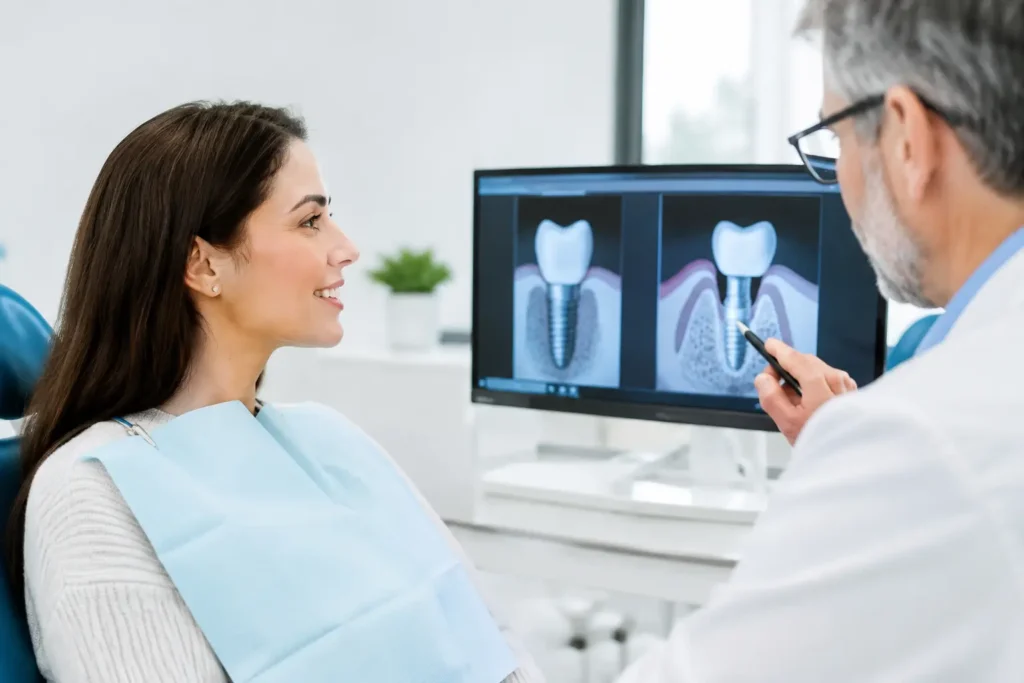
A failing tooth can create urgency, but the best implant plan should never be rushed. The decision between immediate versus staged implants is not simply about getting teeth faster. It is about choosing the protocol that gives your bone, gums, bite, and long-term restoration the strongest possible foundation.
For some patients, an implant can be placed the same day a tooth is removed and supported with a fixed temporary restoration. For others, removing infection, rebuilding bone, and allowing healing before implant placement is the safer route. Both approaches can deliver beautiful, stable results. The right choice depends on your clinical starting point, not a one-size-fits-all timeline.
What Immediate Implants Actually Mean
An immediate implant is placed directly into the extraction site at the same appointment where a damaged or failing tooth is removed. In a full-arch case, patients may also receive a fixed temporary bridge shortly after surgery. This is often called immediate loading or same-day teeth, although these are separate clinical decisions.
Immediate placement refers to when the implant is inserted. Immediate loading refers to when a temporary bridge is attached. A patient may qualify for one but not necessarily the other. For example, an implant may be placed on extraction day but left to heal without a fixed temporary if stability is not high enough.
The main advantage is efficiency. When conditions are favorable, immediate treatment can reduce the number of surgical phases, preserve more of the natural gum architecture, and help a patient leave with a fixed smile rather than a removable denture. This can be especially meaningful for people traveling for full-mouth rehabilitation.
However, same-day treatment is not a shortcut around biology. The implant still needs to integrate with the jawbone over the following months. Temporary teeth must be designed carefully so they protect the healing implants rather than overload them.
How Staged Implant Treatment Works
Staged implant treatment separates the process into planned phases. A failing tooth is removed first. If there is infection, bone loss, or insufficient healthy tissue, the site may be cleaned and grafted. After a healing period, the implant is placed. Once it integrates with the bone, the final crown or full-arch bridge is completed.
This approach requires more patience, but it can be the more predictable choice when the extraction site is compromised. It gives the surgical team time to rebuild the foundation before asking it to support an implant.
A staged plan is commonly recommended when there is significant bone loss around a tooth, active infection that has damaged surrounding tissue, poor initial implant stability, or a need for major bone grafting. It may also be appropriate when a patient has uncontrolled medical conditions, heavy grinding habits, or an unstable bite that needs careful correction before final teeth are made.
Staged treatment does not mean inferior treatment. In many complex cases, it is the disciplined choice that protects the final outcome.
Immediate Versus Staged Implants: The Real Decision Factors
The question is not, “Which option is better?” The better question is, “Which option is safer and more predictable for my anatomy?” A qualified implant specialist evaluates several factors before recommending a timeline.
Bone quality and quantity
An implant needs enough dense, healthy bone to achieve primary stability on the day of surgery. If the implant can be locked firmly into strong bone, immediate placement may be possible. If the socket walls are thin, damaged, or missing, or if there is extensive bone loss, rebuilding the area first may provide a stronger result.
Three-dimensional CT imaging is essential here. Standard two-dimensional X-rays cannot provide the same level of information about bone width, nerve location, sinus position, and hidden defects. Digital treatment planning allows the specialist to assess whether immediate placement is realistic before you travel.
Infection and gum health
Not every infected tooth automatically requires a staged implant. Modern surgical techniques can successfully manage many extraction sites after thorough cleaning and decontamination. But severe infection, cysts, abscesses, or advanced periodontal disease can change the treatment plan.
Healthy gums matter just as much as bone. An implant is not only a titanium post in the jaw. It needs stable soft tissue around it to support a natural-looking result and help protect against inflammation over time.
Implant stability and bite forces
For same-day fixed teeth, stability is critical. The implants must be placed with enough mechanical security to support a temporary bridge during healing. Full-arch treatment can often make immediate loading more achievable because several implants work together to support one bridge.
Still, patients who clench or grind heavily need special planning. A fixed temporary can be reinforced, adjusted out of heavy bite contact, and monitored during healing. Ignoring bite forces is one of the fastest ways to put a new implant restoration at risk.
The type of restoration you need
A single front tooth, several missing teeth, and a full upper or lower arch present very different challenges. Immediate placement in the smile zone may help preserve gum contours, but it demands precise positioning and often bone grafting. A full-arch All-on-4, All-on-6, or All-on-X case may allow fixed temporary teeth even when individual tooth sites are severely damaged, because the implants can be strategically placed in stronger areas of the jaw.
That is why treatment plans should be designed around the final prosthetic result, not just the extraction appointment. The goal is not merely to place implants. The goal is a stable bite, natural facial support, attractive teeth, and a restoration built to last.
Timeline, Recovery, and Travel Planning
Patients considering treatment in Cabo San Lucas or Tijuana often ask whether immediate treatment means they can complete everything in one trip. Usually, the surgical phase and fixed temporary teeth can be completed during the first visit when a patient qualifies. The final zirconia bridge is generally delivered after healing and confirmation that the implants have integrated successfully.
A staged plan may require a longer overall timeline or an additional visit, especially if bone grafting is needed before implant placement. That can feel disappointing at first, but a realistic timeline is better than a rushed plan that compromises the final result.
After either approach, expect some swelling, tenderness, and dietary restrictions. Most patients manage discomfort with prescribed medication and can return to light activity quickly. During early healing, soft foods are essential. Even if your temporary teeth feel secure, they are not an invitation to bite into steak, nuts, hard bread, or ice.
For traveling patients, the planning process should begin before booking flights. A current CT scan, clear photos, medical history, and information about existing bridges, dentures, or loose teeth give the implant team a more accurate starting point. A remote review can identify likely treatment paths, while the final diagnosis is confirmed through an in-person exam and digital records.
Why Digital Planning Changes the Conversation
Immediate and staged implant cases both benefit from digitally guided surgery. With CBCT imaging, intraoral scans, and prosthetic-driven planning, the surgical team can evaluate where the final teeth need to sit before determining where the implants should go.
Guided surgery can improve precision by helping place implants at planned depth, angle, and position. This is especially valuable in full-arch rehabilitation, where small deviations can affect the fit, strength, and appearance of the final bridge.
At Expertos Dentista E Implantes, the focus is not on pushing every patient into same-day implants. It is on identifying the safest route to fixed, functional teeth using specialist-led planning, high-quality materials, and a treatment timeline that respects healing.
Is One Option More Affordable?
Immediate treatment can reduce certain appointments and shorten the process, but it is not automatically less expensive. The cost depends on how many implants are needed, whether extractions are complex, the type of temporary bridge, bone grafting requirements, sedation, and the final restoration material.
A staged case may involve additional procedures, yet it can prevent costly complications when bone and gum conditions are not ready for an implant. The value of a treatment plan should be measured by predictability, longevity, and the quality of the final fixed teeth, not by the shortest initial timeline.
Patients traveling from the United States or Canada can often save substantially on advanced implant treatment in Mexico while still receiving digital planning, guided surgery, and premium zirconia restorations. The appropriate plan is the one that protects those savings with a result you can rely on.
A CT scan can answer more than a quick phone consultation ever could. Send your scan for a free evaluation and find out whether immediate implants are a safe option for your smile, or whether a staged plan will give you the stronger result you deserve.