
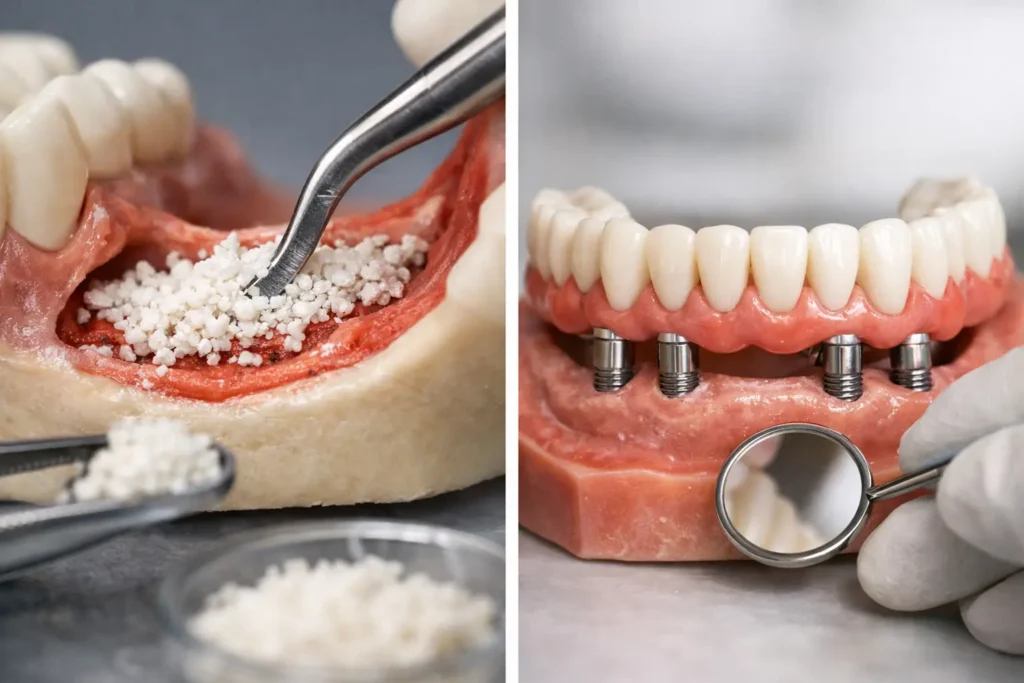
If you have been told you need bone grafting before full arch implants, the first question is usually not technical. It is practical: Will this delay my treatment, raise the cost, or stop me from getting fixed teeth right away? Those are the right questions, because grafting is not automatically required in every full-arch case, and the difference between a smart plan and an overbuilt one matters.
For patients replacing all upper or lower teeth, bone loss is common. Teeth may have been missing for years. Infection may have damaged the jaw. Old dentures may have accelerated shrinkage in the bone. But full arch treatment is different from replacing one or two teeth. In many cases, an experienced implant specialist can work around reduced bone volume by using angled implants, strategic implant positioning, and digital planning instead of adding grafting first.
When bone grafting before full arch implants is actually needed
Bone grafting is used to rebuild or preserve the jaw when there is not enough healthy bone to anchor implants with the right stability. That sounds straightforward, but in full-arch dentistry the decision is more nuanced.
A patient might have significant bone loss and still be a candidate for All-on-4 or All-on-6 without major grafting. That is because full-arch systems are designed to use the strongest available areas of the jaw, often avoiding anatomical limitations like the sinus in the upper jaw or the nerve in the lower jaw. With guided surgery and precise implant angulation, many patients who were told elsewhere they needed extensive rebuilding can move forward with a more efficient plan.
That said, some situations do call for grafting. If the bone is too thin, too soft, or too reduced to achieve initial implant stability, placing implants immediately may not be predictable. If there is severe infection, major defects after extractions, or long-term denture wear with extreme resorption, grafting may improve long-term support and prosthetic design. The key is not whether bone loss exists. The key is whether the remaining bone can support a stable full-arch foundation safely and predictably.
Why some clinics recommend grafting more often than others
This is where patients get confused. One clinic says you need months of grafting. Another says you can get fixed teeth in a much shorter timeline. Both may sound confident. Only one plan may fit your anatomy, goals, and budget.
Part of the difference comes down to philosophy and experience. Traditional implant planning often focuses on rebuilding ideal bone volume first, then placing implants later. Modern full-arch treatment often focuses on using available bone strategically to reduce the need for additional surgeries. Neither approach is automatically wrong. But for patients seeking efficient, high-value care, reducing unnecessary grafting can mean fewer procedures, lower costs, and faster restoration.
Technology also changes the conversation. A clinic using 3D CT scan analysis, digital treatment planning, and guided surgery has a better chance of identifying whether grafting can be minimized or avoided. This is especially important for patients traveling for care, because time matters. If a treatment team can evaluate your scan remotely and map out a precise surgical plan before you arrive, you get more clarity and fewer surprises.
The biggest trade-off: ideal bone volume vs faster treatment
Bone grafting before full arch implants can create more bone, but it also adds healing time. In some cases, that healing period is several months before implants can even be placed. For a patient who wants to move from failing teeth or loose dentures to fixed teeth quickly, that delay is a major factor.
There is also the issue of treatment burden. Grafting means another surgery, more postoperative recovery, more swelling, and another layer of cost. Some grafts are relatively minor and done at the time of extraction or implant placement. Others are more extensive and require a staged approach. The right decision depends on what problem the graft is solving.
If grafting is needed to create a safe and durable result, it may be worth the extra time. If grafting is being proposed simply to chase a more textbook-looking bone contour when the case could succeed without it, many patients would rather choose the simpler route. This is why specialist-led full-arch planning matters. The goal is not to do more. The goal is to do what creates a strong, esthetic, long-lasting result with the least unnecessary treatment.
Bone grafting before full arch implants in the upper vs lower jaw
The upper jaw and lower jaw behave differently, and that affects treatment planning.
In the upper jaw, bone is often softer and the sinus can limit implant placement in the back. This is one reason some patients are told they need sinus grafting or larger reconstruction. Yet many full-arch protocols are specifically designed to avoid the sinus by placing posterior implants at an angle. For the right candidate, this can eliminate a major grafting step.
In the lower jaw, the concern is often vertical bone loss and the location of the inferior alveolar nerve. If the bone has shrunk significantly, there may be less room for implants of ideal length. Again, strategic placement can sometimes solve the problem. But when the ridge is extremely resorbed, grafting or alternative implant strategies may need to be considered.
This is why a panoramic X-ray alone is not enough for a serious decision. A CT scan shows width, height, density, and anatomical limitations in three dimensions. That is the level of detail needed before anyone should tell you with confidence whether grafting is necessary.
What patients should expect if grafting is part of the plan
If your case truly requires grafting, the process should still be explained in simple terms. You should know what type of graft is being used, whether it happens the same day as extractions, whether implants can be placed immediately, and how long healing will take before the next step.
Minor grafting is often used to preserve bone after extractions or fill small defects around implants. This may not change your overall timeline much. Major grafting is different. If the jaw needs substantial rebuilding first, treatment may be staged and the path to fixed teeth will be longer.
Patients also want to know about pain. Most describe grafting recovery as manageable with the right medication and postoperative care. Swelling and tenderness are expected, but the experience is usually less dramatic than people imagine. What matters more is having a clear plan for healing, temporary teeth, diet, and follow-up.
For cross-border patients, coordination is critical. If you are traveling for treatment, your team should explain how many visits are needed, how long you need to stay, and what can be handled remotely before and after your trip. Efficiency is not a luxury in implant dentistry. It is part of good case management.
How grafting affects cost and value
Bone grafting increases the total cost of treatment, but the real question is whether it increases value. Sometimes it absolutely does. When it makes the difference between a weak foundation and a stable one, it protects your investment.
But not every added procedure improves outcomes enough to justify the expense. Patients comparing treatment plans should ask a direct question: Is this graft essential for implant stability, or is it being recommended to improve bone volume in a way that may not be necessary for a full-arch solution?
That distinction can mean thousands of dollars and months of additional treatment time. It can also determine whether you are a candidate for same-day temporary fixed teeth or a longer staged approach. If affordability matters, and for most patients it does, the smartest treatment plan is the one that reaches a durable result without adding avoidable steps.
At Expertos Dentista E Implantes, this is exactly why remote CT scan review and specialist-led planning matter. A well-planned full-arch case can often save time, reduce complexity, and still deliver the strength and esthetics patients want.
The right question is not “Do I need a graft?”
A better question is, “What is the most predictable way to get me fixed teeth?” For some patients, that includes bone grafting before full arch implants. For many others, advanced full-arch techniques make grafting less important than they were led to believe.
You do not need a generic answer. You need a diagnosis based on your anatomy, your medical history, your timeline, and your goals. That starts with a CT scan, not a guess.
If you are weighing treatment in the U.S. against a specialist-led option in Cabo San Lucas, ask for clarity, not sales pressure. Ask what can be avoided, what cannot, and why. The best implant plan is the one that respects both biology and common sense – and gets you closer to fixed teeth with confidence.