
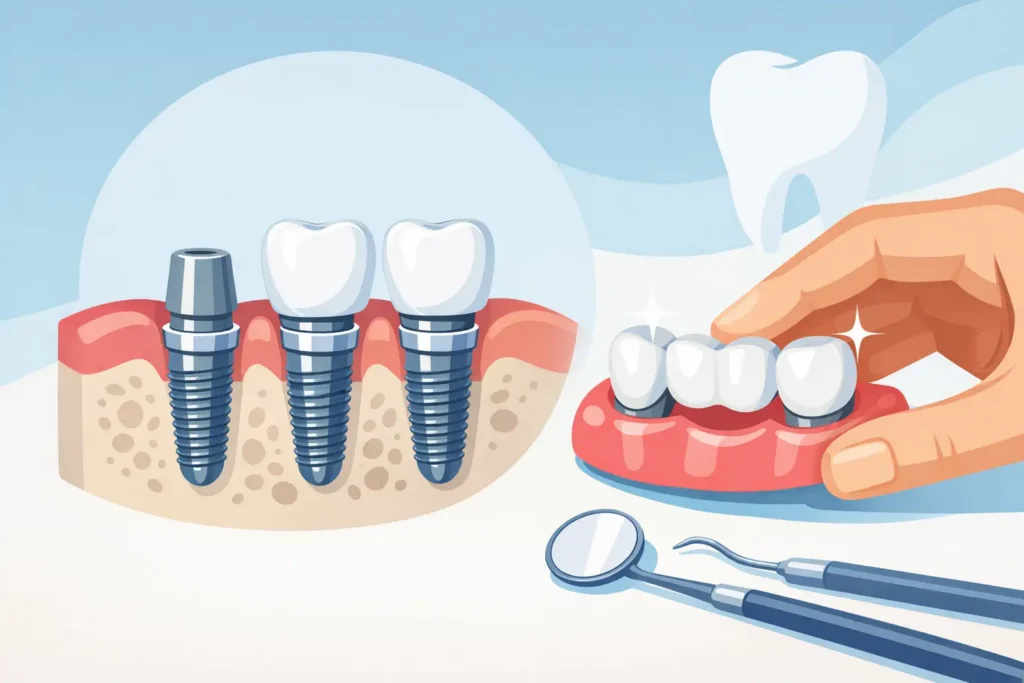
If you are asking can you get temporary teeth after implants, you are probably trying to avoid the worst part of treatment – walking out without a smile you can use. For many patients, especially those replacing most or all teeth, temporary teeth are not only possible, they are often part of the treatment plan. The real question is not just whether you can get them, but whether your bone, bite, gum condition, and implant stability make you a good candidate for fixed temporary teeth right away.
That distinction matters. Some implant cases allow same-day temporary teeth that look natural and stay in place while healing begins. Others need a short waiting period or a different type of temporary restoration to protect the implants and improve the final result. A serious implant provider should tell you which category you fall into before treatment, not after surgery.
Can you get temporary teeth after implants in the same visit?
Yes, many patients can get temporary teeth after implants on the same day. This is common in full-arch procedures such as All-on-4, All-on-6, or All-on-X, where a full set of provisional fixed teeth is attached after implant placement. These are often called immediate-load temporaries or same-day teeth.
This approach is especially appealing for patients traveling for care because it shortens the time spent without functional teeth. You come in with failing teeth, advanced dental problems, or loose dentures, and you leave with a fixed temporary smile in place while the implants heal.
But same-day does not mean automatic. Your surgeon has to achieve enough primary stability in the implants, which means the implants must be anchored firmly enough in the bone at the time of surgery. If the implants are not stable enough, loading them too soon can increase the risk of failure.
How temporary teeth after implants actually work
Temporary teeth are not the final prosthetic. They are a planned transitional restoration that protects your healing phase while restoring appearance and basic function.
In many full-mouth implant cases, any remaining damaged teeth are removed first. The implants are then placed using digital planning and, in advanced centers, guided surgery. After that, a temporary bridge is secured to the implants or delivered in another form depending on your case.
These temporary teeth are designed to do three jobs well. First, they let you smile, speak, and function during healing. Second, they help shape the gums so the final restoration looks better. Third, they give the clinical team a chance to test bite position, tooth display, speech, and comfort before the final zirconia prosthesis is made.
That trial period is one reason well-planned temporaries are valuable. They are not a shortcut. They are part of the process of getting a stronger and more esthetic final result.
Who is a good candidate for same-day temporary teeth?
The best candidates usually have enough bone volume and density to support immediate implant stability. They also tend to have treatment plans that are digitally mapped in advance, including CT scan review, bite analysis, and prosthetic design.
Patients needing full-arch rehabilitation are often better candidates for fixed temporaries than people replacing a single tooth in the esthetic zone. That may sound backward, but full-arch cases allow the bite forces to be distributed across several implants and a carefully designed temporary bridge.
Your candidacy also depends on whether you grind your teeth, smoke heavily, have uncontrolled diabetes, active gum infection, or severe bone loss. These factors do not always rule out temporary teeth, but they can change the plan. In some cases, bone reduction, grafting, or staged treatment may be the safer path.
This is where specialist-led planning matters. A proper review of your CT scan can often show whether same-day temporary teeth are realistic before you travel.
When temporary teeth may not be attached right away
Not every implant case should be loaded immediately. If implant stability is weak, the bone is too soft, infection is extensive, or the bite creates too much pressure, your doctor may recommend a delayed approach.
That does not mean you will be left without teeth. It means the type of temporary may change. Some patients receive a removable temporary during healing. Others may have a short delay before a fixed provisional is placed. The right plan depends on protecting the implants first.
Patients often focus only on speed, but speed without control is a mistake. The best implant treatment is fast when possible and cautious when necessary. That balance is what produces long-term success.
Are temporary teeth fixed or removable?
They can be either, depending on your case.
In full-arch implant treatment, many patients receive fixed temporary teeth that are screwed onto the implants. These feel much more stable than traditional dentures and are usually the option patients want most.
In other situations, a removable temporary is safer. This may happen when implants need more protected healing time or when only certain phases of treatment can be completed in one visit. Removable does not always mean lower quality. Sometimes it is simply the better clinical decision for that healing stage.
The important question to ask is not just, “Will I get temporary teeth?” Ask, “Will they be fixed or removable, and why?” A good clinic should explain the reason clearly.
What do temporary teeth look and feel like?
Good temporary teeth should look presentable, feel secure, and allow you to return to daily life with more confidence. They are usually lighter and less durable than the final prosthetic, but they should still look like real teeth from a conversational distance.
Most patients notice a major improvement immediately, especially if they have been living with broken teeth, missing teeth, or unstable dentures. Speech may take a few days to adjust. Biting force is limited during healing, so you will still need to follow a soft-food diet for a period of time.
This is one area where expectations matter. Temporary teeth are meant to carry you through healing, not to handle steak, hard nuts, or grinding habits right away. If you treat them like final zirconia on day one, you increase the chance of fractures or implant overload.
How long do temporary teeth stay in place?
In many full-arch cases, temporary teeth stay in place for around three to six months while the implants integrate with the bone. During this period, the team monitors healing, refines the bite, and plans the final restoration.
Once healing is complete and the implants are stable, the temporary is replaced with the final bridge. For many patients, that final prosthetic is zirconia because of its strength, esthetics, and long-term performance.
The exact timeline depends on your biology, the number of implants, whether grafting was needed, and how smoothly healing progresses. Faster is not always better. A strong final outcome depends on giving the implants enough time to bond properly.
Why digital planning makes temporary teeth more predictable
Temporary teeth after implants are far more predictable when the case is planned digitally from the start. A CT scan, intraoral records, and guided surgery help the surgeon place implants in positions that support both function and esthetics.
That matters because implant surgery is not just about putting titanium into bone. The implants must line up with the future prosthetic. If the prosthetic plan comes first, temporary and final teeth tend to fit better, look better, and require fewer compromises.
For traveling patients, this level of planning also improves efficiency. Remote case review can identify whether same-day temporary teeth are likely before you commit to treatment dates.
Cost, speed, and why patients travel for this treatment
For many patients in the U.S. and Canada, the appeal is straightforward. They want fixed teeth, a faster process, and major savings compared with domestic implant pricing. Same-day temporary teeth are a big part of that value because they reduce the emotional and practical burden of treatment.
At Expertos Dentista E Implantes, this is why treatment planning starts with diagnostics and candidacy, not guesswork. If you qualify, same-day temporary fixed teeth can make full-mouth rehabilitation dramatically more comfortable and efficient, especially when paired with guided surgery and a clear final zirconia plan.
Patients should still be careful about clinics that advertise instant teeth for everyone. Not every mouth is the same. The right provider will tell you when immediate temporaries are appropriate and when a modified timeline is safer.
The questions you should ask before booking
If temporary teeth are a priority, ask whether your case supports immediate loading, whether the temporary will be fixed or removable, how long you will wear it, and what food restrictions apply during healing.
Also ask who plans the surgery, how your CT scan is reviewed, what happens if implant stability is lower than expected on surgery day, and what the final restoration will be made from. Those answers tell you a lot about the quality of the clinic.
The best treatment plans are clear before you arrive. That is especially true if you are traveling for care and want predictable timing.
Temporary teeth after implants can be life-changing when they are done for the right patient, with the right planning, and for the right reason. If you want to know what is possible in your case, the smartest next step is a specialist review of your CT scan so you can move forward with confidence, not hope alone.