
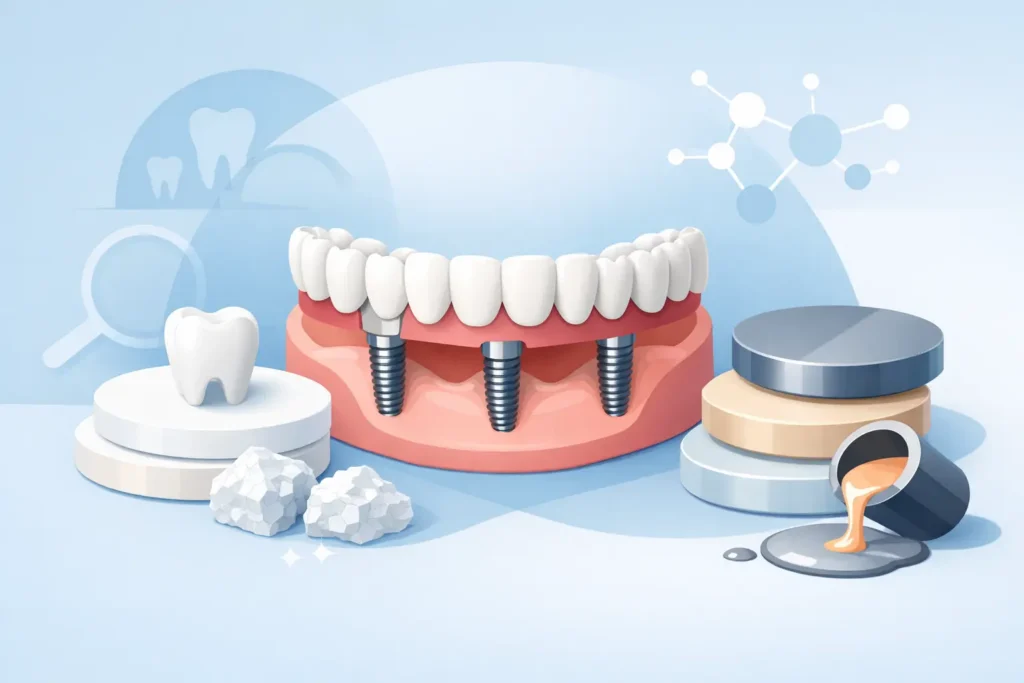
When patients ask about the best material for full arch implants, they are usually asking a bigger question – which option will look natural, last well, feel solid when chewing, and justify the investment. That is the real decision. In full-arch treatment, the material matters because it affects strength, esthetics, maintenance, comfort, and long-term cost.
For most patients who want a fixed, premium result, zirconia is often the leading choice. But that does not mean it is automatically the right choice for every mouth, every bite, or every budget. The best answer depends on bone support, implant position, smile line, bite force, and whether you need an immediate temporary bridge or a long-term final prosthesis.
What is the best material for full arch implants?
If you want the short answer, the best material for full arch implants is usually monolithic zirconia for the final prosthesis and acrylic over a titanium bar for the temporary phase or for selected budget-conscious cases. That is the practical reality in modern implant dentistry.
Why zirconia so often leads the conversation is simple. It offers excellent strength, a highly natural appearance, stain resistance, and a more premium feel than traditional acrylic hybrids. It also performs well for patients who are tired of repeated repairs and want something that feels closer to natural teeth.
At the same time, acrylic still has a real place. It is lighter, easier to adjust, typically less expensive, and often very useful as an immediate fixed provisional while the implants integrate. In certain cases, especially when reducing force on new implants matters, acrylic can be the smarter first step.
The main materials used in full arch restoration
Most full-arch prostheses fall into three broad categories: acrylic with a titanium framework, zirconia, and in some cases porcelain layered over a framework. Each one has advantages and trade-offs.
Zirconia full arch bridges
Zirconia has become the premium material in many advanced implant centers because it combines durability with esthetics. A monolithic zirconia bridge is milled digitally, which improves precision and consistency. For patients traveling for treatment, that digital workflow matters because it supports faster planning, more predictable fit, and cleaner communication between the surgical and restorative phases.
Zirconia tends to resist staining better than acrylic, which is attractive for coffee drinkers, wine drinkers, and anyone who wants a bridge that keeps its color over time. It also has a very solid feel when chewing. Many patients describe it as more natural and more substantial.
Still, zirconia is not perfect. It is more expensive than acrylic, and because it is a very hard material, the bite needs to be planned carefully. If the case is poorly designed, that hardness can transfer force in ways that are less forgiving. This is why digital planning, implant angulation, and specialist-led bite design are not optional details. They are central to success.
Acrylic full arch hybrids
Acrylic bridges, usually supported by a titanium bar or framework, have been used successfully for many years. They remain common for immediate-load bridges and for patients who want a fixed full-arch solution at a lower price point.
Acrylic is lighter and easier to modify. That can be helpful in the healing phase, especially after extractions or bone reduction when tissue changes are expected. If you are getting same-day temporary fixed teeth, acrylic is often the material used first because it allows for easier adjustments as your mouth heals.
The downside is wear. Acrylic teeth can chip, stain, and lose polish faster than zirconia. Over time, they usually require more maintenance. For some patients that is acceptable, especially if it makes treatment financially possible. For others, paying less upfront but dealing with more repairs later is not the outcome they want.
Porcelain over metal or other layered options
Porcelain-based full-arch restorations can look attractive, but they are less common today for many full-mouth implant cases than monolithic zirconia. Layered ceramics may offer excellent esthetics, but chipping risk is a real concern, especially in heavy-bite patients.
That is why many implant specialists prefer monolithic materials for full-arch cases. Fewer weak points usually means fewer complications.
Best material for full arch implants by patient priority
The right material becomes clearer when you look at what matters most to you.
If your top priority is the most premium combination of strength and appearance, zirconia usually comes first. If your priority is a lower upfront cost and a practical fixed option, acrylic may be more realistic. If your priority is immediate treatment with same-day teeth, you may start with acrylic and upgrade later to zirconia after healing.
This is one reason experienced clinics rarely answer the question with a one-size-fits-all statement. The best material is tied to the treatment phase, not just the final photo.
If you want the most natural look
Zirconia generally wins. It has better translucency and a cleaner, more refined finish than acrylic. For patients with a high smile line or strong esthetic concerns, that difference can be meaningful.
If you want long-term durability
Again, zirconia is often the better final option. It resists wear and staining better than acrylic. However, durability is not just about material. A well-designed acrylic bridge can outperform a poorly planned zirconia case every time.
If you want the lowest maintenance
Zirconia usually requires less cosmetic maintenance over time. Acrylic may need polishing, tooth replacement, or more frequent repairs.
If you want the lowest price
Acrylic is generally more affordable. For many patients comparing treatment costs in the U.S. versus Mexico, this matters. A smart treatment plan can sometimes use an acrylic temporary first and a zirconia final later, balancing budget and long-term value.
Why the framework and design matter as much as the material
Patients often focus only on the visible teeth, but the substructure matters just as much. A full-arch prosthesis succeeds because of the entire system – implant position, number of implants, bite design, tissue support, material thickness, and framework strength.
This is where guided surgery and digital planning change the quality of the outcome. If implants are placed in ideal positions, the final bridge can be designed with better support and less stress. If implant placement is compromised, even the best material has limits.
That is why a specialist review of your CT scan is the first step, not an afterthought. The material choice should come after the anatomy and biomechanics are understood.
Temporary vs final bridge – do not confuse them
One of the biggest misunderstandings in implant treatment is assuming the same material should be used from day one through the final result. In many cases, that is not how modern full-arch treatment works.
Immediate temporary teeth are often made from acrylic because the mouth changes during healing. Swelling goes down, tissue contours improve, and implants need time to integrate. Once that phase is complete, the final bridge can be fabricated with much greater precision.
For many patients, the ideal pathway is simple: fixed temporary teeth first, premium zirconia final teeth later. That sequence gives you speed without sacrificing long-term quality.
So, which material should you choose?
If you are comparing options seriously, here is the honest answer. For most final restorations, zirconia is the best material for full arch implants when you want premium esthetics, strength, stain resistance, and a more refined long-term result. Acrylic remains a strong option for temporaries, selected final cases, and patients who need a more budget-friendly solution.
The right choice should not be made from a generic chart online. It should be based on your CT scan, your bite, your smile, your healing timeline, and your financial goals. That is how you avoid paying twice and how you get a bridge that fits your life, not just your treatment quote.
At Expertos Dentista E Implantes, this decision is typically made through digital case planning and specialist-led evaluation, which is exactly how full-arch treatment should be approached. If you are considering All-on-4, All-on-6, or a full-mouth rehabilitation, send your CT scan for a free consultation and compare what is possible before committing to a material that may not match your case.
The best full-arch prosthesis is not simply the strongest or the cheapest one. It is the one designed correctly for your mouth, built for the way you live, and chosen with the end result in mind – stable, fixed teeth you can trust every day.