
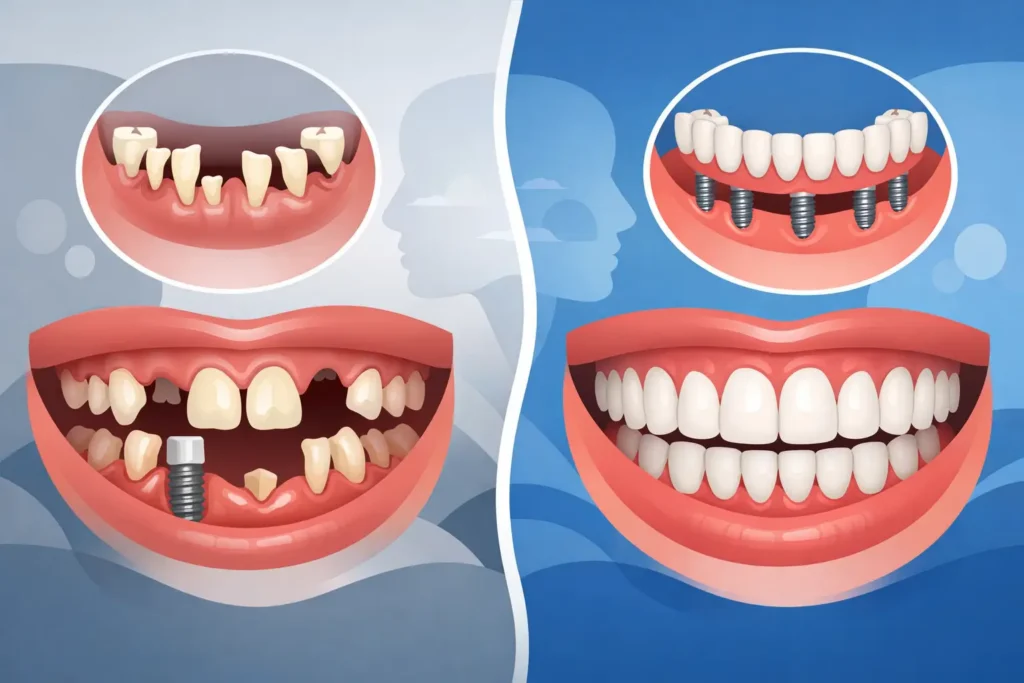
When patients search for full mouth dental implants before and after, they are rarely looking for photos alone. They want to know what actually changes – how they will look, how they will eat, how long the process takes, and whether the result will finally feel stable after years of failing teeth, loose dentures, or repeated dental work.
That is the real before-and-after story. It is not just a cosmetic change. For many patients, full-mouth implant treatment is a shift from pain, embarrassment, and daily compromise to fixed teeth, stronger bite function, and a more predictable routine.
What “before” usually looks like
The starting point is different for every patient, but the pattern is familiar. Some people arrive with multiple broken teeth, advanced gum disease, chronic infections, or old crowns and bridges that are no longer salvageable. Others have been wearing removable dentures for years and are tired of movement, sore spots, adhesive, and food limitations.
In the before stage, the problem is often larger than what shows in a smile photo. Teeth may be worn down. Bite collapse may have shortened the lower face. Bone loss may already be present. Many patients chew on one side, avoid certain foods, or smile with their lips closed without even realizing how much they have adapted.
This is why a true evaluation matters. A clinic cannot responsibly promise a dramatic after result based on a casual conversation alone. Full-arch treatment should be planned with imaging, bite analysis, digital diagnostics, and a clear surgical strategy.
Full mouth dental implants before and after is about more than appearance
The most obvious change is visual. Patients usually move from damaged, missing, stained, or unstable teeth to a fuller, more even smile. But the stronger difference is functional.
After treatment, the goal is fixed teeth that do not slip or come out at night. Patients often report clearer speech, better chewing force, and more confidence in social settings. They stop thinking about whether a denture will move during dinner or whether a front tooth will break again.
There is also a facial effect. When failing teeth or missing teeth have reduced support for the lips and cheeks, a properly designed full-arch prosthesis can restore structure. That does not mean every patient suddenly looks 20 years younger. It means the face often looks healthier, less collapsed, and more balanced.
What happens between before and after
This is where many patients need honest answers. The transformation is real, but it is a process.
For patients who qualify for same-day temporary fixed teeth, treatment can move quickly. After digital planning and guided surgery, failing teeth are removed if needed, implants are placed, and a temporary fixed prosthesis is delivered. That means you do not spend months without teeth. For many travelers from the U.S. and Canada, this speed matters just as much as cost.
Still, the immediate after is not the final after. The first phase gives you fixed temporary teeth while the implants heal and integrate with the bone. During healing, the gums change shape, swelling resolves, and the foundation stabilizes. The final zirconia prosthesis is typically placed after this healing period, once the case is ready for long-term precision.
That distinction matters because patients sometimes compare their temporary phase to final smile photos and assume something is wrong. It is not wrong. It is staged treatment.
The first week after surgery
Most patients are surprised that recovery is manageable with proper planning, anesthesia, and medication. You should expect soreness, swelling, and some dietary restrictions. You should not expect the kind of chaos that people often fear before treatment.
The first several days are usually about rest, soft foods, hydration, and following instructions closely. If extractions were part of the case, the mouth needs time to settle. Speech can feel slightly different at first. Biting should be controlled, especially with a temporary bridge.
A good team makes this stage easier by being clear. You need to know what level of discomfort is normal, when swelling peaks, how to clean around the prosthesis, and when to return for follow-up. Patients traveling for treatment also need logistics handled well, because clinical quality and travel coordination go together.
The biggest visible changes after treatment
When people think about full mouth dental implants before and after, they tend to focus on smile shape and tooth color. Those matter, but the best outcomes are usually more refined than a bright white makeover.
A strong full-mouth result typically improves tooth display, symmetry, bite support, and proportion. The smile should fit the face. The arch should support speech. The bite should be engineered for function, not just photos.
This is one reason digital planning is so valuable. It helps the surgical and restorative plan work together from the start. Implant position, bone availability, prosthetic design, and esthetics should never be treated as separate decisions.
Not every before-and-after case follows the same path
Some patients are good candidates for All-on-4. Others need All-on-6 or another All-on-X design depending on anatomy, bone volume, bite force, and restorative goals. Some cases require extractions and immediate loading. Others benefit from a more staged approach.
There are trade-offs. A patient with significant bone loss may still qualify for a fixed full-arch solution, but the prosthetic design may need to compensate for tissue loss. A heavy grinder may need a different material strategy and closer maintenance. A patient with uncontrolled medical conditions or active periodontal infection may need preparatory treatment before moving forward.
This is why real expertise matters more than marketing language. The best before-and-after outcomes come from selecting the right case design, not forcing every patient into the same package.
Cost changes the decision, but quality has to lead
For many U.S. and Canadian patients, the before stage includes another problem: treatment quotes that feel impossible. Full-mouth reconstruction in the United States can be priced far beyond what many families can justify, even when the need is urgent.
That is why cross-border care has become a serious option, not a fringe one. When treatment is planned by an implant specialist, supported by advanced imaging and guided surgery, and delivered with high-quality materials, patients can save substantially without choosing a low-standard alternative. At Expertos Dentista E Implantes, that model is built around premium full-arch care with digital workflow and remote case review for traveling patients.
The key is not simply finding cheaper treatment. It is finding a clinic that can show how your case will move from diagnosis to temporary teeth to final restoration with clarity and control.
What a good final result should feel like
The final after should feel stable, cleanable, and natural in daily life. You should be able to smile without guarding it. You should be able to eat more confidently than you did with failing teeth or removable dentures. You should also understand how to protect the investment.
That last point matters. Full-mouth implants are not maintenance-free. Even the best work requires professional follow-up, home care, and periodic checks of the prosthesis, bite, and implant health. Zirconia is strong, but habits like clenching, neglecting hygiene, or skipping maintenance can still create complications.
A trustworthy provider says that upfront. Great results are built on excellent treatment and long-term cooperation.
Who tends to be happiest with the after
The happiest patients are usually the ones who begin with realistic expectations. They understand that healing takes time, that temporary teeth are part of the journey, and that the goal is not a generic Hollywood smile. The goal is a strong, attractive, functional restoration designed for their face, bone structure, and lifestyle.
They also tend to be patients who are truly ready to stop patching things. If you are tired of replacing broken crowns, dealing with infections, or adjusting to dentures that never feel secure, full-mouth implants can be a major upgrade in quality of life.
If that sounds like your situation, the next step is simple: get a real evaluation, send your CT scan, and find out what your case would look like before anyone makes promises. The right treatment plan should make the after feel achievable, not uncertain.