
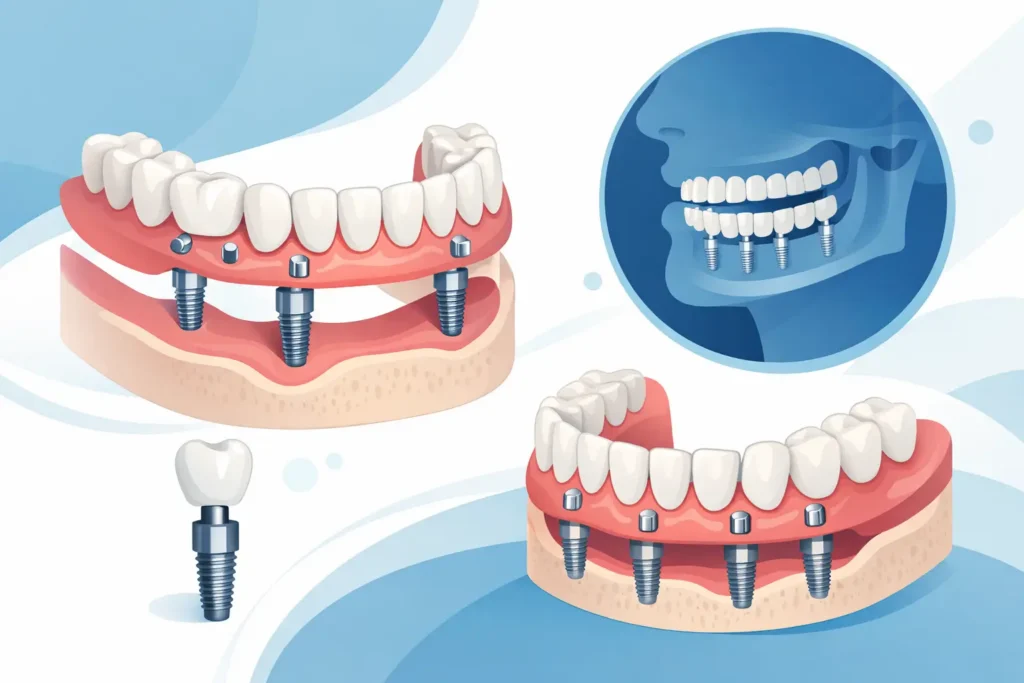
If you are asking what is All-on-X dental implants, you are probably past the stage of casual curiosity. Most patients who search this term are dealing with missing teeth, failing dental work, loose dentures, or a mouth that no longer feels dependable. They want fixed teeth, a clear timeline, and a treatment plan that makes sense financially.
All-on-X is a full-arch implant solution that replaces an entire upper or lower set of teeth using a strategic number of dental implants. The X simply refers to how many implants are used to support the bridge. In one patient, that may be 4 implants. In another, it may be 5, 6, or more, depending on bone volume, bite force, anatomy, and the long-term design goals of the case.
What Is All-on-X Dental Implants and How Does It Work?
All-on-X is not one single brand or one-size-fits-all procedure. It is a treatment concept. Instead of placing one implant for every missing tooth, your surgeon places several implants in strong areas of the jaw and uses them to anchor a full fixed prosthesis.
That matters for two reasons. First, it can often reduce the need for placing 8 to 10 separate implants per arch. Second, it allows a specialist to work around areas where bone has shrunk, especially in patients who have worn dentures for years or have had advanced gum disease.
In many cases, the implants are placed at precise angles to maximize available bone and improve stability. With proper planning, many patients can leave with same-day temporary fixed teeth while the implants heal and integrate. Later, those temporaries are replaced with a stronger, final prosthesis, often made from high-quality materials such as zirconia.
Why Patients Choose All-on-X Instead of Dentures
The appeal is straightforward. Traditional dentures sit on the gums. All-on-X is anchored to the bone. That changes how the teeth feel, how they function, and how confident patients are when they eat, speak, and smile.
A removable denture can shift, click, or create sore spots. It can also accelerate bone loss over time because there is no implant stimulation in the jaw. All-on-X gives patients a fixed option that feels more secure and typically offers stronger chewing ability.
That does not mean dentures are never appropriate. For some patients with major medical limitations, very limited bone, or budget constraints, removable options still have a place. But when a patient wants stability, esthetics, and a more permanent solution, All-on-X is usually the conversation worth having.
Who Is a Good Candidate for All-on-X Dental Implants?
The best candidates are patients missing most or all teeth in an arch, or patients with multiple failing teeth who are tired of repeated patchwork dentistry. Many also have advanced periodontal disease, broken bridges, chronic infections, or dentures they can no longer tolerate.
Candidacy depends on more than just how many teeth are left. Bone availability matters. Gum health matters. Medical history matters. Smoking, uncontrolled diabetes, clenching, and active infection can all affect treatment planning and healing.
This is why digital diagnosis is so important. A proper evaluation typically includes a CT scan, photos, and a bite analysis. With that information, the surgeon can determine how many implants are needed, whether extractions are required, whether bone reduction is part of the plan, and whether immediate temporary teeth are realistic.
In complex cases, the right answer is not always All-on-4. Some patients are better served by All-on-6 or another All-on-X variation because the extra support improves load distribution and long-term durability. The treatment should fit the patient, not the other way around.
All-on-4, All-on-6, and All-on-X: What Is the Difference?
This is where many patients get confused. All-on-4 is one type of All-on-X. All-on-6 is another. All-on-X is the broader category.
The number used depends on the case. Four implants may be enough in a well-planned arch with favorable bone and bite conditions. Six implants may be recommended when more support is needed, when the patient has stronger bite forces, or when the anatomy allows for a more distributed foundation.
More implants are not automatically better in every case. Fewer implants are not automatically cheaper in the long run if the case is under-supported. The goal is not to chase a number. The goal is to create a stable, functional, esthetic full-arch restoration that can hold up over time.
The Typical Treatment Timeline
One reason patients from the U.S. and Canada look at full-arch treatment in Mexico is speed. With a coordinated implant team and digital planning, the process can move much faster than many expect.
The first step is usually a remote review. Patients send a CT scan or panoramic X-ray, along with photos and a short medical history. Based on that, the clinic can give a preliminary assessment, discuss whether the case appears suitable for All-on-X, and outline expected timing.
If the patient proceeds, treatment often includes extractions if needed, implant placement, and delivery of a temporary fixed bridge in the same visit or within a short window. That temporary phase is important. It allows healing while maintaining function and appearance.
After several months of integration, the final prosthesis is fabricated. This stage often involves digital scans, bite refinement, esthetic adjustments, and a stronger final material. The exact timeline varies, but the key point is that many patients do not have to spend months without teeth.
What Recovery Feels Like
Most patients are surprised that recovery is more manageable than they feared. There is typically swelling, some soreness, and a healing period that requires softer foods and close follow-up. But with proper anesthesia, sedation planning, and medication protocols, discomfort is usually controlled well.
The bigger adjustment is often functional rather than painful. Patients need to protect the implants during healing, follow hygiene instructions carefully, and understand that temporary teeth are not the final version. Biting into hard foods too early can create problems.
Good clinics are very direct about this. The surgery is only part of success. The healing phase, maintenance, and final prosthetic design matter just as much.
Cost, Value, and Why So Many Patients Travel
For many patients, the real question behind what is All-on-X dental implants is this: can I finally afford fixed teeth without compromising quality?
In the U.S. and Canada, full-arch implant treatment can be financially out of reach. Cross-border care changes that equation. Patients often save substantially while still receiving specialist-led treatment, advanced digital planning, guided surgery, and premium restorative materials.
That said, price alone should never drive the decision. Full-mouth rehabilitation is too significant to choose based on the lowest quote. Patients should evaluate who is planning the case, what materials are used, whether temporaries are included, how complications are handled, and whether the clinic is experienced with international patients who need efficiency and clear communication.
This is where clinics such as Expertos Dentista E Implantes stand out for the right patient. The value is not just lower pricing. It is the combination of specialist oversight, digital workflow, faster scheduling, and a treatment model built around people traveling for serious dental rehabilitation.
What to Ask Before You Commit
A good consultation should answer practical questions, not just sell the dream. Ask how many implants are planned and why. Ask whether you are a candidate for immediate temporary fixed teeth. Ask what the final prosthesis is made of. Ask how many trips may be needed, what healing restrictions apply, and what maintenance looks like after completion.
You should also ask what happens if your scan shows less bone than expected. Sometimes the initial idea changes once the anatomy is reviewed in detail. That is normal. A trustworthy team explains the trade-offs clearly and adjusts the plan based on what gives you the safest, most predictable result.
Is All-on-X Worth It?
For the right patient, yes. If you are tired of dentures, tired of failing teeth, or tired of spending money on short-term fixes, All-on-X can be life-changing. It restores function, improves appearance, and gives many patients a level of confidence they have not felt in years.
But the real value comes from getting the diagnosis right, choosing the proper implant design for your anatomy, and working with a team that can execute the case with precision. If you are seriously considering fixed full-arch teeth, this is the stage to stop guessing and get your scan reviewed. A clear plan changes everything.