
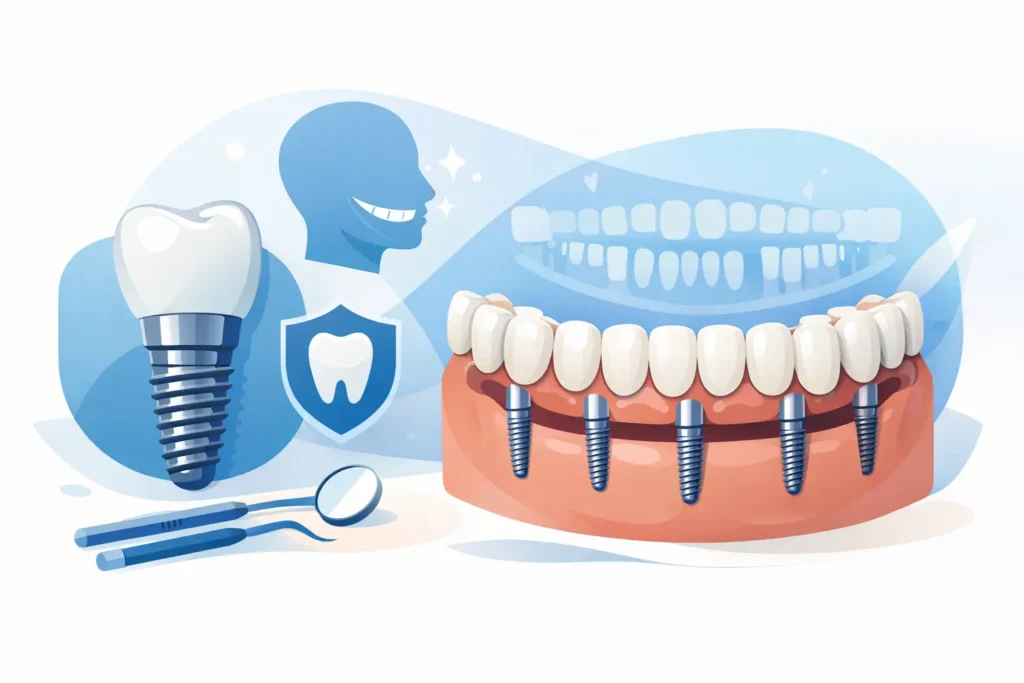
If you are tired of breaking teeth, loose dentures, repeated dental bills, or hiding your smile in photos, full mouth reconstruction with implants is often the turning point. This treatment is designed for people who need more than a few crowns or fillings. It rebuilds the entire mouth with fixed support, stronger function, and a more predictable long-term result.
For many patients from the U.S. and Canada, the real question is not whether they need major treatment. It is whether they can get it done properly, without paying U.S. prices for years of patchwork dentistry. That is why implant-based reconstruction has become the preferred option for people who want permanent teeth, a faster process, and clear answers before they commit.
What full mouth reconstruction with implants actually means
A full mouth reconstruction with implants is not one single procedure. It is a complete treatment plan that restores damaged, missing, infected, or failing teeth across the upper arch, lower arch, or both. The goal is to rebuild function, appearance, stability, and comfort using dental implants as the foundation.
In practical terms, that may involve removing teeth that cannot be saved, placing implants in strategic positions, and attaching a fixed provisional bridge the same day or shortly after surgery. Later, once healing is complete, the temporary teeth are replaced with a stronger final prosthesis, often made from zirconia or another durable material.
This is different from cosmetic dentistry alone. A true reconstruction addresses bite alignment, jaw support, bone condition, gum health, speech, chewing force, and facial balance. It is both restorative and functional. When planned correctly, it can change not just your smile, but how you eat, speak, and feel every day.
Who is a candidate for full mouth reconstruction with implants?
This treatment is usually recommended for patients with advanced tooth loss, severe wear, chronic infection, multiple failed crowns or root canals, or dentures they no longer want to rely on. It is also common for people whose remaining teeth are technically present but no longer stable enough to support a healthy bite.
The best candidates are not always the people with perfect bone or ideal gum tissue. Modern implant dentistry allows for advanced planning, guided surgery, angled implants, and full-arch concepts such as All-on-4, All-on-6, and All-on-X. That gives many patients an option even after years of dental decline.
That said, candidacy depends on several factors. Bone volume matters. Smoking matters. Uncontrolled diabetes matters. Bite habits such as clenching matter. A CT scan and specialist review are what turn guesswork into a real answer. If a clinic offers full-arch implants without asking for imaging, that is a red flag.
Why implants are often better than trying to save everything
Many patients spend years attempting to preserve a mouth that is already structurally failing. They replace one crown, then another tooth fractures. They get a root canal, then the neighboring tooth becomes infected. They wear a removable denture, then struggle with movement, sores, and reduced chewing strength.
Implants change the strategy. Instead of continuing to repair weak foundations, they create a new one. A fixed full-arch prosthesis supported by implants can restore stability in a way traditional removable dentures cannot. It also helps reduce the daily frustration that comes from adhesives, slipping teeth, and food restrictions.
Still, this is not about removing every tooth automatically. In some cases, preserving healthy teeth makes sense. In others, saving compromised teeth only delays the inevitable and increases total cost over time. The right plan depends on what is restorable, what is predictable, and what will truly serve the patient five to ten years from now.
The treatment process: what to expect
A quality full mouth reconstruction starts long before surgery. First comes diagnostics. This typically includes a CT scan, photos, digital impressions or intraoral scans, and a review of your medical and dental history. From there, the surgeon and restorative team map implant positions, prosthetic design, and the sequence of treatment.
If extractions are needed, they are usually done at the time of implant placement whenever possible. In many full-arch cases, patients receive same-day temporary fixed teeth. That means you do not leave wearing a loose denture after major surgery. You leave with a fixed provisional that protects the implants and lets you smile during healing.
The healing phase varies. Some patients move quickly to the final restoration, while others need more time depending on bone quality, grafting needs, or how the bite is being corrected. The final prosthesis is then designed for strength, esthetics, and function. This is where material choice matters. Well-made zirconia restorations are popular because they are durable, precise, and natural-looking.
Technology matters more than marketing
Full-mouth implant treatment should not be judged by price alone. The technology behind the case has a direct impact on fit, accuracy, healing, and long-term performance. Digital planning, guided surgery, and restorative design based on 3D imaging help reduce surprises and improve consistency.
This is especially important in complex cases where implants must be placed around anatomical limits, previous bone loss, or bite collapse. Guided surgery can help position implants more precisely. Intraoral scanning improves prosthetic workflow. Digital smile and bite planning help make the final teeth look balanced instead of bulky or artificial.
At Expertos Dentista E Implantes, this digital approach is central to how complex implant cases are evaluated and executed. For traveling patients, that matters. It allows more accurate remote case review, cleaner scheduling, and a shorter treatment window without sacrificing clinical control.
Cost, value, and why patients travel
For many U.S. patients, the biggest obstacle is not motivation. It is cost. A full mouth reconstruction with implants in the United States can be financially overwhelming, especially when treatment involves both arches, extractions, sedation, temporary bridges, and final zirconia restorations.
Traveling for care changes that equation. Patients often save up to 70 percent compared with U.S. pricing while still receiving specialist-led treatment, advanced diagnostics, and fixed full-arch solutions. That is not a small difference. It can be the difference between postponing treatment for years and finally moving forward now.
The key is understanding the difference between low price and high value. Cheap dentistry becomes expensive when treatment fails, materials are weak, or planning is rushed. Real value comes from experienced implant specialists, a clear surgical and restorative protocol, high-quality materials, and a team that knows how to coordinate care for out-of-town patients.
Common concerns: pain, healing, and travel
Most patients are surprised that the process is more manageable than they expected. Discomfort is real, but it is usually temporary and controlled with medication, rest, and clear post-op instructions. The emotional relief of finally addressing years of dental problems often outweighs the short recovery period.
Healing does require discipline. You may need a soft-food diet for a period of time. You need to follow cleaning instructions carefully. If you grind your teeth or ignore follow-up guidance, you can compromise the result. Fixed teeth are life-changing, but they are still a medical investment that needs protection.
Travel is another major concern, and it should be addressed honestly. You need a schedule that makes sense, a clinic experienced with remote evaluations, and a team that can coordinate treatment efficiently. The best clinics simplify the process from your first CT scan review to your arrival, surgery, temporary teeth, and return visit for the final restoration.
How to evaluate a clinic before you commit
If you are comparing options, ask direct questions. Who plans the case? Who places the implants? What imaging is required? Will you receive fixed temporaries? What is the final prosthesis made from? How are complications handled? How many visits are expected?
You should also ask to see before-and-after cases that resemble your situation, not just ideal cosmetic examples. A serious full-mouth provider should be able to explain why they recommend All-on-4 versus All-on-6, immediate loading versus delayed loading, or zirconia versus other materials. If every patient gets the exact same answer, that is not personalized treatment.
The strongest sign you are in the right place is clarity. You should understand the timeline, the fees, the healing stages, and the limitations of your case. Confidence is good. Overpromising is not.
A full mouth reconstruction with implants is a major decision, but for the right patient, it ends years of instability in one coordinated plan. If you are ready for fixed teeth, better function, and a treatment path that makes financial sense, the next step is simple: send your CT scan, request a free consultation, and get a real answer based on your mouth, not guesswork.