
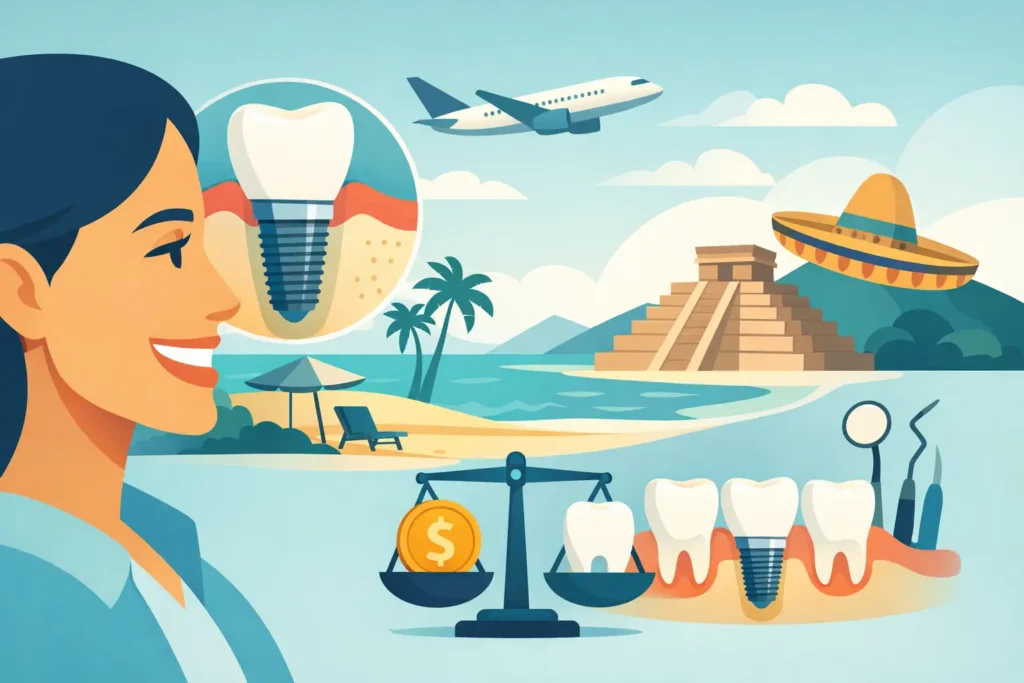
A full mouth implant case in the U.S. can easily land in the price range of a new car. That is exactly why dental tourism Mexico implants has moved from a fringe option to a serious solution for patients who want fixed teeth, faster treatment, and a price that makes sense.
But cost alone should never be the reason you book. If you are replacing multiple teeth, dealing with failing dental work, or trying to get out of removable dentures, the real question is simpler: can you get specialist-level implant treatment in Mexico with a process that feels organized, safe, and predictable? In the right clinic, yes. In the wrong one, the savings disappear fast.
Why dental tourism Mexico implants keeps growing
Most patients looking at Mexico are not bargain hunters. They are people who have already spent years patching problems with crowns, root canals, partials, bone grafts, or temporary fixes. At some point, they want a permanent plan.
That is where Mexico becomes attractive. The best implant centers offer advanced restorative care at a substantially lower fee than many U.S. offices, often with quicker scheduling and a more streamlined treatment path. For full-arch cases such as All-on-4, All-on-6, or All-on-X, that difference can be dramatic.
There is also a practical advantage. Many cross-border clinics are built around international patients, so they tend to organize diagnostics, surgery, temporaries, and follow-up more efficiently than a general dental office that only places implants occasionally. If your case is complex, process matters almost as much as price.
What makes a Mexico implant clinic worth traveling for
Not every clinic offering implants is set up for major restorative work. If you are considering full-mouth rehabilitation, look past marketing language and look at how treatment is actually planned.
The strongest clinics usually have a specialist-led workflow. That means your case is reviewed with a CBCT scan, bite analysis, and digital planning before surgery day. Implant placement is not improvised chairside. It is mapped out based on bone availability, prosthetic design, smile line, and long-term function.
Guided surgery is another strong sign. It helps improve accuracy, especially when a patient needs full-arch treatment, immediate loading, or strategic implant placement to reduce the need for grafting. Digital scanning also matters because it improves the fit of temporaries and final restorations while reducing old-fashioned guesswork.
Material choices matter too. A clinic focused on long-term outcomes should be able to explain the difference between acrylic hybrids, titanium-reinforced options, and zirconia prosthetics in plain English. Cheaper is not always better. For some patients, an acrylic provisional followed by a zirconia final is the smartest path because it balances healing, esthetics, and durability.
Cost savings are real, but the range depends on your case
Yes, patients often save up to 70% versus U.S. pricing. That is one of the biggest reasons people search for dental tourism Mexico implants in the first place. Still, no ethical clinic should quote a major implant case as if every mouth is the same.
Your final cost depends on several variables: how many arches are being treated, whether teeth need to be extracted, whether you need bone reduction, how many implants support each arch, and what material will be used for the final prosthesis. Someone getting a straightforward lower arch is in a very different category from a patient rebuilding both jaws after years of advanced dental breakdown.
A serious clinic should be transparent about that. You want a treatment plan that explains what is included in surgery, temporary fixed teeth, imaging, sedation or pain control approach, follow-up, and final prosthetic stages. If pricing sounds unusually low but details are vague, be careful. The cheapest quote can become the most expensive mistake if it leads to remakes, complications, or travel for corrections.
Speed matters, but only when the planning is strong
One major reason patients travel is time. In the U.S., complex implant cases can drag on for months just to get consultations scheduled. In Mexico, many implant centers are designed to move faster, especially for out-of-town patients.
That does not mean rushed treatment. It means the clinic has a system. You send records in advance, often including a CT scan or local imaging. The doctor evaluates your anatomy remotely. Your travel dates are organized around a clear surgical plan. If you are a candidate for immediate load treatment, you may leave with same-day temporary fixed teeth instead of waiting in a removable appliance.
That speed can be life-changing for patients who still work, travel, speak publicly, or simply do not want to hide their smile for months. The trade-off is that not everyone qualifies for immediate full-arch loading. Bone quality, infection history, bite force, and medical factors all matter. A trustworthy provider will tell you when same-day teeth are realistic and when a staged approach is safer.
Safety and quality are the real decision points
Patients often ask if implant treatment in Mexico is safe. The honest answer is the same as it is anywhere else: it depends on the clinic, the doctor, the planning, and the standards used.
A quality implant center should be able to explain sterilization protocols, diagnostic technology, implant systems, sedation approach, and who is actually doing the surgery. You also want to know who designs the prosthetic side of the case, because implants are not just about placing screws in bone. The final result depends on how the bite, speech, facial support, and esthetics are restored.
This is especially true for full-arch work. A beautiful scan and good implant placement still will not save a poorly designed prosthesis. Long-term comfort depends on more than osseointegration. It depends on load distribution, material strength, hygiene access, and a design that fits your anatomy.
That is why specialist-led centers stand out. They are not selling a quick dental vacation. They are delivering a coordinated surgical and restorative process for patients who need a serious solution.
Who is a strong candidate for implant tourism in Mexico
The best candidates are usually patients who need multiple implants, full-arch reconstruction, or replacement of failing teeth and want fixed teeth without absorbing U.S. pricing. It also fits people who value efficiency and can travel for concentrated treatment visits.
If you have healthy enough bone for implant support, are medically stable, and can follow post-op instructions, you may be an excellent candidate. Even if your case is more advanced, digital planning and modern full-arch concepts often make treatment possible when traditional approaches sounded overwhelming.
Where people get into trouble is assuming every problem can be solved in one trip with no maintenance. Implant dentistry is highly successful, but it is still dentistry. Healing, hygiene, adjustments, and final delivery timing all matter. Patients do best when they choose a clinic that explains the full process instead of promising a miracle.
What to ask before you travel
A good consultation should leave you with clarity, not pressure. Ask who will review your scan, whether your case is being handled by an implant-focused doctor, and whether you are a candidate for immediate temporaries. Ask what final prosthetic material is recommended and why.
You should also ask about the expected number of visits, healing timeline, and what happens if your case changes after the CBCT is reviewed in person. Some patients need extractions, infection control, or bone contouring that changes the day-of plan. That is not a red flag by itself. Poor communication is.
If the clinic works with international patients regularly, they should be comfortable discussing airport logistics, recovery time before flying, medication instructions, and how follow-up is managed after you return home. That kind of clarity reduces stress and helps you plan treatment like a medical decision, not a gamble.
For patients comparing options, this is where providers such as Expertos Dentista E Implantes separate themselves – not just with lower fees, but with digitally planned, specialist-led treatment that is built for cross-border full-arch cases.
The best results come from thinking beyond the trip
A strong implant result should still feel solid years from now, not just look good in travel photos. That means choosing a clinic that thinks about long-term bite stability, prosthetic maintenance, tissue health, and material performance from the beginning.
If you are researching dental tourism Mexico implants, focus on value, not just price. Value means experienced planning, clear communication, quality materials, and a treatment path that fits your anatomy and goals. If you already have a CT scan, send it for a professional review and get a real answer based on your mouth, not a generic quote based on hope.
The right clinic should make the decision feel clearer, not more confusing. And when the plan is right, fixed teeth in Mexico can be one of the smartest investments you make in your health, confidence, and daily life.