
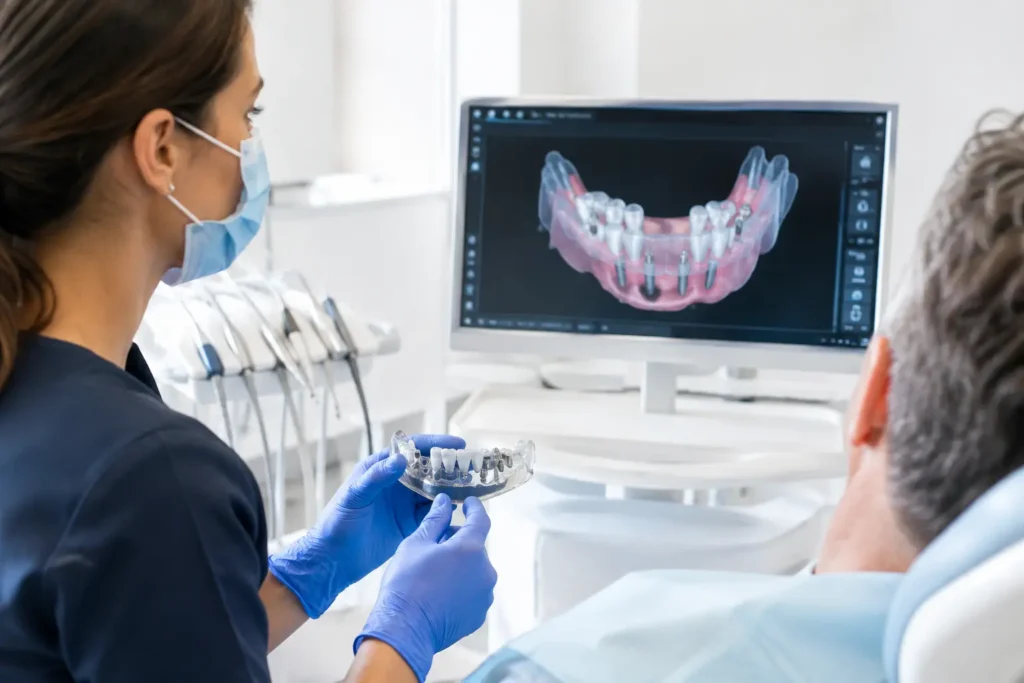
A full-arch implant case should not begin with a guess in the treatment room. It should begin with a detailed digital plan that shows where bone is available, where vital anatomy sits, and how your new fixed teeth need to function. That is how guided implant surgery works: your implant treatment is planned virtually before surgery, then transferred to your mouth with a custom surgical guide.
For patients replacing failing teeth or removable dentures, this planning can make treatment more predictable. It is especially valuable when the goal is an All-on-4, All-on-6, or customized All-on-X restoration with same-day temporary fixed teeth. Guided surgery is not a shortcut or a substitute for an experienced implant specialist. It is a precision tool that helps the specialist execute a well-designed plan.
How Guided Implant Surgery Works Step by Step
The process starts with diagnostics, not implants. Your doctor reviews a 3D CBCT scan, digital intraoral scans, photographs, bite records, and your health history. Together, these records create a detailed picture of your jaw, gums, airway considerations, existing teeth, and facial proportions.
For international patients, the first review can often begin remotely. If you already have a recent CT scan, sending it for evaluation may help determine whether you are a candidate for fixed full-arch treatment, what type of implant plan may be appropriate, and how many visits you may need. A final diagnosis still requires an in-person clinical evaluation.
1. The Smile and Bite Are Designed First
In traditional implant planning, the available bone can sometimes drive the entire procedure. In a digitally guided workflow, the restoration is designed first whenever possible. The clinical team plans the position, shape, and bite of the future teeth, then determines the ideal implant positions to support that result.
This prosthetically driven approach matters because implants must do more than integrate with bone. They must support a bridge that looks natural, allows you to speak clearly, and distributes chewing forces properly. For a full-mouth rehabilitation, small changes in tooth position can affect lip support, facial appearance, bite comfort, and long-term maintenance.
2. Your CBCT Scan Becomes a 3D Surgical Map
A CBCT scan shows the jaw in three dimensions. Unlike a standard dental X-ray, it allows the implant specialist to assess bone width, height, density, sinus spaces in the upper jaw, and the location of nerves in the lower jaw.
Using specialized planning software, the doctor can virtually place each implant at a selected depth, angle, and position. The plan also accounts for the final bridge, the need for immediate temporary teeth, and whether tilted implants could avoid anatomical structures or reduce the need for grafting.
For example, in many All-on-4 cases, posterior implants are intentionally angled to use available bone more effectively. That can allow a fixed arch to be supported with fewer implants than a conventional approach. Whether this is right for you depends on bone quality, bite forces, medical history, habits such as grinding, and the condition of the gums and jaw.
3. A Custom Surgical Guide Is Created
Once the virtual plan is approved, a surgical guide is fabricated. This is a custom device that rests securely on the teeth, gums, or bone, depending on the case. It contains precisely positioned sleeves or channels that help guide the surgical instruments during implant placement.
Think of it as a physical transfer of the digital plan. Rather than relying only on visual estimation during surgery, the doctor uses the guide to follow the planned implant trajectory. In fully guided protocols, the guide may direct the sequence of drills and implant placement. In other cases, the guide is used for the initial osteotomy, while the doctor makes real-time adjustments based on surgical findings.
That distinction is important. A guide improves control, but clinical judgment remains essential. Bone conditions can differ from what imaging suggests, and an experienced specialist must be ready to adjust the plan if necessary.
What Happens on Guided Implant Surgery Day
On the day of treatment, comfort and safety come first. Depending on your needs and medical profile, treatment may be performed with local anesthesia and appropriate sedation options. Any remaining unhealthy teeth are removed when indicated, and the surgical site is prepared.
The guide is seated and checked for stability. The surgeon follows the planned positions to prepare the implant sites and place the implants. Implant stability is measured during surgery. If the implants achieve adequate initial stability and your bite conditions are favorable, a temporary fixed bridge may be attached the same day.
Same-day teeth do not mean the final zirconia bridge is placed immediately. The initial bridge is typically a carefully designed temporary restoration. It gives you fixed teeth while your implants heal and integrate with the bone. During this phase, you follow a controlled diet and attend follow-up visits so the team can monitor healing, bite, and gum changes.
After healing, the final prosthetic phase begins. This is when the bite is refined and the final zirconia bridge is created for strength, esthetics, and long-term function. The timeline varies, but healing commonly takes several months. Patients should be cautious of promises that imply every case can receive final teeth in one visit.
Why Digital Guidance Matters for Full-Arch Cases
The value of guided surgery is not simply that it uses advanced equipment. Its real value is coordination. The implant surgeon, restorative dentist, and laboratory work from a shared plan rather than treating the surgery and teeth as separate projects.
For the right candidate, this can support more accurate implant placement, better alignment with the planned restoration, and a more efficient surgical appointment. It can also help the team plan for temporary teeth in advance, which is a major concern for patients who do not want to leave treatment with a removable denture.
Guidance is particularly helpful when multiple implants must work together under one full-arch bridge. A few degrees of variation in implant angle can complicate the restorative phase. Planning implants around the final teeth helps reduce those avoidable compromises.
Still, guided surgery is not automatically better for every single implant case. A simple implant in a straightforward area may be safely placed freehand by a qualified implant professional. Complex anatomy, limited bone, full-arch rehabilitation, immediate loading, and high esthetic demands are the situations where comprehensive digital planning often provides the greatest advantage.
Recovery, Travel, and Your Role in the Result
Most patients experience swelling, tenderness, and fatigue for several days after full-arch surgery. Pain control, antibiotics when prescribed, and clear post-operative instructions help make recovery manageable. You will need a soft-food diet while healing, even if you receive fixed temporary teeth. Those temporaries are designed for appearance and function, not for chewing hard foods without limits.
Travel patients should build recovery time into their schedule. At Expertos Dentista E Implantes, planning can include remote record review before travel, coordinated treatment sequencing, and follow-up guidance after you return home. The goal is efficient treatment without rushing clinical decisions.
Smoking, uncontrolled diabetes, active gum disease, severe grinding, and poor oral hygiene can affect implant success. These are not automatic disqualifiers in every situation, but they require honest discussion and a personalized risk-management plan. The best implant result is a partnership: precise surgery, quality materials, a well-designed bridge, and consistent maintenance from the patient.
Questions Patients Ask About Guided Implant Surgery
Is guided implant surgery less painful?
The guide itself does not determine how much discomfort you feel. Pain control depends on the extent of surgery, anesthesia, tissue management, individual healing, and following post-operative instructions. Guided planning may support a more controlled procedure, but it should never be marketed as pain-free.
Can everyone get same-day fixed teeth?
No. Same-day temporary fixed teeth require adequate implant stability, appropriate bone conditions, and a bite that can be managed safely during healing. If stability is not sufficient, a different temporary solution may protect the implants and improve the chance of long-term success.
Does guided surgery guarantee implant success?
No surgical technique can guarantee a result. Guided technology improves planning and accuracy, but long-term success also depends on biology, surgical execution, healing, bite forces, smoking status, hygiene, and ongoing professional care.
If you are comparing full-arch implant options in the United States, Canada, or Mexico, ask to see how your case will be planned before surgery begins. Send your CT scan today for a free evaluation and find out whether a digitally guided treatment plan can help you move from failing teeth or dentures to a stable, fixed smile.