
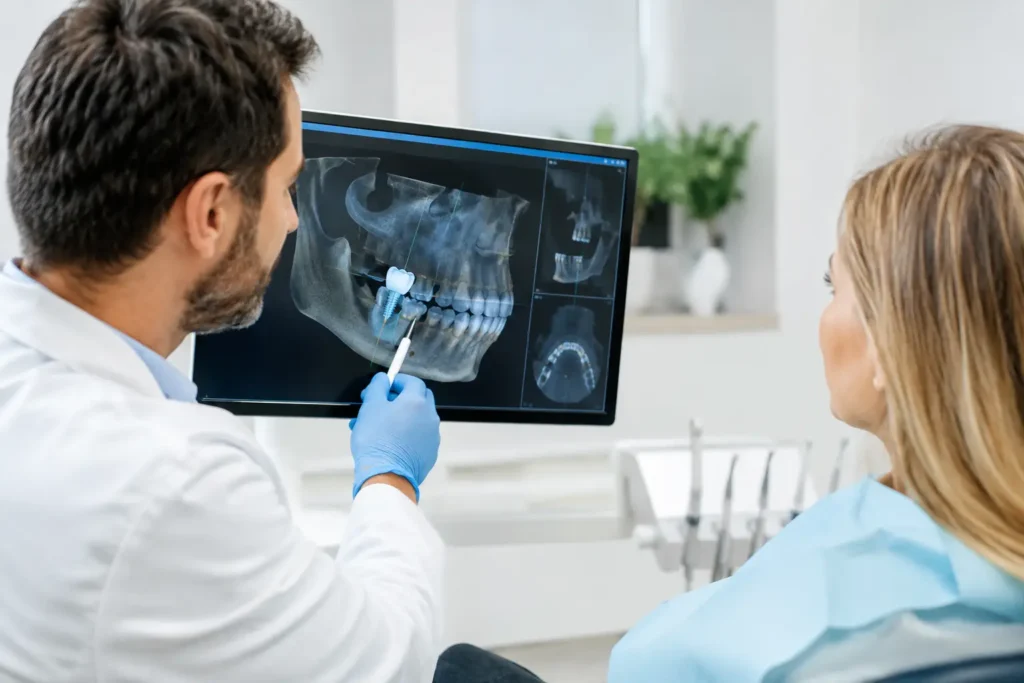
A severe bone loss implant case is not automatically a reason to settle for removable dentures. Even when the jaw has lost significant volume after years of missing teeth, gum disease, failing bridges, or poorly fitting dentures, many patients can still be treated with fixed implant teeth. The difference is not a one-size-fits-all implant plan. It is a precise evaluation of the bone that remains, the health of the gums and bite, and the surgical approach that can create stable long-term support.
For patients who have been told, “You do not have enough bone for implants,” the next step should be a CT scan review by an implant specialist. A two-dimensional X-ray cannot show the full shape, density, or location of the available jawbone. A 3D scan can.
Why Severe Bone Loss Changes Implant Planning
Bone is maintained by the pressure and stimulation of natural tooth roots. Once teeth are missing, the jaw gradually resorbs. This process can accelerate with untreated periodontal disease, infection, smoking, osteoporosis, trauma, or years of wearing dentures that rest directly on the gums.
The challenge is not simply placing an implant into any available space. Implants must be positioned where the bone can support them while avoiding the sinus cavities in the upper jaw and important nerves in the lower jaw. The final teeth must also be designed to fit the face, lip support, speech, smile line, and bite.
That is why experienced planning matters. Placing too few implants, using poor angulation, or skipping necessary grafting may reduce initial cost, but it can create a weak foundation for a full-arch bridge. In complex cases, the surgical plan and the prosthetic plan must be built together from the beginning.
The CT Scan Is the Starting Point
A cone beam CT scan allows the clinical team to measure bone height, width, and quality in millimeters. It also shows hidden infection, retained roots, sinus position, nerve pathways, and whether bone loss is localized or spread across the entire arch.
For remote patients, a CT scan can often be reviewed before travel so the team can provide a more informed preliminary recommendation. This is far more useful than choosing an implant package based only on photos or a general price quote. Send your CT scan for a free evaluation and learn whether your case may be suitable for grafting, angled implants, or a full-arch All-on-X solution.
Severe Bone Loss Implant Case Treatment Options
There is no single best answer for every patient. The right treatment depends on where the bone remains, how much is available, medical history, the condition of the existing teeth, and whether the goal is one tooth, several teeth, or a fixed full-arch restoration.
Bone Grafting and Sinus Lifts
When bone loss is limited to a specific area, bone grafting can rebuild the site before implant placement. The graft material acts as a framework that supports new bone formation over time. Depending on the case, implants may be placed at the same appointment or after a healing period.
In the upper back jaw, the sinus cavity often expands after tooth loss, leaving little vertical bone for an implant. A sinus lift creates space beneath the sinus membrane for graft material, helping establish enough support for future implants.
Grafting can be an excellent choice when preserving natural anatomy is the priority. The trade-off is time. Some grafted cases require several months of healing before final implant placement. For patients seeking faster full-mouth rehabilitation, a graft-free approach may sometimes be possible.
Angled Implants and All-on-4 or All-on-6
Full-arch protocols such as All-on-4, All-on-6, and All-on-X are designed to use the strongest available bone, often in the front part of the jaw. Rather than placing every implant straight up and down, posterior implants may be tilted to avoid the sinus or nerve while increasing contact with available bone.
This approach can allow qualified patients to avoid extensive grafting and receive a fixed temporary bridge soon after surgery. Four implants may work in select cases, while six or more may be recommended when additional support, bone distribution, bite force, or prosthetic design calls for it. The number should be determined by your anatomy, not by a marketing slogan.
A temporary fixed bridge is not the final zirconia prosthesis. It protects the healing implants and allows you to leave with teeth while the bone integrates. Once healing is complete and the bite is stable, the final restoration can be fabricated for strength, esthetics, and easier long-term maintenance.
Advanced Implant Options for Extreme Upper-Jaw Loss
Some patients have very limited bone in the upper jaw, especially after decades without teeth or multiple failed restorations. In these cases, conventional implants and standard All-on-4 placement may not provide enough anchorage.
Advanced options can include longer implants placed into denser anatomical areas, such as pterygoid implants, or zygomatic implants that anchor in the cheekbone. These are highly specialized procedures and are not appropriate for every patient. They require detailed 3D planning, experienced surgical judgment, and a clear prosthetic plan.
The goal is not to choose the most aggressive procedure. It is to choose the least invasive option that provides a stable, predictable foundation for fixed teeth.
What the Treatment Process Looks Like
A complex implant case should feel organized, not confusing. It begins with a review of your CT scan, dental history, current symptoms, medications, and treatment goals. If you have remaining teeth, the team determines which can be saved and which are causing infection, mobility, or ongoing bone loss.
Digital planning is then used to map implant positions and design the future smile before surgery. Guided surgery may be used to translate that plan more accurately to the mouth. This helps improve implant positioning, reduce unnecessary trauma, and coordinate the surgical phase with the temporary bridge.
On surgery day, failing teeth may be removed, infection is cleaned, implants are placed, and a fixed temporary bridge may be delivered when implant stability allows. Not every severe bone loss case qualifies for same-day fixed teeth. If the bone is too soft, grafting is extensive, or an implant does not achieve adequate stability, a different temporary solution may be safer. A responsible team will explain that decision clearly rather than forcing an immediate-load protocol.
Expect swelling, tenderness, and dietary restrictions during the first days. Most patients use prescribed pain-control instructions, rest, and follow a soft-food diet while healing begins. Smoking, uncontrolled diabetes, poor oral hygiene, and heavy biting forces can increase the risk of complications, so honesty during the evaluation is essential.
Planning Care When You Are Traveling for Implants
For patients traveling from the United States or Canada, speed should never replace planning. The advantage of coordinated implant care in Cabo San Lucas or Tijuana is that diagnostics, surgery, temporary teeth, and follow-up milestones can be organized into an efficient treatment schedule.
Before you travel, confirm what records are needed, how many days you should plan to stay, what your temporary teeth will be made from, and when you will return for the final zirconia bridge. Ask who will perform the surgical and restorative phases, what happens if grafting becomes necessary, and how postoperative questions will be handled once you return home.
At Expertos Dentista E Implantes, treatment planning is centered on CT-guided diagnostics, guided surgical protocols, and fixed full-arch solutions designed around each patient’s anatomy. The objective is not simply lower pricing. It is to deliver a complete plan that makes clinical and financial sense.
Cost Should Reflect the Complexity of Your Case
Severe bone loss treatment can cost more than a straightforward implant because it may involve extractions, grafting, specialized implants, surgical guides, sedation, temporary teeth, and a final full-arch prosthesis. However, patients can often save substantially compared with equivalent full-mouth treatment in the United States, particularly when care is planned as a complete rehabilitation rather than a series of emergency repairs.
Be cautious with prices that sound unusually low but exclude imaging, extractions, temporary bridges, final zirconia teeth, anesthesia, or follow-up care. Request a written treatment plan that separates the phases and identifies what is included. A lower quote is only a real savings if it provides the foundation and restoration your mouth actually needs.
If you have been told your bone loss is too severe for fixed teeth, do not make a decision based on that sentence alone. Get a CT-based implant evaluation, understand the options in front of you, and choose a treatment plan built for stability, comfort, and the life you want to live with your new smile.