
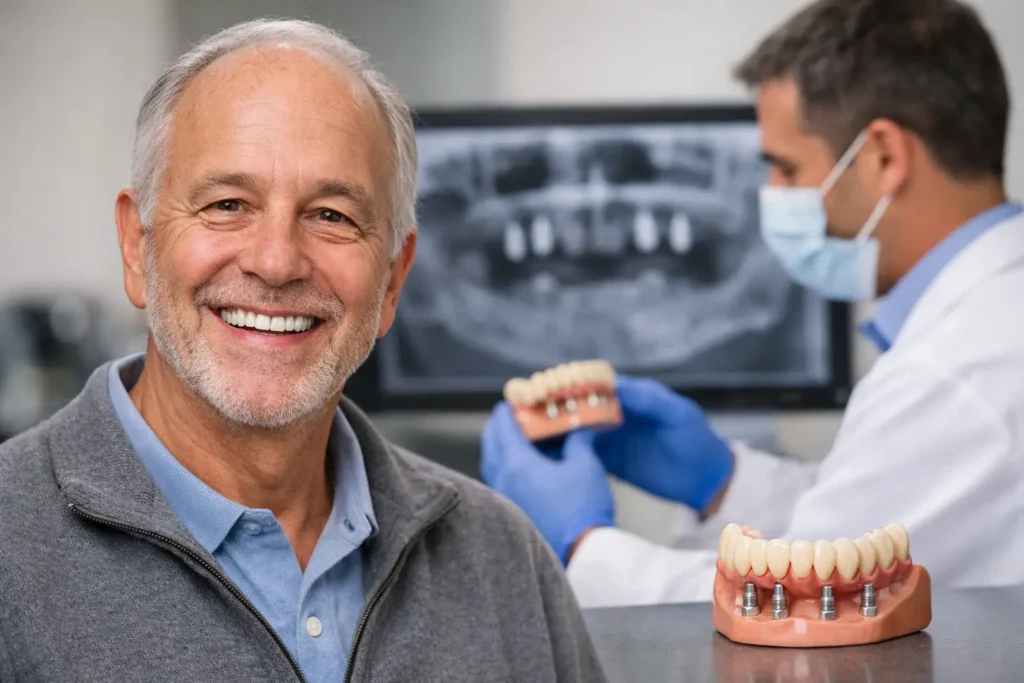
Severe bone loss changes the conversation about full-mouth implants. A patient may have been told they need extensive bone grafting, cannot receive fixed teeth, or must continue with removable dentures. This All-on-4 case study of severe bone loss shows why those answers are not always final. With a detailed CT scan, prosthetically driven planning, and an experienced implant specialist, many patients can qualify for a fixed full-arch solution without months of grafting.
The deciding factor is never a single X-ray or a one-size-fits-all promise. It is the quality and distribution of the remaining bone, the patient’s medical history, bite forces, gum condition, and the ability to place implants in stable positions that support a full arch.
The Severe Bone Loss Challenge
Consider a representative full-arch patient: a 64-year-old with loose upper teeth, long-standing periodontal disease, and an old removable partial denture. Several back teeth were already missing. The remaining teeth had mobility, recurrent infection, and bone loss that was especially pronounced in the posterior upper jaw.
The patient wanted fixed teeth, not another removable appliance. In a conventional implant plan, replacing each missing tooth individually would likely require multiple grafting procedures and a long healing period. The sinus cavities in the upper jaw had expanded into areas where molar roots once sat, leaving limited vertical bone for traditional posterior implants.
This is where a full-arch strategy can be fundamentally different from replacing teeth one by one. All-on-4 treatment does not try to recreate every tooth root. It uses four strategically positioned implants to support a fixed bridge. The two rear implants are often angled to use stronger available bone toward the front of the jaw and avoid the sinus cavities or nerve pathways.
Angled implants are not a shortcut. They require precise planning and a prosthetic design that distributes bite forces correctly. Done well, they can reduce the need for sinus lifts and major grafting while still providing stable support for a full fixed arch.
All-on-4 Case Study: Severe Bone Loss Evaluation
Before treatment, the patient sends a recent CBCT scan for a remote evaluation. A panoramic X-ray can show broad concerns, but a 3D CT scan is what allows the implant team to measure bone width, height, density, sinus position, and anatomical limitations in millimeters.
In this case, the scan showed that posterior bone was insufficient for conventional straight implants. However, there was usable bone in the anterior maxilla and along the lateral areas of the arch. The treatment plan called for removal of the remaining failing teeth, thorough cleaning of infected tissue, and placement of four implants with the posterior implants tilted into the strongest available bone.
Digital planning began with the end result: where should the teeth sit for a natural smile, comfortable speech, proper lip support, and a stable bite? From there, implant positions were planned to support that final bridge. This is called prosthetically driven implant planning, and it matters because an implant can be surgically stable yet poorly positioned for the teeth it must support.
A surgical guide was prepared to transfer the digital plan into the mouth with greater precision. Guided surgery can improve accuracy, efficiency, and predictability, especially in complex anatomy. It does not replace surgical judgment. The specialist must still assess bone quality, achieve proper implant stability, and adapt responsibly if clinical conditions differ from the scan.
The Same-Day Fixed Teeth Process
On the surgical day, the failing teeth were removed and the sites were carefully debrided. Implant placement followed the digital plan, with particular attention to engagement in dense bone. Primary stability is essential for immediate loading – the clinical term for placing a fixed temporary bridge shortly after surgery.
Not every severe bone loss case can receive same-day fixed teeth. If implant stability is below the required threshold, if infection cannot be fully managed, or if bone is too compromised in a key area, a staged approach may be safer. A responsible clinic does not force immediate loading simply because it is attractive to patients traveling for treatment.
For this patient, all four implants achieved the stability needed for a fixed temporary prosthesis. Digital records were used to fabricate a provisional full-arch bridge designed to protect the implants during healing. The temporary teeth restored the patient’s ability to smile, speak, and eat a soft diet without leaving the clinic with a removable denture.
The provisional bridge is not the final zirconia restoration. During the first months of healing, the implants integrate with the bone and the gums reshape around the new teeth. The temporary also gives the patient and clinical team time to evaluate bite, speech, tooth display, and comfort before finalizing the permanent design.
Why Bone Grafting Was Not the First Choice
Bone grafting remains valuable in implant dentistry. It can rebuild areas where there is not enough bone for a stable, well-positioned implant. In some cases, it is the best and safest choice. But grafting adds cost, surgery, healing time, and uncertainty, particularly when patients have advanced gum disease, smoke, have uncontrolled diabetes, or have medical factors that affect healing.
In this case, the available bone was sufficient for an All-on-4 design that avoided the weakest posterior areas. Rather than building bone solely to place individual implants where molars once were, the plan used the bone that remained strategically. This is one reason All-on-4 can be a practical option for patients who have been told their bone loss is too severe for fixed teeth.
The trade-off is clear: four implants carry a full arch, so implant placement, bite design, and long-term maintenance must be taken seriously. Patients with very strong bite forces or teeth grinding may benefit from a different implant distribution, such as All-on-6 or an All-on-X plan. Severe bone loss does not automatically mean All-on-4 is the right solution. It means the case needs an expert evaluation, not a generic estimate.
Healing, Final Zirconia, and Long-Term Results
During the healing phase, the patient follows a soft-food diet and avoids biting hard foods with the temporary bridge. This is not a minor instruction. Excessive force can compromise integration before the implants are fully bonded to the bone. Medication, hygiene instructions, and follow-up visits are planned around the individual case.
After healing, the patient returns for final records. Intraoral scanning, bite registration, and facial measurements guide the permanent prosthesis. A full-zirconia bridge is often selected for its strength, natural appearance, and biocompatibility. The final teeth should not look oversized or artificial. They should restore facial support while allowing the patient to speak clearly and clean around the bridge correctly.
At the final delivery, the bite is checked carefully. Small adjustments matter because a full arch functions as one connected restoration. The patient also receives instructions for daily cleaning with specialized brushes or water-flossing tools and understands the need for professional maintenance visits. Fixed does not mean maintenance-free.
What This Case Means for Patients With Bone Loss
The outcome of a severe bone loss case depends on diagnosis, not marketing claims. A patient may qualify for graft-free All-on-4 treatment, need additional implants, require grafting in one area, or be better served by a staged plan. The right answer comes from a CBCT scan reviewed by a specialist who plans both the surgery and the final teeth.
For patients traveling to Cabo San Lucas or Tijuana, remote case review can clarify feasibility before booking treatment. Expertos Dentista E Implantes uses digital planning and specialist-led evaluation to determine whether same-day fixed teeth are clinically appropriate, not merely desirable.
If you have been told you lack enough bone for dental implants, do not assume removable dentures are your only option. Send your CT scan today for a free consultation. A precise review can show whether the bone you still have can support the fixed smile you want – and what treatment path gives you the strongest long-term chance of keeping it.