
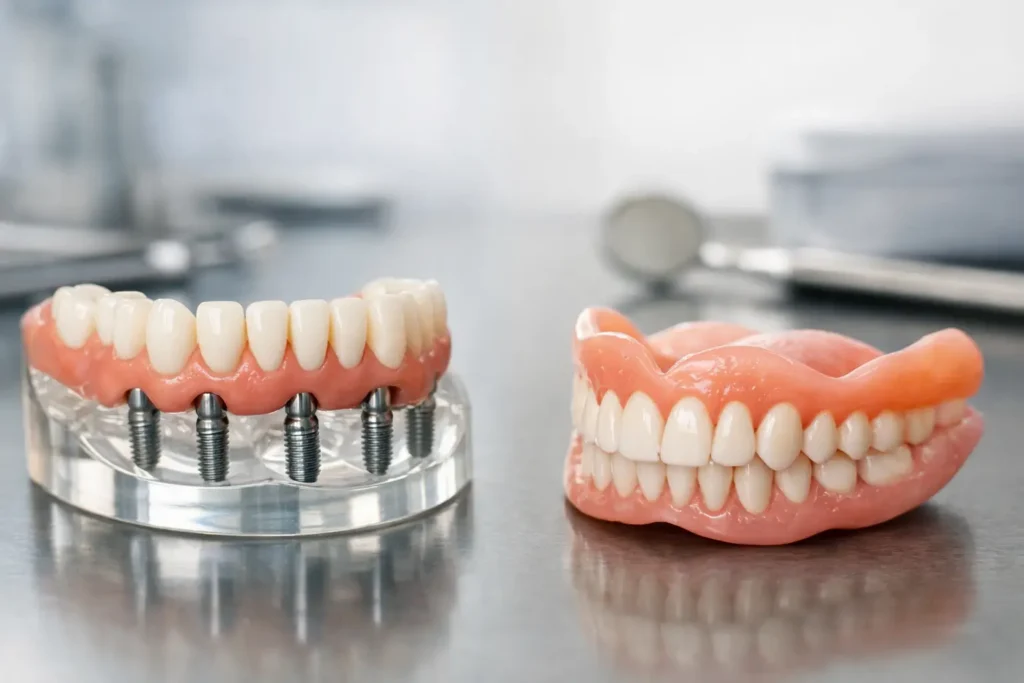
If you are stuck choosing between all on x vs dentures, the real question is not just price. It is whether you want a removable solution that replaces teeth at the surface level, or a fixed full-arch restoration that is designed to function more like natural teeth. For many patients dealing with failing teeth, loose dentures, or repeated dental repairs, that difference changes daily life.
This comparison matters most when you are not looking for a temporary patch. You want to eat with confidence, speak clearly, smile without worry, and avoid spending money over and over on something that still feels like a compromise. That is where the gap between traditional dentures and All-on-X becomes very clear.
All-on-X vs dentures: the core difference
Dentures sit on top of the gums. Even well-made dentures rely on suction, fit, and in some cases adhesive. They can restore appearance, but they do not replace tooth roots, and they do not stop the jawbone from shrinking over time.
All-on-X is a fixed implant solution. A full arch of teeth is supported by multiple dental implants placed in the jawbone, often four, six, or more depending on your anatomy and treatment plan. The prosthetic is secured in place, which gives it a very different feel from a removable denture.
That is why these options are not interchangeable, even though both replace missing teeth. One is removable and tissue-supported. The other is fixed and implant-supported.
What daily life feels like with each option
This is where many patients make their decision.
With dentures, movement is the biggest complaint. Some patients do well at first, especially if they still have enough bone and saliva for retention. But many struggle with slipping during meals, irritation from pressure points, sore spots, and the social anxiety that comes with removable teeth. Lower dentures are usually more difficult than upper dentures because they have less natural suction.
With All-on-X, the goal is stability. Because the arch is anchored to implants, patients typically feel more secure when chewing and speaking. There is no daily removal, no adhesive routine, and no fear that the teeth will shift during a conversation or meal. That fixed design is often the main reason patients move away from dentures.
There is still an adjustment period with All-on-X, and it is surgery, so expectations should stay realistic. But once healed, the experience is much closer to having a solid set of teeth than wearing a prosthesis that comes in and out.
Appearance and confidence
Dentures can look good, especially when they are newly made. But as bone changes over time, the fit changes too. That can affect facial support, lip position, and the way the dentures sit when you talk or smile.
All-on-X tends to offer a more stable aesthetic result because the restoration is digitally planned and fixed in a set position. In advanced cases, the prosthetic can also be designed to improve smile line, tooth display, bite support, and overall facial balance. For patients who have hidden their smile for years, this is not a small upgrade. It is often the point of treatment.
Material also matters. Traditional dentures are usually made from acrylic. Full-arch implant restorations may begin with a same-day temporary and later transition to stronger, more refined materials such as zirconia, depending on the case and the final treatment design.
Chewing power is not the same
Patients often underestimate how much missing teeth or unstable dentures have changed their diet. Soft foods become the default. Steak, apples, nuts, and crunchy vegetables become difficult or impossible.
Dentures can restore basic function, but they do not usually restore strong bite force. Because they rest on the gums, they can lift or rock under pressure. That makes chewing less efficient and often less enjoyable.
All-on-X is different because implants transfer force into the bone. That usually allows for stronger, more confident chewing once healing is complete. It does not mean you treat implant teeth carelessly, but it does mean many patients return to foods they had avoided for years.
Bone loss is one of the biggest long-term differences
This is one of the most important points in the all on x vs dentures discussion.
When teeth are missing, the jawbone no longer receives normal stimulation through the roots. Dentures do not replace that stimulation. Over time, the bone continues to shrink. That is why dentures often become loose and need relines, remakes, or adjustments. It is also why the face can start to look more collapsed as the years pass.
Implants help preserve bone by acting like artificial roots. They do not make the body stop aging, but they can significantly reduce the pattern of bone loss that happens with complete tooth loss. For patients thinking beyond the next year, this matters.
Upfront cost vs long-term value
Dentures cost less at the beginning. That is the main reason many patients choose them. If your budget is extremely limited, a denture may feel like the only realistic option right now.
But lower upfront cost does not always mean lower lifetime cost. Dentures may need adhesives, relines, repairs, remakes, and periodic replacement. If fit declines, comfort and function decline too. Some patients end up paying repeatedly to maintain a solution they still do not like.
All-on-X costs more because it involves surgery, implants, advanced diagnostics, digital planning, temporary teeth, and a final fixed restoration. It is a more complex treatment. But for many patients, the value comes from what it replaces: constant adjustments, removable appliances, repeated frustration, and years of compromise.
For patients comparing treatment in the U.S. to treatment in Mexico, cost becomes even more relevant. A specialist-led full-arch case with guided surgery and high-quality materials can be dramatically more affordable while still delivering the kind of fixed result patients actually want. That is one reason so many people send their CT scan first before making a decision.
Are you a candidate for either one?
Dentures fit a wide range of patients because they do not require surgery. That makes them an option for people with major medical limitations, very low bone volume, or those who simply do not want implants.
All-on-X requires a more detailed evaluation. Bone quality, sinus position, bite relationship, infection, gum condition, and overall health all matter. The good news is that many patients who assume they are not candidates actually are, especially when treatment is digitally planned by an implant specialist and designed around available bone.
That said, not every patient is best served by the same version of treatment. Some need All-on-4. Others need more implants for better support. Some require extractions or periodontal treatment first. This is why a remote evaluation with a CT scan is so valuable. It replaces guesswork with a real plan.
Recovery, maintenance, and expectations
Dentures are easier at the start because there is no implant surgery. But they often require more adaptation in day-to-day use. Learning to eat, speak, and live with a removable prosthesis can take longer than expected.
All-on-X involves surgery and healing, but modern protocols can make the process far more efficient than many patients assume. In the right case, same-day temporary fixed teeth may be possible, allowing you to leave with a stable smile while the implants heal. That changes the experience completely for patients who do not want to be without teeth.
Maintenance matters with both options. Dentures must be removed and cleaned daily. All-on-X also requires diligent hygiene and professional follow-up. Fixed does not mean maintenance-free. It means the restoration stays in place while you care for it properly.
So which option makes more sense?
If your priority is the lowest possible upfront cost and avoiding surgery, dentures may still be the practical choice. They can restore appearance quickly and help in situations where implants are not appropriate.
If your priority is stability, stronger function, better long-term bone support, and a fixed smile that feels more secure, All-on-X is usually the better answer. It is especially appealing for patients who are tired of loose dentures, failing teeth, or patchwork dentistry that keeps costing money without solving the real problem.
The right decision depends on your anatomy, your health, and how much compromise you are willing to accept. If you are already asking whether there is a better option than dentures, there usually is. A free consultation and CT scan review can tell you quickly whether a fixed full-arch solution is realistic for you, what the timeline looks like, and how much you could save compared to U.S. treatment.
The best treatment is not the one that looks cheapest on paper. It is the one that gives you back comfort, confidence, and a smile you can actually rely on.