
If you are weighing implant supported bridge vs dentures, you are probably not looking for a textbook answer. You want to know what daily life will actually feel like – eating, speaking, smiling, cleaning, traveling, and whether the lower upfront price of dentures is worth the compromises that often come with them.
For many adults dealing with missing teeth, failing dental work, or a full-mouth situation, this is less about replacing teeth and more about getting normal life back. That is why the right choice depends on more than cost alone. It depends on stability, bone health, appearance, maintenance, and how permanent you want the result to feel.
Implant supported bridge vs dentures: the core difference
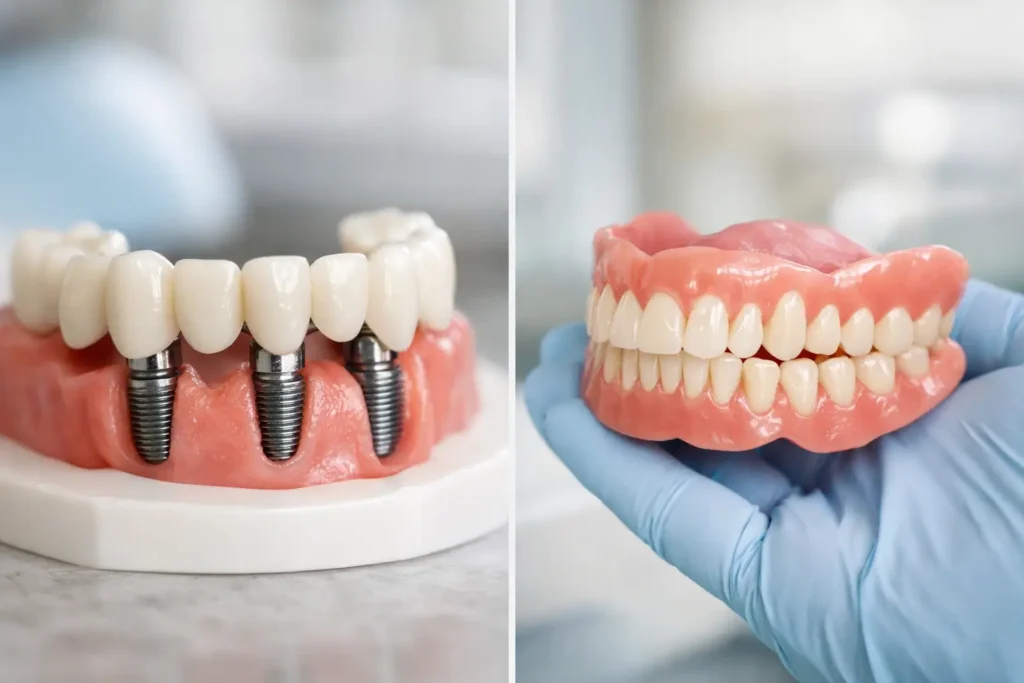
A denture is a removable prosthesis that sits on the gums. It can replace some teeth or a full arch, but it relies mainly on the soft tissue and underlying ridge for support unless it is paired with implants.
An implant supported bridge is fixed in place using dental implants anchored in the jawbone. Instead of resting on the gums and moving with pressure, it is attached to implants and behaves more like a secure set of teeth. In a full-arch case, this may be part of an All-on-4, All-on-6, or All-on-X treatment approach.
That one difference changes almost everything. Removable dentures are usually faster and less expensive at the start. Implant-supported bridges are more advanced, require surgery, and cost more upfront, but they offer a much more stable and natural-feeling result.
What feels better in real life?
This is where many patients stop comparing brochures and start asking better questions.
Dentures can restore appearance, but many people never feel fully relaxed wearing them. Lower dentures are especially known for movement because the tongue and jaw muscles constantly challenge the fit. Even upper dentures that fit well can loosen over time as the bone changes. That can affect chewing, speech, and confidence in social situations.
An implant supported bridge is designed for a different level of function. Because it is fixed to implants, it does not slide, lift, or rely on adhesive. Patients usually describe the difference in one simple way: dentures feel like something you wear, while a fixed bridge feels much closer to having teeth again.
That matters when you are ordering dinner, speaking in a meeting, or laughing without thinking about whether anything shifted.
Chewing power and food choices
Chewing efficiency is one of the biggest real-world differences between implant supported bridge vs dentures.
Traditional dentures can make it difficult to bite into tougher foods or chew evenly. Many denture wearers adapt by avoiding steak, apples, nuts, crusty bread, and other foods that demand more stability. Over time, that can narrow the diet and take some of the enjoyment out of eating.
With an implant supported bridge, the force is distributed through implants into the jawbone. That creates a more secure bite and typically allows a much wider food range once healing is complete. It does not mean you should abuse the restoration, but it does mean most patients return to a more normal diet with far less caution.
For people who are tired of planning meals around what their teeth can handle, fixed implant treatment can be a major quality-of-life upgrade.
Bone loss is the part many patients are not told clearly enough
When teeth are lost, the jawbone no longer receives the stimulation that natural tooth roots once provided. The body starts resorbing bone in those areas.
Dentures do not stop that process. In fact, as bone shrinks, dentures often become looser and require relines, adjustments, or replacement. The facial profile can also change over time, especially in long-term denture wearers. That is one reason some people feel they look older after years without fixed support.
Implants help preserve bone because they act like root substitutes. A fixed implant supported bridge does not just replace visible teeth – it supports the structure underneath. That is a major long-term advantage, especially for patients who want both function and facial support.
This is also why waiting too long can reduce options. Severe bone loss may still be treatable, but it can make the case more complex.
Cost: lower now or better value later?
Dentures usually win on initial price. If your main goal is the most affordable way to replace missing teeth right now, dentures may seem like the obvious answer.
But the full financial picture is not always that simple. Removable dentures often need periodic relines, repairs, remakes, adhesive products, and follow-up adjustments as the mouth changes. If the fit declines and chewing becomes more difficult, the “cheaper” solution can start feeling expensive in other ways – comfort, confidence, and repeated maintenance.
An implant supported bridge requires a larger upfront investment because it involves surgical planning, implant placement, temporary teeth in many cases, and a final prosthesis. However, for the right candidate, it often delivers stronger long-term value because it is fixed, more stable, and less dependent on the ongoing compromise of a removable appliance.
For many patients traveling from the U.S. or Canada, the discussion changes once they compare treatment outside the American pricing model. Specialist-led full-arch implant care with digital planning and guided surgery can become far more attainable when costs are significantly lower than in the U.S.
Appearance and confidence
A good denture can look attractive. That should be said clearly. Dentures are not automatically unattractive or poorly made.
Still, there are limits to what removable prosthetics can achieve, especially when bone and gum support have changed. As the jaw shrinks, lip support and facial balance can become harder to maintain naturally. The fit can also affect speech and expression in subtle ways patients notice even if others do not.
A fixed implant bridge generally offers a more secure, more natural-looking foundation for the smile. Because the restoration is planned around implant position, bite, facial support, and digital design, the result can feel more precise and customized. In full-mouth rehabilitation, that precision matters.
Patients who have spent years hiding their teeth or managing unreliable dentures usually care about one thing above all: not having to think about their teeth all day. Fixed treatment is often the closest answer to that goal.
Are dentures ever the better choice?
Yes. Not every patient needs or wants a fixed implant solution.
Dentures may be the better fit if you need a fast, low-cost replacement, have medical factors that delay implant surgery, or simply prefer a removable option. Some patients also start with dentures as a transitional solution before moving to implants later.
There are also middle-ground options, such as implant-retained overdentures, which use implants for added stability while still remaining removable. That can improve retention compared with traditional dentures without reaching the full cost of a fixed bridge.
This is why a proper evaluation matters. The best treatment is not the most expensive one. It is the one that fits your anatomy, health, goals, and budget without overselling or cutting corners.
What the treatment process looks like for fixed implants
Patients often assume an implant supported bridge means a long period without teeth. In advanced full-arch care, that is often not the case.
With digitally planned treatment and guided surgery, many full-arch patients can receive implants and a same-day temporary fixed bridge, then return later for the final prosthesis after healing. That process is especially appealing to patients who are traveling and want efficiency without sacrificing standards.
The exact timeline depends on bone quality, infection, extractions, and overall case complexity. Some cases are straightforward. Others need a more staged approach. A real specialist will tell you which one you are – not force everyone into the same package.
At clinics such as Expertos Dentista E Implantes, this is where remote CT scan review, specialist-led planning, and clear travel coordination become valuable. If you are considering treatment in Cabo San Lucas, sending your scan for a free consultation can help clarify whether a fixed bridge is realistic before you commit to travel.
How to decide between implant supported bridge vs dentures
Ask yourself a few honest questions. Do you want the lowest upfront cost, or do you want the most stable long-term result? Are you comfortable removing your teeth at night, or does that feel like a compromise you no longer want to make? Has bone loss already affected fit, comfort, or appearance? And if you choose dentures now, are you prepared for the maintenance that often comes with them?
If your priority is affordability above all else, dentures may still serve a purpose. If your priority is fixed teeth, stronger chewing, preserved bone, and a result that feels more like your own mouth again, an implant supported bridge is usually the better answer.
The right choice should make your life easier, not just your treatment estimate smaller. If you are serious about replacing missing teeth once and doing it well, get a specialist evaluation, send your CT scan, and make the decision based on what you want your next 10 years to feel like.