
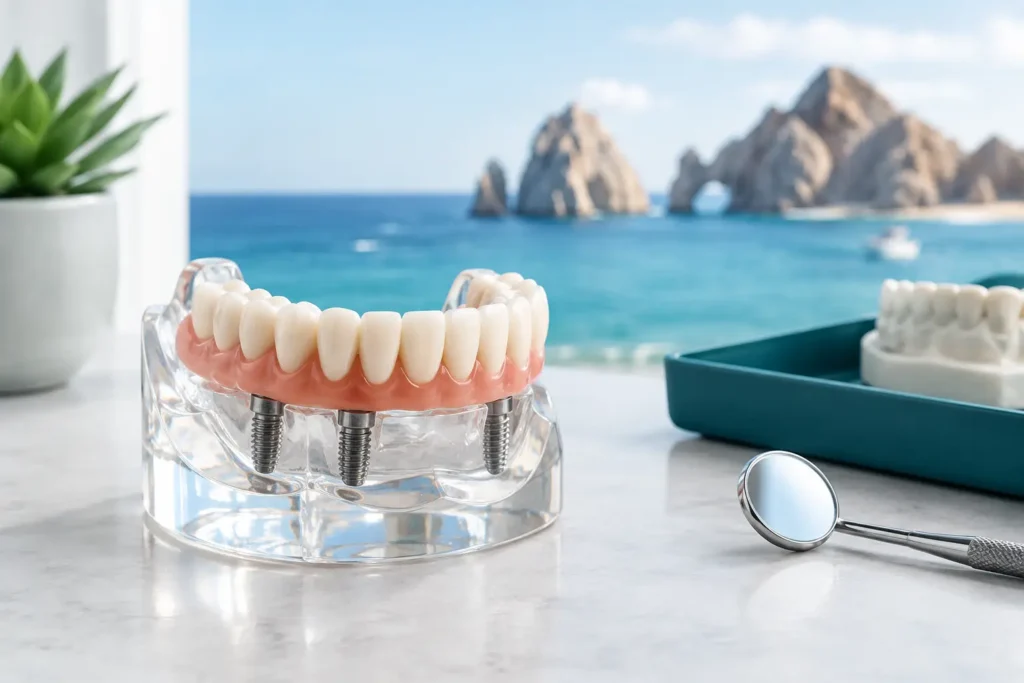
A loose denture can turn ordinary moments – breakfast with family, dinner out, a conversation without self-consciousness – into something that requires planning. This fixed teeth for seniors guide explains how full-arch implant treatment in Cabo San Lucas may replace removable teeth with a fixed restoration, while keeping the decision grounded in clinical evaluation, materials, timing, and realistic expectations.
Fixed teeth are not one single treatment. The right approach depends on your remaining teeth, jawbone volume and quality, bite, gum health, medical history, and goals. For some people, a full-arch implant restoration is appropriate. For others, preserving healthy teeth, treating gum disease first, or considering a different design may be more sensible.
What “fixed teeth” means for seniors
Fixed teeth are restorations attached to dental implants rather than removed each night. Dental implants are small posts placed in the jawbone to support a bridge of replacement teeth. In a full-arch restoration, several implants support one complete upper or lower arch of teeth.
This differs from a traditional removable denture, which rests on the gums and is taken out for cleaning. A fixed implant bridge is designed to stay in place, though it still requires daily hygiene and professional maintenance. It should not be confused with a temporary appliance or a snap-in denture, which uses implants for retention but remains removable by the patient.
For seniors who are tired of denture movement, adhesives, or difficulty chewing, the appeal is understandable. Still, the aim is not simply to add implants. It is to create a stable bite, suitable tooth position, and a restoration that can be maintained over time.
All-on-4, All-on-6, and All-on-X explained
All-on-4 uses four implants to support a full arch. In selected cases, angled posterior implants can help use available bone efficiently and avoid certain anatomical structures. All-on-6 uses six implants and may be considered when the clinical plan calls for additional implant support.
All-on-X is a broader term. The “X” means that the number and placement of implants are determined after evaluation rather than selected from a preset package. More implants are not automatically better, and fewer are not automatically inadequate. The appropriate design depends on bone anatomy, bite forces, restorative space, oral hygiene capacity, and the planned restoration.
Some patients with substantial upper-jaw bone loss may require advanced options such as zygomatic, transnasal, or pterygoid implants. These techniques use alternative areas of available bone and are only considered after careful CT-based assessment. They are not routine recommendations and are not necessary for every patient with missing teeth.
Why digital planning matters in Los Cabos
For patients traveling from California, Washington, Metro Vancouver, Calgary, or elsewhere in the United States and Canada, planning before travel can make the process clearer. A cone beam CT scan provides a three-dimensional view of the jawbone, sinus areas, nerves, and existing teeth. It gives the clinical team information that ordinary two-dimensional X-rays cannot provide.
At Expertos Dentista e Implantes, CT-based digital planning is used to evaluate implant positions and treatment options. Guided-surgery planning may help translate the approved plan to surgery. Intraoral scanning and photogrammetry – a precise method of recording implant positions – support the design of the final restoration.
Technology supports judgment; it does not replace it. An in-person examination and review of your records are still needed to confirm whether a plan is appropriate. Ask the clinic how to share your CT scan securely before making travel arrangements, and request a written treatment plan that explains the proposed work in plain language.
Provisional teeth and final zirconia teeth are different stages
One of the most common points of confusion is the difference between provisional teeth and final teeth. A provisional is a temporary fixed restoration that may be placed after implant surgery when clinical conditions support it. It is not the final bridge, and it is not promised for every patient.
The provisional phase allows healing and gives the clinician an opportunity to evaluate function, appearance, speech, and bite. During this period, you may be asked to follow specific food and hygiene instructions to protect the healing implants. The timing and type of temporary solution depend on the individual case.
After healing, the final full-arch prosthesis is created. Zirconia is a ceramic material often selected for final restorations because it can be designed for strength, appearance, and long-term hygiene. It is not automatically the right choice in every clinical situation, but it is the final material offered for full-arch bridges at this practice. The clinic does not offer acrylic or metal full-arch bridges.
A thoughtful final prosthesis should account for more than tooth color. It should consider lip support, smile line, phonetics, bite, cleaning access, and the relationship between the upper and lower arches. That is why final teeth should follow healing rather than be treated as an afterthought.
Fixed teeth for seniors guide: costs per arch
Cost comparisons are most useful when they compare like with like. Full-arch fees are commonly quoted per arch, meaning upper or lower, not both jaws together. A quote for treatment of both arches will therefore be different from the published single-arch range.
At the Cabo San Lucas clinic, published guide prices for zirconia full-arch restorations are USD 13,000 to USD 14,000 per arch for All-on-4 and USD 14,000 to USD 15,000 per arch for All-on-6. A zygomatic implant All-on-4 approach is published at USD 16,000 per arch. These figures are indicative, require an individual written quote, and should be reviewed alongside the number of visits, diagnostic needs, extractions, temporary options, and any additional procedures your case may require.
A single implant package starts at USD 1,899 and includes the implant, Ti-base, and zirconia crown. Single-tooth treatment and full-arch rehabilitation are planned differently, so one price should not be used to estimate the other.
When reviewing a quote, ask what materials are proposed, whether the amount is per arch or for both arches, what clinical steps are included, and how follow-up will be organized. A clear written plan should state the options discussed, procedures, materials, fees, expected visits, and follow-up considerations.
The normal two-trip process
Full-arch treatment normally involves two trips. The first visit may include the clinical examination, surgery, and, when appropriate, a provisional fixed restoration. The second visit is planned after healing for records, final fabrication, fitting, and adjustments of the zirconia prosthesis.
The length and scheduling of each visit depend on your treatment plan. Some patients require more preparation, additional monitoring, or changes based on healing. It is better to plan travel with flexibility than to assume that every stage follows an identical calendar.
Before traveling to Los Cabos, organize your medical and dental records, current medication list, CT scan if available, and contact details for your local dentist or physician when relevant. Build in time before your return flight for appointments and avoid scheduling tightly around major personal commitments. The clinic does not need to replace your local dental care; continued local support can be valuable between planned visits.
Daily care after fixed full-arch treatment
Fixed does not mean maintenance-free. Food debris and plaque can collect around the bridge and implant areas, especially beneath the restoration. Your team should show you the cleaning tools and technique appropriate for your design, which may include a soft toothbrush, interdental brushes, floss-threading tools, or an oral irrigator.
Professional reviews matter as well. During these visits, the clinician can assess the gums, bite, restoration surfaces, and areas that are difficult to clean at home. If you grind your teeth or have a history of clenching, discuss protective options with your clinician. Small adjustments and preventive care can be preferable to waiting for discomfort or visible damage.
Questions worth asking before you decide
A useful consultation should leave you with answers, not just a price. Ask how many implants are proposed and why, whether a provisional fixed bridge is clinically appropriate, what final material is planned, and what factors could change the timeline or fee. Also ask how your records will be reviewed, what follow-up is recommended, and who to contact if you have concerns after returning home.
Fixed teeth can be a meaningful option for seniors who want an alternative to removable dentures, but suitability is personal. A clinical evaluation is the starting point for deciding whether All-on-4, All-on-6, another implant design, or a different approach fits your needs. If you are considering care in Cabo San Lucas, request a personalized written treatment plan and arrange an evaluation with the team before committing to travel.