
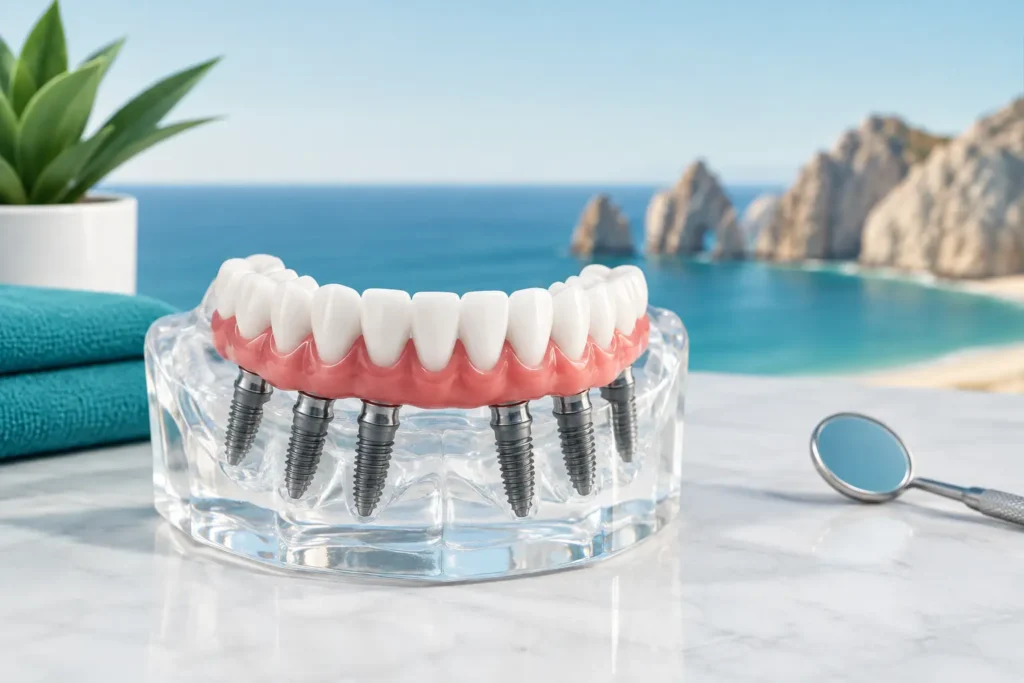
A removable denture can affect more than meals. It can change how confidently you speak, smile, and make travel plans. For adults considering all on 6 cabo san lucas treatment, the key question is not simply whether six implants are possible. It is whether a carefully planned, fixed full-arch solution fits your bone, bite, health history, expectations, and travel schedule.
All-on-6 is one option for replacing a full upper or lower arch of teeth with a fixed bridge supported by dental implants. At Expertos Dentista e Implantes in Los Cabos, planning starts with an individual clinical evaluation and a written discussion of the treatment options that may be appropriate for you.
What All-on-6 treatment means
All-on-6 refers to a full-arch restoration supported by six dental implants. An implant is a small post placed in the jawbone to support replacement teeth. After the implants heal and integrate with the bone, they can support a full-arch prosthesis, commonly called a bridge.
The number six describes a treatment concept, not a promise that every patient needs or qualifies for exactly six implants. Bone volume, bone quality, sinus anatomy in the upper jaw, bite forces, gum health, and the position of the nerves in the lower jaw all matter. Some patients may be candidates for All-on-4, while others may require a different approach, including advanced implant options when upper-jaw bone loss is significant.
The purpose of a full-arch plan is to create stable, functional teeth while respecting the anatomy available. That is why a CT scan, also called a 3D cone beam scan, is central to proper planning rather than an optional extra.
Is All on 6 in Cabo San Lucas right for you?
People often research All-on-6 when they have failing teeth throughout one arch, have already lost most or all of their teeth, or are tired of relying on a removable denture. Those situations may make a full-arch conversation worthwhile, but they do not determine treatment by themselves.
A clinical evaluation considers your current teeth, jawbone, gums, medical history, medications, bite, and oral habits such as clenching or grinding. If teeth need to be removed, the timing and condition of the extraction sites also affect the plan. A clinician may recommend treating one arch first, addressing gum disease before implant surgery, or considering another full-arch design.
For patients traveling from Greater Los Angeles, the Seattle area, Metro Vancouver, Calgary, or elsewhere in the United States and Canada, it can be useful to gather recent dental records before contacting the clinic. Ask the team how to securely share a CT scan and any relevant X-rays. A scan can help guide an initial discussion, though the final recommendation requires a clinical evaluation.
All-on-4 versus All-on-6
All-on-4 and All-on-6 are both fixed full-arch implant approaches. The practical difference is the number and distribution of implants planned to support the restoration. Neither is automatically better for every person.
All-on-4 can be an appropriate option in cases where anatomy and treatment goals support it. All-on-6 may be considered when the available bone and clinical situation allow for six well-positioned implants. The decision should be based on planning, not a preference for the largest number of implants or a one-size-fits-all package.
In cases with severe upper-jaw bone loss, conventional All-on-4 or All-on-6 may not be the right starting point. Selected patients may need evaluation for zygomatic, transnasal, or pterygoid implants. These are advanced options used in specific anatomical situations and require individualized assessment.
Digital planning before implant surgery
Full-arch treatment depends on more than placing implants. The implants must be planned around the final teeth, your bite, and the available bone. This is often called prosthetically driven planning: the replacement teeth guide the implant plan, rather than trying to fit teeth around implant positions chosen in isolation.
At Expertos Dentista e Implantes, the planning process may include CT-based digital planning, guided-surgery planning, intraoral scans, and photogrammetry. Intraoral scanning creates a detailed digital record of the mouth without traditional impression material. Photogrammetry is a digital method that can help record implant positions with high precision for the final restoration.
Guided surgery planning may help translate the digital plan into the clinical procedure. It does not replace clinical judgment, and the surgical approach remains dependent on what is found during evaluation and treatment. Its value is in supporting a more deliberate, well-documented workflow.
A written treatment plan should clearly identify the proposed procedure, restoration material, anticipated visits, fees, and follow-up expectations. It should also explain alternatives when more than one approach is clinically reasonable.
Zirconia bridges and the treatment stages
The final full-arch restorations at the practice are zirconia. Zirconia is a strong ceramic material used for dental crowns and full-arch bridges. It can be designed for durability and natural-looking tooth color, but its shape, bite design, and maintenance needs should be tailored to the individual patient.
The clinic does not offer acrylic or metal full-arch bridges. This is useful to know when comparing quotes because different materials and prosthetic designs can change both the price and the long-term maintenance discussion.
Full-arch implant treatment normally involves two trips. During the first visit, the clinical team completes the planned surgical and restorative stages appropriate to the case. A temporary fixed restoration may be provided when clinical conditions support it. It is provisional, meaning it is not the final bridge and is intended to protect healing and support function during the healing period.
Not every patient should receive a provisional fixed bridge, and it should never be assumed before evaluation. The final zirconia prosthesis is completed after healing, when the clinical team can confirm implant stability, assess the bite, and collect the detailed records needed for the definitive restoration.
The interval between visits depends on the individual case. Healing needs, bone quality, the need for extractions or grafting, bite considerations, and general health can all influence timing. Be cautious with any plan that promises the same schedule for every traveler.
All-on-6 costs in Los Cabos
Published All-on-6 pricing at Expertos Dentista e Implantes is USD $14,000 to $15,000 per arch for a zirconia restoration. This is a guide, not a substitute for a personalized written quote.
“Per arch” means the fee applies to either the upper arch or the lower arch. It does not mean both arches are included. If you are considering upper and lower full-arch treatment, request a plan that separates each arch and explains the clinical work involved in each one.
For context, published All-on-4 pricing is USD $13,000 to $14,000 per arch, also with zirconia restorations. Advanced zygomatic implant treatment under an All-on-4 approach is published at USD $16,000 per arch. Your needs may involve services beyond the listed full-arch category, such as extractions, periodontal treatment, imaging, or other preparatory care, so written details matter.
When comparing clinics, ask what material is proposed, whether the estimate is per arch or for both arches, which visits are anticipated, and how the provisional and final restoration stages are defined. The lowest headline price is not always the clearest comparison if it does not explain the bridge material, treatment sequence, or follow-up.
Preparing for treatment travel to Cabo San Lucas
Travel planning is part of responsible full-arch care, but it should follow the clinical plan rather than lead it. Avoid booking a tightly timed return trip until the team has reviewed your needs and discussed the visit schedule.
Bring an updated medication list and share relevant medical information before treatment. If you have a primary dentist or physician at home, keep their contact information available. Plan for a companion if the clinical team recommends one based on your procedure and anesthesia arrangements. It is also wise to allow room in your schedule for appointments, instructions, and any changes that may be needed during the visit.
Before leaving Los Cabos, make sure you understand hygiene instructions, food guidance for the provisional phase if applicable, medication directions, and the process for contacting the clinic with questions. Long-term success also depends on regular maintenance. Full-arch bridges need professional reviews and daily cleaning around the restoration and gums. Implant-supported teeth are fixed, but they still require consistent care.
A well-chosen full-arch treatment plan should feel clear, not rushed. If you are considering All-on-6 in Cabo San Lucas, request a personalized clinical evaluation and written treatment plan that explains your options, zirconia restoration design, per-arch fees, travel visits, and follow-up needs before you make a decision.