
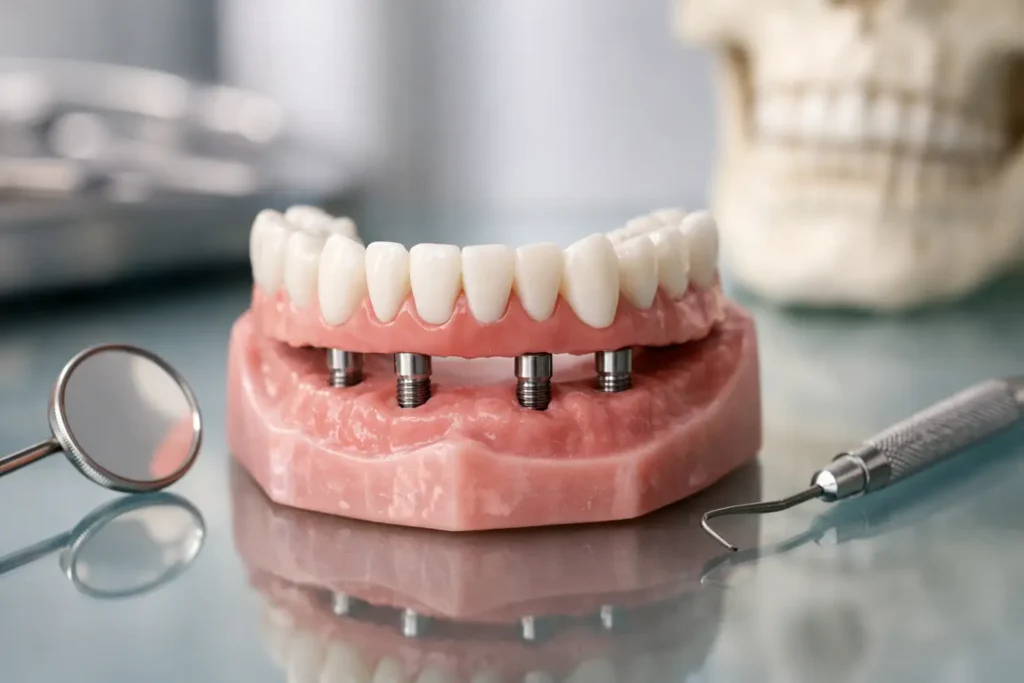
Most patients asking how all on 4 works are not casually browsing. They are usually tired of broken teeth, loose dentures, repeated dental bills, or being told they need a full-mouth solution that feels out of reach. The good news is that All-on-4 is designed for exactly that situation – replacing a full arch of missing or failing teeth with a fixed set of implant-supported teeth, often on the same day as surgery.
This treatment is popular because it solves several problems at once. It gives you fixed teeth instead of something removable, uses fewer implants than placing one implant for every missing tooth, and can often avoid more extensive bone grafting. For many patients, that means a faster path to a stable smile, better function, and a more predictable investment.
What how all on 4 works actually means
All-on-4 is a full-arch implant protocol. Instead of replacing each tooth with its own implant, the dentist places four dental implants in the jaw and uses them to support a full bridge of teeth.
The concept is strategic. The two front implants are typically placed straight, where bone is often strongest. The two back implants are usually angled to maximize available bone and avoid anatomical structures like the sinus in the upper jaw or the nerve in the lower jaw. That angled placement is one reason the procedure can work even for patients who have already lost some bone.
Once those implants are placed, a fixed temporary bridge can often be attached the same day. So when people say they want same-day teeth, this is usually what they mean. You leave with fixed provisional teeth while the implants heal and integrate with the bone.
How all on 4 works step by step
The process starts long before surgery. A proper case evaluation is what makes the final result predictable.
1. Digital planning and case review
A CT scan is usually the foundation. It shows bone volume, bone density, sinus position, nerve location, infection, and whether any teeth need to be removed. Photos, bite analysis, and medical history also matter.
This is where experienced planning makes a real difference. Not every patient has the same bite force, smile line, bone condition, or esthetic goals. A patient with severe gum disease, long-term denture wear, or collapsed bite may need a different approach than someone simply replacing failing crowns and bridges.
2. Removing failing teeth if needed
If you still have damaged or infected teeth, they are usually extracted at the time of surgery. The goal is to clear disease, preserve usable bone, and prepare the arch for implants and the temporary bridge.
In some cases, extractions and implant placement happen the same day. In other cases, if infection is severe or bone quality is poor, treatment may need to be staged. That depends on the biology, not just the schedule.
3. Implant placement
Four implants are placed in specific positions to support the full arch. Precision matters here. Guided surgery and digital planning help the surgeon place implants at the right angle, depth, and spacing.
This is not guesswork. The position of the implants affects strength, esthetics, cleaning access, and how the final bridge will fit. When the implants achieve good primary stability, a fixed temporary bridge can often be attached right away.
4. Same-day temporary teeth
For many patients, this is the biggest advantage. Instead of wearing a removable denture during healing, you can leave with a fixed temporary set of teeth.
These temporary teeth are not the final prosthesis. They are designed to look good, restore function, and protect the implants while the bone heals around them. You will still need to follow a soft-food diet and healing instructions carefully. Fixed does not mean you can immediately bite into steak or hard nuts.
5. Healing and integration
Over the next few months, the implants fuse with the bone through a process called osseointegration. This is what creates long-term stability.
During this phase, follow-up visits are important. The bite may need adjustments, healing tissue is monitored, and the temporary bridge helps shape the gums for the final result. Patients who respect the healing phase usually get better long-term outcomes.
6. Final bridge delivery
Once healing is complete, the temporary is replaced with the final prosthesis. This is often made from stronger, more refined materials such as zirconia, depending on the case.
The final bridge is designed for durability, esthetics, speech, and easier cleaning. It should feel more precise and more natural than the provisional teeth you wore during healing.
Who is a good candidate for All-on-4?
All-on-4 is often ideal for patients who are missing most or all teeth in one arch, have multiple failing teeth, or are frustrated with dentures. It is also attractive for patients who want fixed teeth without the cost and complexity of placing many individual implants.
That said, not every patient is automatically a candidate. Bone quality, medical conditions, smoking, active infection, uncontrolled diabetes, and bite habits such as clenching can affect the plan. Some patients are better served with All-on-6 or another All-on-X design if they need more support or have specific structural demands.
A high smile line can also change the esthetic strategy. If too much gum shows when you smile, the shape and transition line of the prosthesis need careful planning. That is why a CT scan alone is not enough. Implant planning also includes facial balance, lip support, speech, and smile design.
What makes All-on-4 different from dentures?
The biggest difference is stability. Traditional dentures rest on the gums and can shift, rub, or loosen over time. All-on-4 is anchored to implants in the bone, so the teeth stay fixed in place.
That stability usually improves chewing strength, speech confidence, and overall comfort. Many patients also notice a stronger sense of security in social settings because they are not worrying about movement or adhesives.
There is another important difference. Dentures do not help preserve bone the way implants can. When teeth are missing, the jawbone tends to shrink over time. Implant-supported treatment can help reduce that ongoing bone loss, although the degree varies by patient.
Does All-on-4 hurt?
Most patients expect it to be worse than it is. During surgery, the area is numb, and sedation options may be available depending on the case. Afterward, discomfort is usually described more as soreness, swelling, and pressure than severe pain.
The first few days are the toughest, then things gradually improve. Pain control, antibiotics if prescribed, ice, rest, and following post-op instructions all matter. Patients with advanced infection or complex extractions may feel more discomfort than straightforward cases, so recovery is never identical for everyone.
How long does All-on-4 last?
The implants themselves can last many years when they integrate well and are maintained properly. The bridge also has a long lifespan, but it is still a dental restoration, which means wear, bite force, hygiene, and material choice all affect longevity.
Temporary teeth are not meant to be permanent. The final bridge is the long-term solution, and premium materials such as zirconia generally offer better strength and esthetics for many full-arch cases. Even then, maintenance is part of success. You will need regular checkups, professional cleanings, and good home care.
The biggest trade-offs patients should understand
All-on-4 is efficient, but it is still major treatment. You are making a medical and financial decision that affects function, appearance, and long-term oral health.
The biggest benefit is speed and fixed teeth with fewer implants. The trade-off is that everything depends on precise planning, careful surgery, and smart prosthetic design. A low price by itself is not enough. If the bite is poorly managed or the implants are not ideally positioned, problems can show up later as fracture, hygiene difficulty, speech issues, or implant overload.
That is why specialist-led planning, digital workflow, and guided surgery matter. Patients traveling for care often want to save money, but they also want confidence that the treatment is being done correctly the first time. In the right hands, that balance is possible.
If you are comparing options, the next smart step is simple: get your case reviewed, send your CT scan, and find out what your bone, bite, and health actually allow. The best full-arch plan is the one built around your anatomy, not a one-size-fits-all package.