
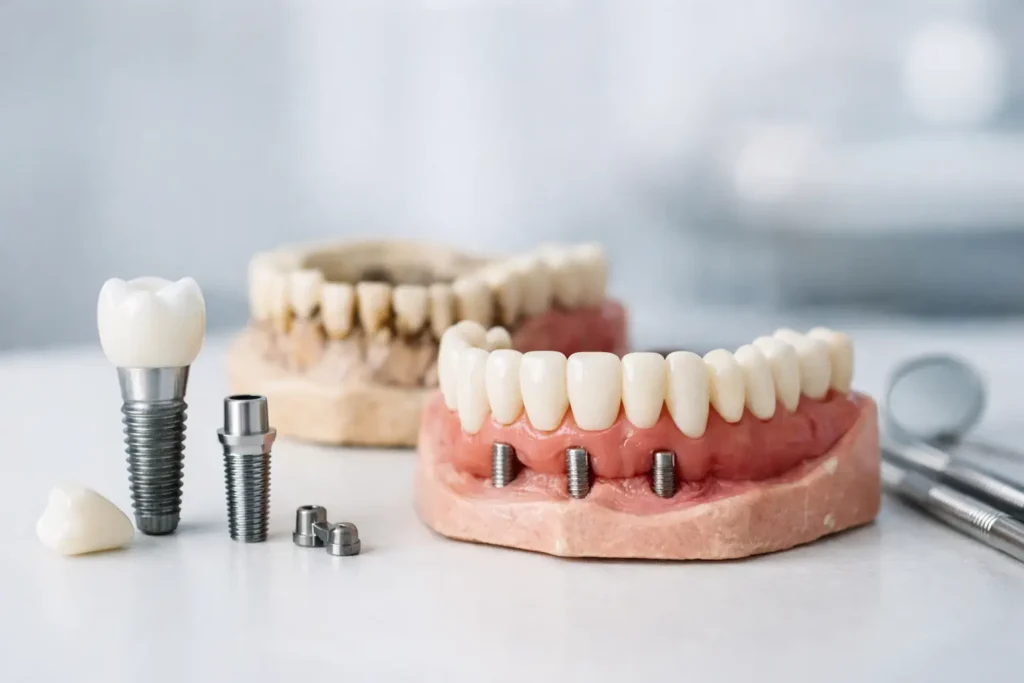
When patients ask, are full mouth implants worth it, they are usually not asking about implants in the abstract. They are asking whether fixed teeth are really worth the money, the travel, the surgery, and the hope. If you are tired of broken teeth, loose dentures, repeated dental bills, or hiding your smile, that question is very real – and the answer depends on what you are comparing them to.
For many patients, full mouth implants are worth it because they solve problems that removable dentures and failing dental work never fully fix. They can restore chewing strength, improve appearance, support facial structure, and give you the feeling of having stable teeth again. But they are still a major treatment, and they make the most sense when the diagnosis, surgical plan, materials, and long-term expectations are handled correctly.
Are full mouth implants worth it compared to dentures?
For the right patient, yes. Traditional dentures usually cost less upfront, but they often come with daily compromises. They can move while eating, rub against the gums, affect speech, and create constant frustration with adhesive, sore spots, and food limitations. Over time, they also do not stop jawbone loss.
Full mouth implants are different because they anchor a fixed prosthesis to the bone. That changes everything from stability to confidence. Most patients notice the difference immediately when they can bite into food without worrying that their teeth will shift. They also like not having to remove their teeth at night.
That said, dentures still make sense for some people. If budget is the only factor, or if someone is not a good surgical candidate, a denture may be the better immediate option. The real question is not just what costs less today. It is what gives you the best function, comfort, and predictability over the next 10 to 20 years.
What makes full mouth implants worth the investment?
The value comes from permanence, efficiency, and quality of life. Patients who choose full-arch implant treatment are usually done with patchwork dentistry. They do not want another cycle of extractions, temporary fixes, relines, root canals, and repairs. They want one clear plan.
A well-executed full mouth case can replace an entire upper arch, lower arch, or both using systems such as All-on-4, All-on-6, or All-on-X. In many cases, patients receive same-day temporary fixed teeth, which means they leave surgery with teeth attached rather than going months without them. That matters emotionally as much as physically.
The other part of value is precision. Digitally planned treatment, guided surgery, and high-quality prosthetic materials can reduce guesswork and improve fit, bite, and esthetics. When treatment is led by an implant-focused team instead of a general office trying to manage a complex full-mouth case, the odds of a smoother experience improve.
When full mouth implants may not be worth it
There are situations where full mouth implants are not the best answer, or not the best answer yet. If a patient has uncontrolled diabetes, heavy smoking habits, severe untreated periodontal infection, or medical conditions that interfere with healing, treatment may need to be delayed or modified. Implants need a healthy enough foundation.
They may also be less worth it if the plan is oversized for the problem. Not every patient with several bad teeth needs a full-arch solution. Sometimes saving strategic natural teeth is the smarter move. Sometimes a staged approach makes more financial and clinical sense.
And not all full mouth implant treatments are equal. A low price with poor planning is expensive in the end. If corners are cut on imaging, surgical guides, implant positioning, temporary design, or final materials, the patient can end up paying more in remakes, repairs, and frustration.
Cost matters, but so does what you are getting
This is where many patients get stuck. They see a large treatment quote in the US and assume full mouth implants are simply out of reach. Then they see lower pricing elsewhere and wonder what the catch is.
The right way to judge value is to compare scope, not just price. Ask what is included in the treatment plan. Does the quoted fee include extractions, temporary fixed teeth, sedation, imaging, guided surgery, follow-up care, and the final zirconia prosthesis? Or are those separate charges waiting to appear later?
For many patients traveling from the US or Canada, treatment in Mexico becomes worth it because the savings are substantial while the technology and materials remain high level. In a clinic built around implant dentistry, you can often access digital planning, CBCT-based evaluation, guided placement, and full-arch rehabilitation at a fraction of typical US pricing. That changes the math quickly.
Still, lower price alone should never be the reason to commit. You want specialist-led planning, a clear timeline, and a team that can review your CT scan before you travel. If the process feels vague, it probably is.
Are full mouth implants worth it for quality of life?
For many patients, this is the strongest argument. Full mouth implants are not only about teeth. They affect how you eat, speak, socialize, work, and age. Patients who have lived with failing teeth or unstable dentures often do not realize how much daily stress those problems create until they are gone.
Eating becomes easier. Photos become less awkward. Conversations feel more natural. Many patients say the biggest change is not cosmetic – it is the relief of not thinking about their teeth all day.
There is also the issue of bone support and facial appearance. Tooth loss can lead to collapse in the lower face over time. Implant-supported restorations help preserve bone better than removable dentures, which can contribute to a stronger facial profile and a more natural look.
That does not mean they feel exactly like natural teeth. They are prosthetic teeth, and there is an adjustment period. But for the right patient, they can feel dramatically closer to normal life than dentures do.
What determines whether your result is worth it?
Three things matter most: diagnosis, execution, and final prosthetic quality.
Diagnosis comes first. A proper full-mouth case starts with imaging, bone evaluation, bite analysis, medical review, and a realistic conversation about goals. If you grind heavily, have severe bone loss, or need extractions and infection control, the plan must account for that from day one.
Execution is the surgical and restorative phase. Implant placement angle, depth, and spacing are not small details. They affect strength, appearance, hygiene access, and long-term success. Guided surgery and digital treatment planning help create more predictable placement, especially in same-day fixed cases.
Then comes the prosthesis. A strong, well-designed final restoration matters just as much as the implants themselves. Many patients specifically want zirconia because it offers excellent durability and esthetics. That can be a major part of why treatment feels worth the investment over time.
A good candidate usually knows what they want
The patients who feel best about full mouth implants are often the ones who are clear about their priorities. They want fixed teeth. They want to stop spending on short-term repairs. They want a plan with real structure, not endless trial and error.
If that sounds like you, full mouth implants may be a very strong fit. If you are unsure whether to save some teeth, wear dentures, or move to a full-arch solution, that does not mean you are not ready. It just means your case needs a real evaluation rather than a sales pitch.
At Expertos Dentista E Implantes, that is exactly where the process should begin – with imaging, diagnosis, and a treatment plan built around your anatomy, health, budget, and timeline. If you already have a recent CT scan, send it for a free consultation and get a clear answer before making any travel or financial decisions.
The bottom line on whether full mouth implants are worth it
They are worth it when they replace ongoing failure with lasting function. They are worth it when you are choosing a fixed solution over years of compromise. They are worth it when the treatment is planned by the right team, with the right materials, for the right reasons.
If you are comparing them only to the cheapest option, the price may feel high. If you are comparing them to years of dental instability, repeated repairs, removable dentures, and lost confidence, the value becomes much easier to see.
The smartest next step is not guessing. It is getting your case evaluated properly, understanding exactly what is included, and choosing the option that gives you the best life after treatment – not just the lowest quote today.