
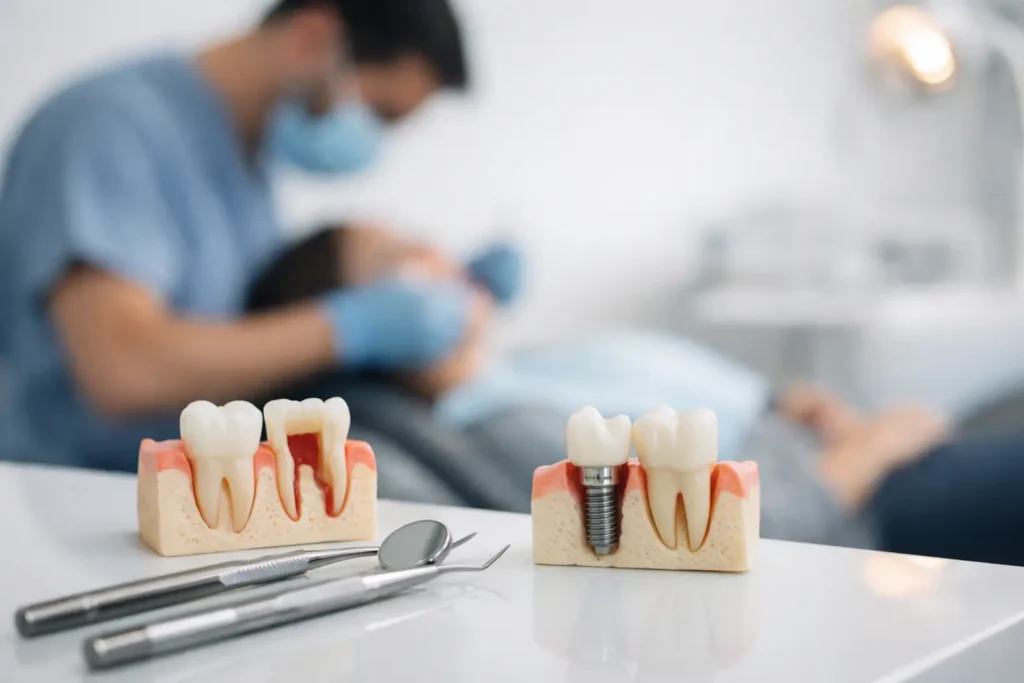
Losing a tooth is stressful. Being told you may need an extraction, a bone graft, months of healing, and then an implant later can make the process feel even heavier. That is why many patients ask about tooth extraction and implants same day. In the right case, it is possible to remove a failing tooth and place a dental implant in the same visit, cutting down treatment time and helping you move toward fixed teeth faster.
This approach is often called immediate implant placement. It sounds simple, but the decision is highly technical. Same-day treatment can be excellent when the anatomy, bone quality, gum condition, and bite all support it. It is not the right move for every patient, and that is exactly why specialist-led planning matters.
How tooth extraction and implants same day works
When a tooth is removed, the dentist evaluates the socket, surrounding bone, soft tissue, and any sign of infection or damage. If the site is stable enough, the implant can be placed immediately into the extraction area. In some cases, bone grafting is still done at the same time to fill small gaps around the implant and support long-term healing.
The goal is not just speed. The goal is to place the implant in the ideal position for strength, appearance, and future restoration. For front teeth, this becomes even more important because gum symmetry and smile esthetics are part of the result. For back teeth, chewing forces and implant stability become the bigger issue.
Same-day implant placement does not always mean same-day final teeth. Many patients receive a temporary tooth or temporary fixed bridge first, then return later for the final restoration once the implant has integrated with the bone. That distinction matters because it keeps expectations realistic while still delivering a faster path to function and confidence.
Who is a good candidate for tooth extraction and implants same day
The best candidates usually have enough healthy bone to stabilize the implant at the time of surgery. They also tend to have controlled gum health, no major untreated infection that has destroyed the socket, and a bite that allows the implant to heal without excessive pressure.
If the failing tooth is fractured, decayed below the gumline, or structurally hopeless but the surrounding bone is still strong, same-day placement may work very well. It can also be a smart option for patients who want to reduce the number of surgeries and shorten the overall timeline.
What can make you a weaker candidate? Severe bone loss, active periodontal disease, smoking, uncontrolled diabetes, heavy grinding, or an infection that has compromised the area too much. None of these automatically rule treatment out, but they may shift the recommendation toward extraction first and implant placement later.
This is where a CT scan changes everything. A two-dimensional X-ray can miss key details. A 3D scan allows the surgeon to measure bone volume, identify anatomical limits, assess density, and plan the angulation of the implant before treatment begins. That level of planning is especially important for patients traveling for care and trying to maximize each visit.
The biggest benefits of same-day implant placement
The most obvious advantage is time. Instead of extracting a tooth, waiting months, and then scheduling implant surgery later, treatment can move forward in one surgical phase. That is a major benefit for busy professionals, retirees managing travel, and patients who simply do not want to stay in treatment any longer than necessary.
There is also a biological advantage in some cases. Placing the implant soon after extraction may help preserve the natural bone contour, especially when done with careful technique and digital planning. That can support a better esthetic result and reduce collapse of the ridge.
Another benefit is emotional. Patients dealing with broken teeth, failing bridges, or visible gaps are often exhausted by the condition of their mouth before they ever start treatment. A faster path to a fixed solution matters. It reduces the period of uncertainty and helps restore confidence sooner.
For full-arch patients, the impact can be even greater. If multiple failing teeth need to be removed and the bone allows, extractions, implant placement, and a temporary fixed prosthesis can often be coordinated in a much shorter timeline than many people expect.
The trade-offs and risks you should understand
Faster does not mean easier. Immediate implants demand precision. The implant must achieve strong primary stability on the day it is placed. If that stability is not there, forcing the case just to stay on a same-day schedule is a mistake.
There is also a higher planning burden in esthetic areas. With front teeth, even a small error in position can affect the final look of the gumline or crown. That is why guided surgery, digital imaging, and restorative planning should drive the case from the start.
Infection is another concern people ask about. A localized infection does not always prevent immediate implant placement, but it depends on how much damage is present and whether the area can be thoroughly cleaned and stabilized. This is a clinical judgment call, not a marketing promise.
Healing can be more delicate, too. If you receive a temporary tooth, it may need to be kept out of heavy biting forces for a period of time. Patients who ignore diet instructions or put too much pressure on the area can compromise the outcome.
What recovery usually looks like
Most patients are surprised that the procedure is more manageable than they expected. You can typically expect some swelling, tenderness, and minor bleeding in the first few days. Pain is usually controlled with prescribed or recommended medication, and many patients return to light daily activity quickly.
The bigger part of recovery is not pain. It is discipline. You may need a soft-food diet, gentle oral hygiene around the site, and close follow-up instructions depending on whether the implant was restored immediately with a temporary tooth.
Osseointegration, which is the biological bonding of implant to bone, still takes time. Even when the implant goes in the same day as the extraction, the body needs months to complete the healing process. That is why the final crown or final full-arch prosthesis is often delivered later, after the implant has proven stable.
Same-day single implants vs full-mouth cases
A single tooth case and a full-mouth rehabilitation are very different decisions. With one tooth, the focus is often on preserving bone and matching the appearance of the natural smile. With full-arch cases, the surgeon is thinking about implant distribution, bite force, bone availability, and how to deliver a fixed temporary bridge safely.
For patients with many failing teeth, the phrase same day often refers to same-day extractions and same-day temporary fixed teeth supported by implants. That can be life changing, but it is not automatic. The treatment plan depends on bone volume, systemic health, and whether the case is best suited to All-on-4, All-on-6, or another implant design.
This is one reason many patients choose specialist centers rather than general offices handling implants only occasionally. Advanced cases need more than a good intention. They need digital planning, surgical experience, prosthetic coordination, and a team that understands how to manage the timeline from scan to final teeth.
Cost matters, but value matters more
Many patients start this search because implant treatment in the United States can feel out of reach. Same-day treatment can reduce time away from work and cut down the number of surgical phases, but the real question is whether the case is being done correctly.
If you are comparing options, ask what is included in the process. Does the evaluation involve a CT scan review? Is the surgery guided? Who designs the temporary and final restoration? What happens if a bone graft is needed? Is the treatment plan built around long-term success or simply around giving you the fastest quote?
Patients traveling to places such as Cabo San Lucas often do so for a practical reason: they want specialist-level implant care, a faster turnaround, and meaningful savings compared with U.S. pricing. That combination can be compelling when the clinic is set up for complex implant cases and cross-border coordination.
What to ask before you commit
Before you say yes to tooth extraction and implants same day, ask whether you are actually a good candidate and why. You should understand if the site has enough bone, whether immediate temporization is realistic, and what the backup plan is if the implant cannot be placed safely after extraction.
You should also ask who is planning the case. Implant success is not only about placing a titanium post in bone. It is about creating the right foundation for the final tooth or final bridge. That requires surgical and restorative planning together, not as separate steps.
If you already have a CT scan, send it for review. A serious implant team can often tell you very quickly whether same-day treatment is realistic, whether additional procedures may be needed, and how many visits your case may require.
When done for the right patient, same-day extraction and implant treatment can replace a long, frustrating process with a clear path forward – and that kind of momentum matters when you are ready to stop patching problems and start rebuilding your smile.