
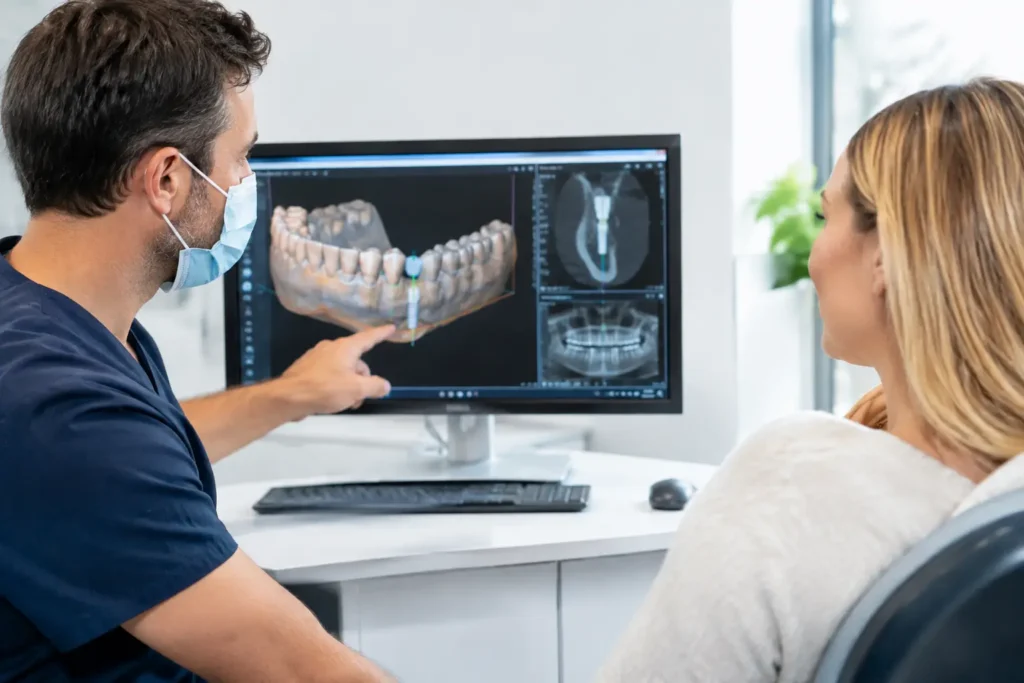
A full-arch implant case should not begin with guesswork. It should begin with a clear digital map of your bone, bite, gum line, facial support, and final tooth position. That is how digital implant planning helps create a safer, more predictable path to fixed teeth, especially for patients considering All-on-4, All-on-6, or a complete smile restoration.
For patients traveling from the United States or Canada, planning matters even more. You want to know what treatment involves before you arrange flights, reserve accommodations, or commit to surgery. A digitally planned case gives the clinical team a detailed blueprint before treatment day, helping turn a complex rehabilitation into an organized process with defined goals.
How Digital Implant Planning Helps Full-Arch Patients
Digital planning combines detailed diagnostic records into one treatment plan. These records commonly include a 3D CBCT scan, digital impressions from an intraoral scanner, clinical photographs, and bite records. Instead of relying on a two-dimensional X-ray or a rough visual estimate, the implant specialist can assess the jaw in three dimensions.
This is particularly valuable when teeth are failing, bone has shrunk after years of tooth loss, or existing crowns and bridges have changed the bite. The doctor can study available bone volume, identify the position of nerves and sinus cavities, and determine where implants can be placed to support a fixed bridge.
The goal is not simply to place implants. The goal is to place them in positions that support a strong, functional, natural-looking final restoration.
It starts with the final teeth, not just the implants
A major advantage of digital planning is prosthetically driven treatment. In plain language, the team plans the new teeth first, then plans implant positions that can properly support those teeth.
This matters because implants that are technically placed in bone may still be poorly positioned for the final bridge. If implant angles, spacing, or depth do not support the desired tooth design, the restoration can become harder to clean, less attractive, or more difficult to repair over time.
With a digital smile and bite design, your provider can evaluate tooth length, smile line, lip support, visible gum tissue, and the relationship between your upper and lower teeth. For a patient who has worn dentures or lived with collapsing teeth for years, this step can be transformative. The new teeth are planned to restore more than chewing. They are planned to restore facial balance and confidence.
Better Precision During Guided Implant Surgery
Once the implant plan is approved, it can be transferred to a surgical guide. This custom guide fits over the teeth, gums, or bone and directs the surgical instruments according to the digital plan.
Guided surgery can help the specialist place implants at the planned angle, depth, and location. In full-arch treatment, small changes in implant position can affect the fit and strength of the entire bridge. Precision supports better implant distribution, more efficient use of available bone, and a foundation designed for your temporary fixed teeth and future zirconia restoration.
Guided surgery is not a substitute for an experienced implant surgeon. The guide is a tool, and the clinician must still make decisions based on real conditions during treatment. Bone quality, infection, tissue health, and anatomy can differ from what scans suggest. However, when advanced imaging, careful planning, and specialist judgment work together, the process becomes far more controlled.
It can reduce unnecessary surprises
No ethical clinic should promise that every case will be simple. Some patients need extractions, bone grafting, sinus management, periodontal treatment, or a staged approach before final implants can be placed. Others may not be candidates for immediate fixed teeth on the same day.
Digital planning identifies many of these issues early. A CBCT scan can reveal hidden infection, limited bone, retained roots, or sinus anatomy that would not be clear in a standard exam alone. This gives you a more realistic understanding of your treatment timeline and investment before you travel.
For international patients, early clarity is a major advantage. At Expertos Dentista E Implantes, a remote CT scan evaluation can help determine whether a full-arch approach may be appropriate before your visit to Cabo San Lucas or Tijuana. Your final diagnosis still requires an in-person examination, but advance planning can prevent costly and frustrating surprises.
Faster Treatment Without Rushing the Medicine
Patients often ask whether digital dentistry is faster. In many cases, yes. The workflow can reduce manual steps, improve communication between the surgical and restorative teams, and allow temporary teeth to be prepared more efficiently.
For qualified All-on-X patients, this can support same-day temporary fixed teeth after implant surgery. You leave with a stable temporary bridge rather than a removable denture, then return for the final zirconia teeth once healing and implant integration are complete.
Speed has limits. A same-day temporary is not the same as your permanent final bridge, and it is not appropriate for every patient. Healing time is still part of successful implant treatment. The temporary restoration protects the treatment plan while you adapt, heal, and follow a soft-food diet during the early recovery period.
Digital planning helps make that faster timeline possible without treating speed as the only outcome. The better question is not, “How quickly can I get teeth?” It is, “Can I get stable teeth on a timeline that protects my long-term result?”
A Better Fit for Your Bite and Daily Comfort
Implants do not move like natural teeth, so bite design is critical. If a full-arch bridge has uneven pressure, excessive force, or poorly balanced contact points, it can create discomfort and place unnecessary stress on implants, screws, and the prosthesis.
Digital bite records and virtual design tools help the clinical team evaluate how your teeth meet when you close, chew, and move your jaw. This is especially helpful for patients with worn teeth, jaw tension, broken crowns, or a history of repeated dental repairs.
A well-planned bite can improve chewing efficiency and protect the long-term investment in your restoration. It also helps the lab create a bridge with the right contours for speech, lip support, hygiene access, and facial appearance.
There are trade-offs. A very aesthetic tooth design may need adjustment if it creates too much force or makes cleaning difficult. Longer-looking teeth may be possible in some cases, while others require a more conservative design because of bone loss or lip position. A specialist-led planning process puts function first, then builds aesthetics around what your anatomy can support safely.
Why Digital Records Matter for Patients Who Travel
Cross-border implant treatment should feel organized, not uncertain. Digital records allow the care team to review information before your arrival, coordinate surgical and restorative stages, and communicate your case clearly across locations when needed.
They also make future care easier. If you need an adjustment, replacement screw, hygiene visit, or additional restorative work later, your digital scans and treatment records provide a useful reference. This is particularly valuable for full-mouth rehabilitation, where each component must work with the rest of the system.
Digital planning does not mean treatment is automated. It means your treatment is designed before it begins. The most successful cases still rely on careful diagnosis, high-quality implant materials, precise surgical execution, good healing, and a patient who follows aftercare instructions.
What to Send for a Digital Implant Evaluation
If you are researching fixed teeth and comparing treatment options, a recent CBCT scan is often the most useful first step. It gives the implant specialist the information needed to evaluate bone, anatomy, and potential implant positions. Clear photos of your teeth and smile, along with details about dentures, failing bridges, pain, medical conditions, and previous dental work, can further improve the preliminary assessment.
A free consultation can help you understand whether All-on-4, All-on-6, individual implants, or another restorative path fits your situation. The right plan is not always the one with the most implants. It is the one that delivers stable support, healthy tissue, a functional bite, and teeth you can feel confident wearing every day.
Send your CT scan today and ask for a specialist review before making travel plans. A detailed digital plan cannot replace an in-person exam, but it can give you the clarity to move forward with confidence.