
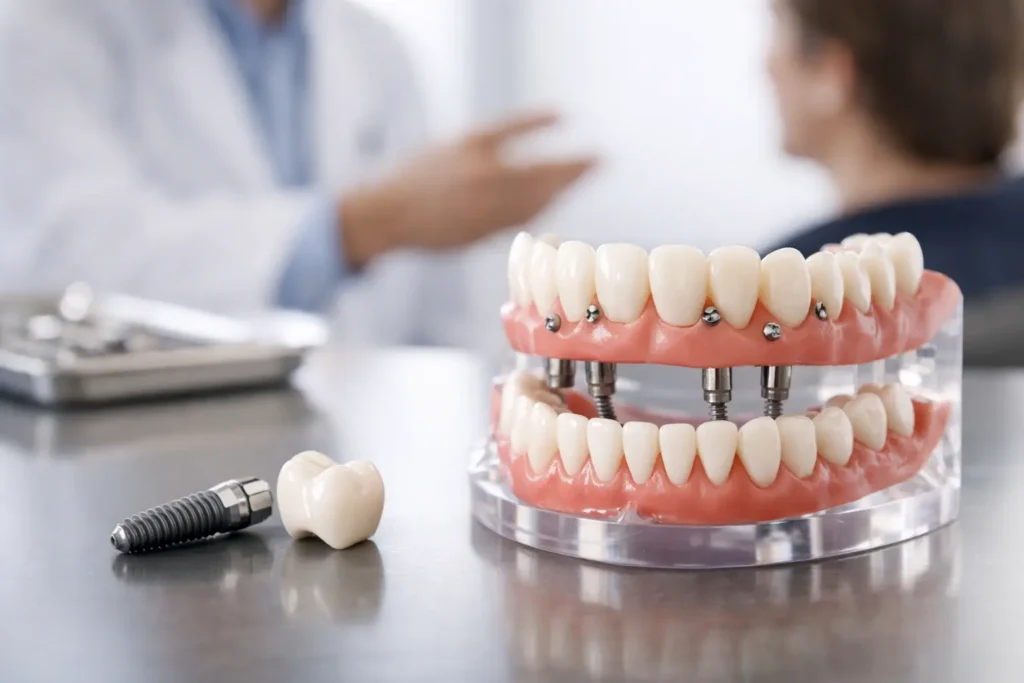
Sticker shock usually hits fast with full-mouth implants. Patients ask one version of the same question every day: what is the all on 4 upper lower cost if you need both arches done, and why do quotes vary so much? The short answer is that total price depends on more than the implants themselves. It reflects your bone condition, the type of fixed teeth you choose, whether extractions are needed, and where the treatment is performed.
If you are comparing clinics in the U.S., Canada, and Mexico, you are not just comparing price tags. You are comparing surgical planning, materials, lab quality, timeline, and how predictable the final result will be. That matters because a low quote can become expensive very quickly if it leaves out essential parts of treatment.
All on 4 upper lower cost in real numbers
For both the upper and lower arches, the all on 4 upper lower cost in the United States often lands anywhere from about $40,000 to $70,000 or more. In some metropolitan markets, premium cases with zirconia restorations, sedation, extractions, bone reduction, and immediate fixed temporaries can exceed that range.
In Mexico, the same type of double-arch treatment is commonly far lower, often around $16,000 to $30,000 depending on the case design and final prosthetic materials. That gap is why so many patients start looking outside the U.S. system after their first consultation. Saving up to 70% vs USA is realistic in the right case, but only if you are comparing equivalent treatment standards.
That last point is critical. An acrylic temporary bridge is not the same as a final monolithic zirconia bridge. A quote that includes guided surgery, same-day fixed teeth, CT-based planning, and specialist-led surgery is not the same as a basic implant package built around the lowest possible fee.
Why the price changes so much from patient to patient
A true all-on-4 case is never one-size-fits-all. Two patients may both need full upper and lower restoration, but their costs can still be very different.
The first big factor is extractions. If you still have failing teeth, the surgeon may need to remove them before placing implants. Some patients also need infection control, deep cleaning, or site preparation before the implants can be placed safely.
The second factor is bone quality. The upper jaw is often more complex than the lower because the bone is usually softer, and anatomy near the sinus can create limitations. In many upper-arch cases, the surgeon may still be able to place tilted posterior implants to avoid more invasive grafting, but that depends on the scan. If the bone is too compromised, your treatment may shift from a straightforward All-on-4 plan to All-on-6 or another All-on-X design.
Material choice also changes the final number. A lower-cost option may use an acrylic or hybrid prosthesis, while a more premium final restoration may be zirconia. Zirconia costs more, but many patients prefer it for durability, stain resistance, esthetics, and long-term feel. If your goal is a permanent full-mouth solution that looks more natural and holds up better over time, the restoration material matters as much as the surgery.
What should be included in the quote
When patients compare clinics, this is where mistakes happen. They focus on the headline number and not on what the fee actually covers.
A meaningful full-arch quote should clearly explain whether it includes the consultation, 3D CT scan review, digital treatment planning, extractions, implant placement, temporary fixed teeth, follow-up visits, and the final prosthesis. You also want to know whether anesthesia or sedation is included, and whether there are additional charges for bone reduction, sinus-related anatomy challenges, or replacement parts.
If a clinic gives you a very low number without asking for your CT scan, that is not precision. It is an estimate built on assumptions. Specialist-led planning starts with diagnostics, not sales language.
Upper vs lower arch costs are not always equal
Many patients assume the upper and lower arch cost the same. Sometimes they do, but often they do not.
The upper arch can be more technique-sensitive because of anatomy, smile line, lip support, and bone density. Esthetics are also less forgiving on the upper. If the final teeth show heavily when you smile, the design work becomes more important. The lower arch may be simpler in some cases, but not always. Severe bone loss, bite issues, or years of wear can complicate lower treatment too.
This is why a combined upper-and-lower quote should never be treated like a flat commodity number. A proper plan looks at both arches together, including bite balance, facial support, and how the final prostheses will function as a system.
Why Mexico is lower without being lower quality
Patients are often comfortable with the savings. What they want reassurance on is quality.
The reason treatment can cost less in Mexico is not that implants suddenly become cheap or that standards disappear. The difference is usually overhead, operating costs, lab expenses, and the business model. A specialist practice focused on international patients can deliver advanced implant treatment at far lower cost than a U.S. office carrying higher facility and insurance-related expenses.
That said, not every clinic offering low prices delivers the same level of care. You should look for digital planning, guided surgery when indicated, high-quality implant systems, clear temporary-to-final workflow, and a team that understands full-mouth rehabilitation instead of only straightforward implant placement.
For patients traveling to Cabo San Lucas, the added advantage is efficiency. Many full-arch cases can be organized around a compressed schedule, with remote case review before travel and same-day temporary fixed teeth when clinically appropriate. That reduces both downtime and uncertainty.
The cheapest quote is rarely the best value
There is a difference between affordable treatment and bargain treatment. If a clinic cuts corners on diagnostics, surgical planning, prosthetic design, or final materials, the consequences show up later as breakage, poor bite, speech issues, gum irritation, or an unnatural look.
A strong value case balances cost with long-term success. You want stable implants, a prosthesis designed for your face and bite, and a process that is predictable from surgery through the final restoration. In full-mouth treatment, correction costs are often higher than doing it right the first time.
How to estimate your own case more accurately
The fastest way to move from guesswork to a real number is to send your CT scan or panoramic imaging for review. A specialist can often identify whether you are likely a straightforward All-on-4 candidate or whether your case needs more support, more implants, or a staged approach.
Photos help too. Smile photos, close-ups, and a short health history can clarify what is happening with your bite, remaining teeth, and esthetic goals. This makes a major difference because many cost variations are not visible from a basic phone conversation.
If you are still deciding, ask clinics the same direct questions. What is included in the upper and lower quote? Are temporary fixed teeth included? What is the final prosthesis made of? How many trips are required? Is the treatment planned by an implant specialist? Clear answers usually tell you more than a polished ad ever will.
Is all-on-4 for both arches worth it?
For the right patient, yes. If you are tired of failing teeth, repeated dental repairs, loose dentures, or avoiding certain foods, fixed full-arch implants can be life-changing. The improvement is not only cosmetic. It is functional, social, and often emotional.
Still, it depends on your goals and your oral condition. Some patients are better served by All-on-6, some need preliminary care first, and some should compare fixed implant options against removable solutions based on budget and health factors. Good treatment planning is not about forcing everyone into the same package. It is about matching the solution to the case.
At Expertos Dentista E Implantes, that evaluation starts with diagnostics and a realistic conversation, not pressure. If you want a precise answer on all on 4 upper lower cost, the next step is simple: get your scan reviewed, confirm what is included, and compare quality as carefully as price. The right full-mouth plan should save money, but it should also give you back certainty every time you smile, speak, and eat.