
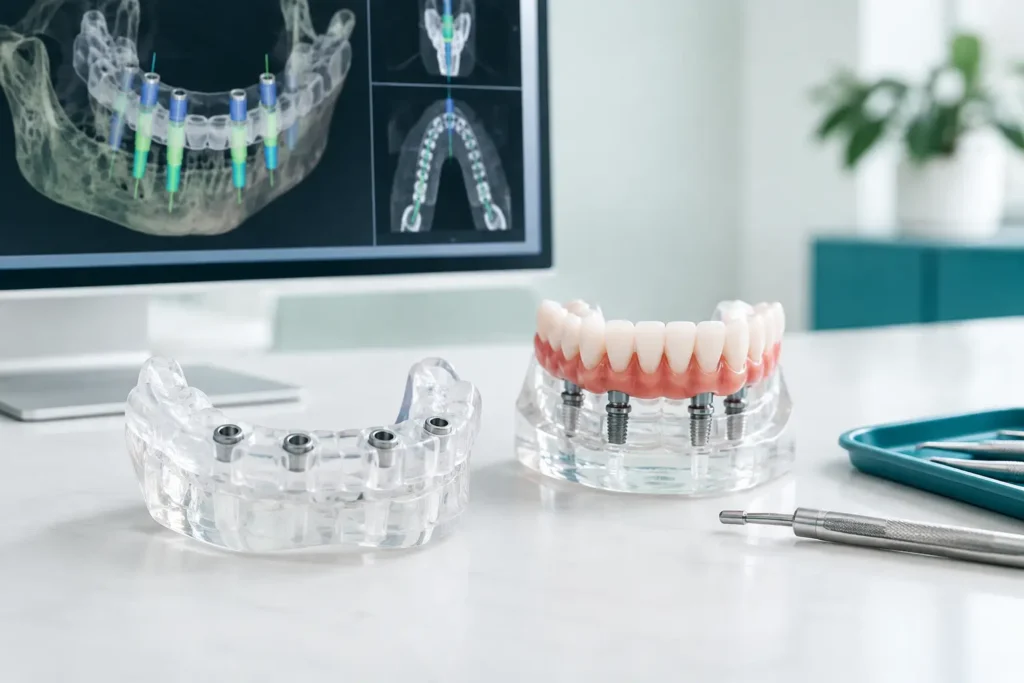
A guided implant surgery review should answer more than one question: “Will a surgical guide be used?” For someone replacing a failing dentition or removable dentures, the more useful question is how digital planning supports the entire treatment plan – from implant positions and provisional teeth to healing, final zirconia options, and follow-up after returning home.
For patients traveling to Cabo San Lucas from California, Washington, Metro Vancouver, Calgary, or elsewhere, guided surgery can provide an organized way to plan full-arch care before travel. It is not a shortcut around diagnosis, healing, or maintenance. Its value depends on careful records, clinical judgment, bone and gum conditions, bite design, and a plan that is tailored to you.
What Guided Implant Surgery Actually Means
Guided implant surgery uses a digital surgical guide, sometimes called a surgical template, to help transfer a virtual implant plan to the mouth. The planning process typically begins with a CT scan, also known as a cone beam CT or CBCT. This three-dimensional scan helps the clinician assess available bone, sinus and nerve locations, tooth roots when present, and other anatomical details that cannot be evaluated fully with a standard X-ray.
The CT information can be combined with digital impressions from an intraoral scanner. For full-arch cases, photogrammetry may also be used. Photogrammetry is a digital method for recording the precise position of implants, which can be particularly valuable when designing a final full-arch prosthesis.
A guide does not replace the clinician. It is a planning and surgical aid that helps the team follow a planned position, angle, and depth when conditions allow. During surgery, the plan may need adjustment if the actual clinical situation differs from the scan, if bone quality is different than expected, or if safety requires a different approach. That is one reason a guided implant surgery review should focus on the quality of the whole workflow, not simply whether a guide is advertised.
Guided Implant Surgery Review: What to Ask Before You Travel
The most helpful review is one you conduct before committing to dates or flights. Ask how your CT scan will be reviewed, whether it can be shared securely before your visit, and what records are needed for a preliminary assessment. A clinical evaluation remains necessary to determine suitability and confirm the final plan.
You should also ask whether the proposed treatment is All-on-4, All-on-6, or another All-on-X approach. These terms describe full-arch restorations supported by a planned number of implants. They are not interchangeable packages. Some patients may be candidates for four implants, while others may benefit from six or require a different plan due to anatomy, bite forces, bone conditions, or restorative goals.
A written treatment plan should clearly explain the recommended option, alternatives, expected procedures, materials, fees, number of visits, and follow-up considerations. If extractions, periodontal treatment, grafting, sedation, or other services may be relevant, ask whether they are included, excluded, or dependent on the in-person examination. Clarity before travel is more useful than a broad promise of speed.
Questions about the provisional teeth
Many full-arch plans include a fixed provisional restoration after surgery when clinical conditions make it appropriate. Provisional teeth are temporary teeth designed to support appearance and function during healing. They are not the final prosthesis, and not every patient should expect the same type of immediate restoration.
Ask what the provisional is made from, how it will be cared for, what eating restrictions may apply, and what would change the plan. The final prosthesis is usually made after healing and records have been taken to confirm bite, fit, appearance, and implant positions. For some patients, a zirconia final restoration may be clinically appropriate. Zirconia is a strong ceramic material often considered for final full-arch teeth, but material selection should reflect your bite, esthetic preferences, hygiene needs, and clinical situation.
Why Digital Planning Matters for All-on-4 and All-on-6
Full-arch implant care is not just implant placement. The implants must support a restoration that fits the smile, lip support, speech, bite, facial proportions, and daily hygiene needs. Planning backward from the intended teeth can help the team decide where implants may offer the best restorative support.
For an All-on-4 or All-on-6 case, digital planning can help coordinate implant placement with the position of the planned teeth. It can also help identify limitations early. For example, a scan may indicate that a patient needs further evaluation before a final recommendation can be made. That is useful information, even when it changes an initial expectation.
Digital tools also improve communication. Patients can better understand why one plan is recommended over another when the clinician explains the relationship between anatomy, implant support, and the future prosthesis. The goal is not to make every case look identical. It is to make treatment decisions more visible, more deliberate, and easier to discuss.
The Normal Two-Trip Full-Arch Process
For many traveling patients, full-arch treatment normally involves two trips. The first visit may include an in-person examination, imaging review, extractions if indicated, implant surgery, and provisional fixed teeth when clinically appropriate. The timing and sequence vary by case.
Healing comes next. During this period, implants need time to integrate with the bone, and the gums and bite may change. Your dentist may coordinate remote check-ins or recommend that you see a local dental professional for specific follow-up needs. Before leaving Cabo San Lucas, ask who to contact if you have a concern once you are home and what documentation you should keep.
The second visit is generally focused on the final restoration. This stage may involve new digital scans, photogrammetry, bite records, try-ins, and final delivery of the prosthesis. A final zirconia bridge may be an option for some patients, but the final material and design should be confirmed in the written plan rather than assumed from a general price listing.
Patients considering travel from Los Angeles, Seattle, Vancouver, or Calgary should leave flexibility in their schedules. Avoid booking tight connections immediately after appointments, and plan for the possibility that clinical needs may adjust the timing. Bring a current medication list, relevant medical information, and a way to contact your regular dentist or physician if coordination is needed.
Cost: Read Per-Arch Pricing Carefully
Cost is a reasonable part of any guided implant surgery review, but comparisons are only meaningful when the scope is clear. At Expertos Dentista e Implantes, the published guide for All-on-4 and All-on-6 treatment is USD $13,000 to $14,000 per arch for All-on-4 and USD $14,000 to $15,000 per arch for All-on-6. That range is a guide, not a quote, and it does not represent treatment for both arches.
A personalized written quote should specify what is included in your recommended plan: the surgical phase, implants, provisional restoration if appropriate, final restoration, materials, imaging, laboratory work, and follow-up. It should also identify items that may depend on the clinical evaluation. If you are comparing clinics, compare the treatment stages and materials, not only the headline number.
For single-tooth replacement, the clinic’s published single implant package starts at USD $1,899 and includes the implant, Ti-base, and zirconia crown. As with full-arch care, an individual assessment and written quote are needed to confirm the appropriate treatment and fees.
Maintenance Begins After the Final Teeth Are Placed
Fixed implant teeth still require consistent care. Food debris and plaque can collect around a full-arch prosthesis, so daily home hygiene and professional maintenance appointments matter. Your team should explain how to clean under and around the bridge, what tools may be useful, and how often your final restoration should be reviewed.
A well-designed restoration should support access for cleaning, but it does not eliminate maintenance. Ask whether the prosthesis may need periodic removal for professional assessment, how repairs are handled, and what records you should share with a local dentist after returning to the United States or Canada.
If you are considering guided full-arch treatment in Los Cabos, send your CT scan securely and request a personalized treatment plan. A careful evaluation can clarify whether guided surgery, All-on-4, All-on-6, a zirconia final restoration, or another approach fits your clinical needs and travel plans.