
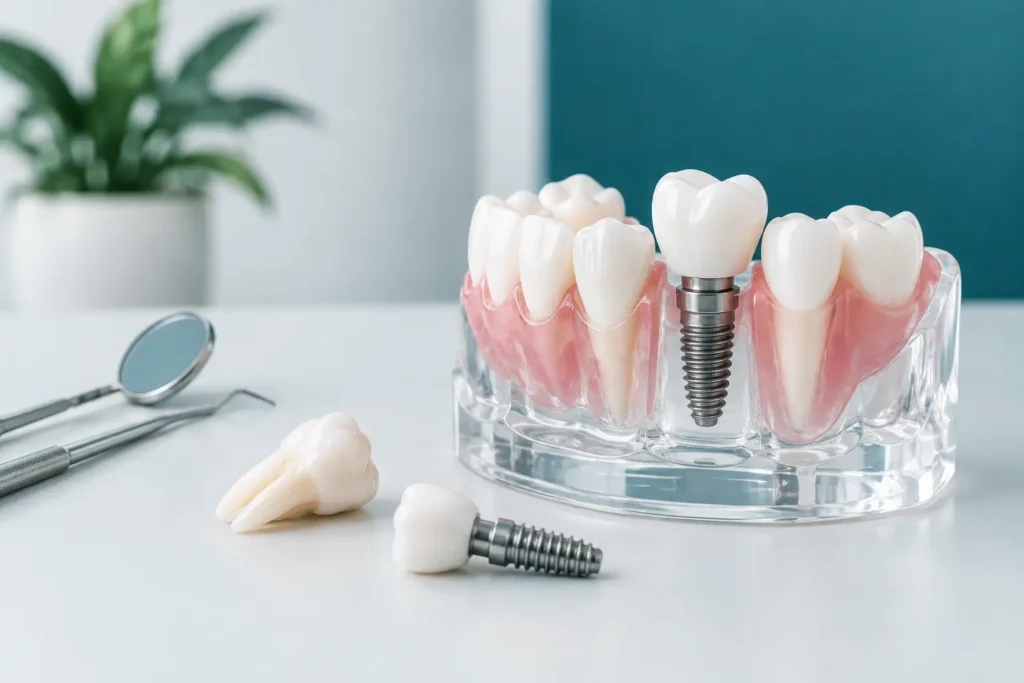
A failing tooth does not always mean you must wait months before beginning implant treatment. Can extractions and implants combine in one coordinated plan? Often, yes. In selected cases, a dentist may remove a tooth and place an implant during the same surgical appointment. But this is not an automatic shortcut, and it is not the right approach for every tooth, jaw, or full-arch case.
For patients considering care in Cabo San Lucas, the useful question is less about speed and more about whether the sequence protects the bone, supports long-term function, and allows a well-planned final restoration. That decision starts with a clinical exam and a CT scan, also called a cone beam CT or CBCT, which creates a 3D view of the jaw.
When Can Extractions and Implants Combine?
An implant placed immediately after a tooth is removed is called an immediate implant. The clinician removes the tooth carefully, cleans the socket, evaluates the surrounding bone and gums, and decides whether the implant can be positioned with good initial stability.
Immediate placement can be considered when there is enough healthy bone in the right location, the implant can be firmly stabilized, and infection or damage around the tooth can be managed appropriately. The condition of the gum tissue matters as well. It influences how natural-looking and easy to clean the final crown or bridge may be.
The phrase “same-day implant” can be misleading because it describes timing, not a guaranteed treatment result. Placing an implant on the day of extraction does not mean that a permanent crown or final full-arch bridge will be placed that day. Bone needs time to heal and integrate with the implant, a process called osseointegration.
When a staged approach may be safer
Sometimes removing the tooth is only the first stage. If a socket has significant infection, insufficient bone, a thin outer bone wall, or an anatomy that does not allow ideal implant positioning, healing first may offer a more predictable path. Bone grafting or gum treatment may also be recommended before or alongside implant planning.
This is not a setback or a lesser treatment. The goal is to create a stable foundation for the implant and the restoration it will support. A personalized treatment plan should explain why immediate placement is or is not being recommended, along with the expected visits and alternatives.
Extractions and Implants in Full-Arch Treatment
The decision becomes more complex when several teeth are failing or when a removable denture is no longer working well. Full-arch rehabilitation replaces all teeth in one upper or lower arch with a fixed bridge supported by implants. Options may include All-on-4, All-on-6, or an individualized All-on-X plan, referring to the number and placement of implants used to support the arch.
In many full-arch cases, remaining teeth are extracted and implants are placed in the same surgical phase. Digital planning is especially valuable here. A CT scan helps evaluate bone volume, sinus position in the upper jaw, nerve pathways in the lower jaw, and the angle needed for each implant. Intraoral scanning records the mouth digitally, while photogrammetry may be used to capture highly precise implant positions for the final bridge.
Guided-surgery planning can help translate that digital plan into treatment. It does not replace clinical judgment, but it can support accurate implant placement and clearer restorative planning.
A provisional fixed bridge may be possible after surgery when clinical conditions support it. “Provisional” means temporary: it is designed to help with appearance and function during healing, not to be the final prosthesis. Whether a temporary fixed bridge is appropriate depends on implant stability, bite forces, bone quality, healing considerations, and the overall plan. Some patients may need a different temporary solution.
The final bridge is planned after healing. Zirconia is one material that may be recommended for final full-arch restorations because it is strong and can be designed for a natural appearance. It is not automatically the best choice for every case. Bite, available space, opposing teeth, hygiene needs, and aesthetic goals all influence material selection.
What Happens Before the Extraction Appointment?
Good treatment begins before travel, not after you arrive. If you already have a recent CT scan, ask the clinic how to share it securely for review. Existing dental records, panoramic X-rays, photographs, and a description of your symptoms or current denture can also help the team understand the starting point.
A remote review can help identify likely options, but it does not replace an in-person clinical evaluation. The final decision may change after examination of the gums, bite, tooth mobility, medical history, and 3D imaging quality.
Your written treatment plan should clearly distinguish what is planned for one arch from treatment for both arches. It should describe the proposed extractions, implant count, provisional restoration if appropriate, final restoration, materials, number of visits, estimated timing, fees, and follow-up expectations. This clarity matters when comparing options across clinics.
At Expertos Dentista e Implantes, full-arch planning is individualized rather than based on a one-size-fits-all promise. The published All-on-4 and All-on-6 guide is USD 13,000 to USD 14,000 per arch for All-on-4 and USD 14,000 to USD 15,000 per arch for All-on-6, not for both arches. Actual treatment needs and fees require a personalized written quote. For a single missing tooth, a single implant package starts at USD 1,899 and includes the implant, Ti-base, and zirconia crown, subject to individual evaluation.
Planning Two Trips to Los Cabos
Full-arch treatment normally involves two trips. The first visit commonly includes the in-person evaluation, any planned extractions, implant surgery, and a provisional fixed restoration only when clinically appropriate. The second visit follows healing and focuses on the final prosthesis.
The interval between visits is determined by your case, not a generic calendar promise. Bone healing, implant integration, gum health, bite adjustment, and the design of the final bridge all affect timing. Patients traveling from Greater Los Angeles, Seattle, Metro Vancouver, Calgary, or elsewhere in the United States and Canada should leave flexibility in their travel plans rather than schedule around an assumed fixed recovery timeline.
Before booking travel, ask practical questions: How many days should you expect to remain locally for the first visit? What records should be sent in advance? What is included in the written quote? How will questions be handled once you return home? What maintenance appointments will be needed, either locally or with your regular dentist?
It is also wise to share relevant medical information early, including medications, prior implant treatment, smoking or nicotine use, diabetes management, blood thinners, and history of periodontal disease. These factors do not automatically rule out treatment, but they can influence surgical planning and healing recommendations.
Aftercare Is Part of the Implant Plan
Combining extractions and implants does not end with surgery. The healing phase calls for careful home care and follow-up. Your clinical team will give instructions tailored to the procedure, which may include dietary guidance, hygiene methods around the surgical area, and signs that should prompt contact with the clinic.
Once the final restoration is in place, implants still need regular maintenance. Daily cleaning around the bridge, professional hygiene visits, and periodic evaluation help protect the gums and supporting bone. A fixed full-arch bridge does not develop cavities, but the tissues around implants can still become inflamed if plaque accumulates.
The right sequence is the one that gives your implants, gums, and final teeth the best conditions to succeed. If you are considering extractions with single implants or a full-arch solution in Los Cabos, request a personalized clinical evaluation and written treatment plan. A CT-based review can clarify whether immediate placement, a staged approach, or another option fits your needs.