
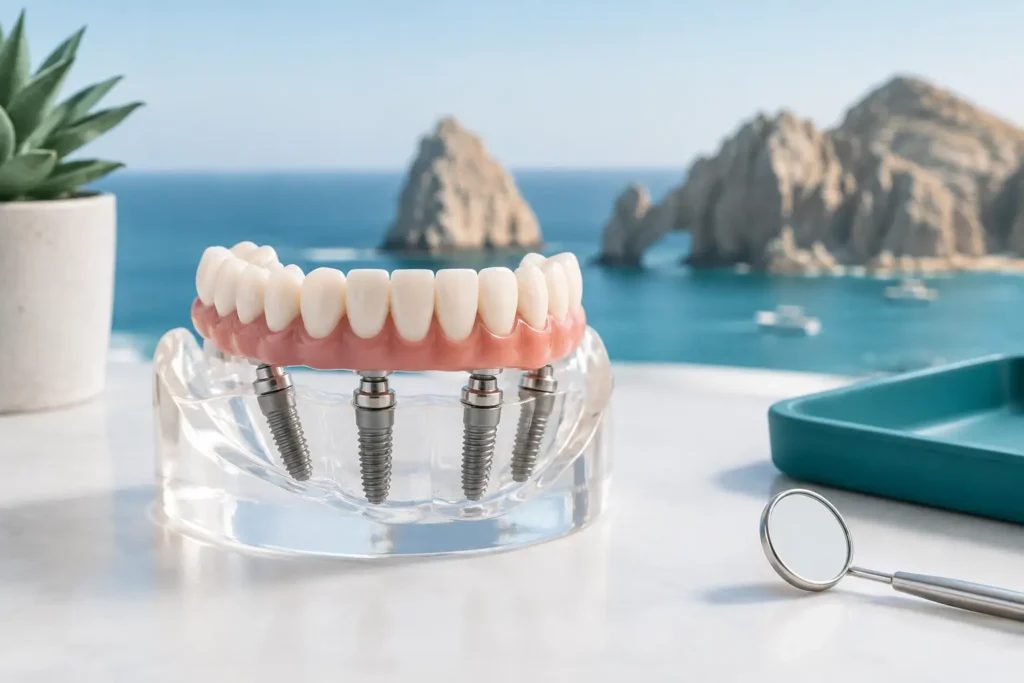
Replacing an entire upper or lower arch is a major clinical and financial decision, especially when travel is involved. When researching all on 4 cost Cabo San Lucas, the most useful number is not simply the starting price. You need to know whether the fee is per arch, which restoration material is planned, whether your bone and bite support the approach, and how treatment will be staged.
At Expertos Dentista e Implantes in Los Cabos, full-arch care is planned around the individual patient rather than a one-size-fits-all package. A clinical evaluation, CT scan, digital planning, and a written treatment plan help clarify the appropriate option before you commit to travel.
All-on-4 Cost in Cabo San Lucas: Per-Arch Pricing
All-on-4 is a full-arch implant approach in which four strategically positioned dental implants support a fixed bridge of replacement teeth. It can be considered for an upper or lower jaw, but the clinical design depends on bone volume, bite forces, gum health, medical history, and the condition of any remaining teeth.
Published prices at the Cabo San Lucas clinic are a starting guide and apply per arch, not for a full mouth. If both upper and lower arches need treatment, each arch requires its own evaluation and written quote.
| Full-arch option | Published guide price | What it means | | — | —: | — | | All-on-4 with zirconia restoration | USD 13,000-14,000 per arch | Four implants supporting a zirconia full-arch restoration when clinically appropriate | | All-on-6 with zirconia restoration | USD 14,000-15,000 per arch | Six implants may be considered when additional implant support is appropriate | | Zygomatic implant All-on-4 | USD 16,000 per arch | A specialized option for selected upper-jaw cases with significant bone loss |
These figures are indicative rather than a substitute for a diagnosis. They should not be read as a promise that every patient is a candidate for a particular design or that both arches will cost the same. Your personalized written treatment plan should identify the recommended option, materials, procedures, anticipated visits, fees, and follow-up considerations.
What Affects All-on-4 Cost in Los Cabos?
The number of implants is only one part of a full-arch plan. The complexity of the jaw, the need for extractions, the condition of the bone, and the final restorative design can all affect treatment recommendations. A CT scan, or three-dimensional imaging of the jaw, gives the clinical team information that standard dental X-rays cannot provide on their own.
Digital planning is particularly valuable for full-arch treatment. CT-based planning, intraoral scanning, guided-surgery planning, and photogrammetry may be used to plan implant positions and record the precise relationship between implants and the final teeth. Photogrammetry is a digital measurement process that can help capture implant positions accurately for restorative planning.
The final bridge material also matters. The clinic provides zirconia final restorations for full-arch cases and does not offer acrylic or metal full-arch bridges. Zirconia is a ceramic material valued for its strength and tooth-like appearance, but its design still needs to be tailored to your bite, space, hygiene needs, and treatment goals. No single material or implant design is right for every person.
All-on-4, All-on-6, or Advanced Implant Options
All-on-4 is often discussed because angling the back implants may help use available bone in certain cases. That does not mean four implants are automatically the preferred choice. In some situations, All-on-6 may provide a different distribution of support and may be recommended after clinical planning.
For selected patients with severe bone loss in the upper jaw, conventional implant placement may not be sufficient. Zygomatic, transnasal, or pterygoid implants are advanced options that use different areas of available bone. They require careful evaluation and are not routine replacements for standard implants. A CT scan is essential when discussing whether an advanced approach may be relevant.
The practical point is simple: compare plans, not just implant counts. A lower advertised price may not describe the same restorative material, clinical complexity, visit schedule, or final prosthesis. Ask for the details in writing so you can make a fair comparison.
Why Full-Arch Treatment Normally Takes Two Trips
Full-arch treatment at the Cabo San Lucas clinic normally involves two trips. The first visit may include the surgical phase and, when clinically appropriate, provisional fixed teeth. Provisional teeth are temporary restorations intended to support the healing stage. They are not the final zirconia bridge, and they are not appropriate in every case.
Healing and integration are important parts of implant treatment. Dental implants need time to integrate with the surrounding bone before the final restoration is completed. The timing of the second trip depends on your clinical situation and the treatment plan, rather than a universal calendar promise.
During the final restorative phase, the team records the details needed to create the zirconia prosthesis. This can include digital impressions, bite records, esthetic preferences, and verification of implant position. The goal is to create a final bridge that is functional, cleanable, and designed for your specific smile and bite.
Planning Travel From the United States or Canada
For patients traveling from Greater Los Angeles, Seattle, Metro Vancouver, Calgary, or elsewhere, preparation can make the process more straightforward. Before arranging travel, request a clinical review and ask the team how to share your CT scan securely. If you do not have current imaging, ask what records are needed for an initial discussion.
It is also wise to build flexibility into travel plans. Appointment timing, healing, and the need for additional records can vary by case. Bring a list of medications and relevant health information, and confirm the planned visit schedule before booking nonrefundable travel.
A clear conversation before your first trip should cover whether extractions are anticipated, whether provisional fixed teeth may be appropriate, what is included in the planned treatment, and what follow-up will look like after you return home. If you have a general dentist at home, consider discussing how routine preventive care and emergency support would be coordinated after treatment.
Questions Worth Asking Before You Compare Quotes
A good full-arch quote should help you understand the treatment, not leave you guessing. Ask whether the price is for one arch or both, whether it includes the final zirconia restoration, and whether a provisional restoration is planned only if clinical conditions allow it.
Also ask how the implant plan was developed, what digital records will be used, how many visits are anticipated, and what maintenance is expected after the final bridge is delivered. If additional procedures might be needed, ask how they would be identified and presented in the written plan.
This conversation is not about finding a universal answer. It is about confirming that the recommended treatment is based on your anatomy and priorities rather than a generic package.
Maintaining a Zirconia Full-Arch Bridge
A fixed bridge still requires daily care. Food and plaque can collect around the gums and beneath the bridge, so patients need a cleaning routine designed for implant restorations. Your care team can show you the appropriate tools and access areas after delivery.
Ongoing professional maintenance also matters. Regular examinations allow the dentist to assess the tissues around the implants, the bite, the bridge, and the components that connect it. If you clench or grind your teeth, an appropriate protective plan may be discussed as part of long-term care.
The right next step is a personalized clinical evaluation, not a decision based on a headline price. Send your available CT scan securely and request a written treatment plan from the Cabo San Lucas team so you can review your options, per-arch fees, treatment stages, and travel timing with clarity.