
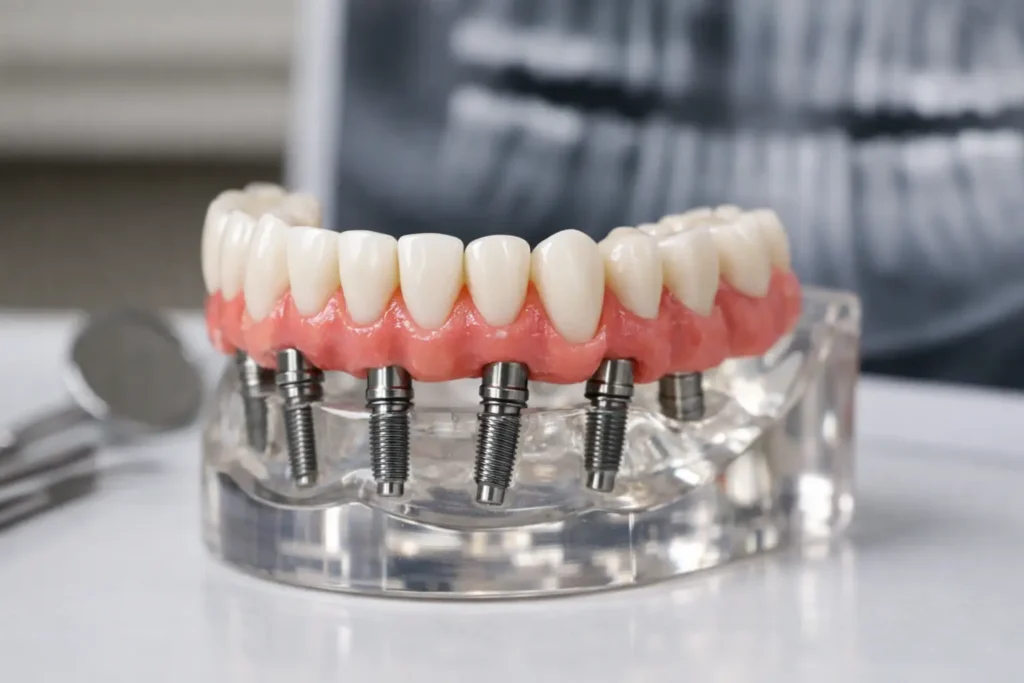
If you are comparing full-mouth implant options, the real question is not just cost. It is whether you can get fixed teeth that feel stable, look natural, and hold up under daily chewing. That is exactly why so many patients ask how all on 6 works before they commit to treatment.
All-on-6 is a full-arch implant solution that uses six dental implants to support a fixed bridge for the upper or lower jaw. Instead of replacing each missing tooth with its own implant, the system uses six carefully planned anchors to hold an entire row of teeth in place. For patients with major tooth loss, failing teeth, or loose dentures, it offers a more secure and more functional alternative to removable appliances.
How all on 6 works in simple terms
Think of All-on-6 as a foundation system. The six implants are placed into the jawbone in positions chosen for strength, balance, and long-term support. Once those implants are stable, they hold a custom full-arch prosthesis that restores your smile, bite, and facial support.
The reason six implants matter is distribution of force. Chewing pressure is spread across more support points than in lower-count systems. That can improve stability, especially in patients who want a strong fixed solution for the back teeth as well as the front. It does not mean every patient needs six implants, and it does not make All-on-6 automatically better than All-on-4 in every case. The right choice depends on bone volume, bite forces, anatomy, and treatment goals.
A qualified implant specialist plans all of this before surgery using a digital workflow. That includes imaging, bite analysis, and prosthetic planning so the implant positions support the final teeth, not just the surgery itself.
Who is a good candidate for All-on-6?
Most patients looking into All-on-6 fall into one of a few groups. Some have already lost most of their teeth. Others still have teeth, but those teeth are failing because of advanced decay, gum disease, fractures, or years of repeated dental work that no longer holds. Many are also frustrated with dentures that move, click, or limit what they can eat.
A strong candidate usually has enough jawbone to support six implants or can be treated with a plan designed around existing bone. Good overall health helps, and controlled medical conditions are often manageable. Smoking, uncontrolled diabetes, active infection, and severe grinding do not always rule out treatment, but they can affect healing and long-term success.
This is why a CT scan matters. A proper 3D evaluation shows bone shape, density, sinus position, nerve location, and potential limitations. It is the fastest way to move from guessing to a real treatment plan. If you want answers based on your mouth, not generic internet advice, send your CT scan today and request a free consultation.
What happens during the All-on-6 process?
The process starts with diagnostics and planning. Records are taken, including a 3D scan or CT, photos, and bite information. If you still have damaged teeth, the doctor evaluates whether they should be removed. The goal is to build a stable final result, not delay the inevitable with temporary fixes.
Next comes digital planning. This is where modern implant treatment separates itself from older guesswork-based methods. Implant positions are selected based on available bone and the design of the future bridge. Guided surgery may be used to improve precision and efficiency.
On surgery day, any necessary extractions are performed, the six implants are placed, and a temporary fixed bridge may be attached the same day or shortly after if your case allows it. This is one of the biggest reasons patients travel for treatment. You can arrive with failing teeth or dentures and leave with fixed temporary teeth instead of waiting months without a solution.
Healing takes place over the next several months as the implants integrate with the bone. During that period, you follow a controlled diet and attend follow-up visits or remote check-ins as instructed. Once healing is confirmed, the temporary is replaced with the final prosthesis, often made from stronger, more refined materials such as zirconia.
Why some patients choose All-on-6 over dentures
Removable dentures restore appearance, but they do not function like natural teeth. They can shift while speaking, reduce bite strength, and accelerate bone loss because they sit on the gums rather than stimulate the jawbone. Many patients also feel older than they are when they depend on adhesives and removable appliances.
All-on-6 changes that experience. The bridge is fixed in place, which means greater confidence when eating, talking, and smiling. It also gives patients a more secure bite and a more natural sense of permanence. You do not remove it at night, and you do not clean it like a denture. You care for it more like fixed teeth, using the hygiene tools your doctor recommends.
That said, fixed does not mean maintenance-free. Professional cleanings, home care, and regular evaluations are still essential. The bridge is strong, but your investment lasts longer when the surrounding tissues stay healthy.
Is All-on-6 better than All-on-4?
Sometimes yes. Sometimes no. That is the honest answer.
All-on-4 uses four implants to support a full arch and can be an excellent option for many patients, especially when anatomy or budget points in that direction. All-on-6 uses two additional implants, which may offer more support and more balanced load distribution. For some patients, that can translate into a stronger restorative design and added confidence for long-term function.
But the better option is not decided by marketing language. It is decided by your bone, your bite, your arch shape, and your restorative plan. A patient with excellent anatomy may do very well with four implants. Another patient may benefit from six because of chewing forces, bone conditions, or the need for broader support across the arch.
This is why specialist-led planning matters. The best clinics do not force every patient into one system. They evaluate whether All-on-4, All-on-6, or All-on-X is the smartest solution for the case.
Recovery and pain: what patients should expect
Most patients are relieved to learn that recovery is usually more manageable than they expected. Discomfort, swelling, and bruising are normal in the first few days, but pain is generally controlled with prescribed medications and clear post-op instructions.
The bigger challenge is following the healing protocol. If you receive immediate temporary teeth, you still need to protect the implants while they fuse to the bone. That means eating a soft diet and avoiding the kind of pressure that can compromise early healing. Shortcuts during this period can create avoidable problems.
Patients who travel for care often worry about logistics, but a well-organized clinic makes a major difference. Remote case review, pre-arrival planning, guided surgery, and a fast treatment timeline can simplify the process significantly. For many U.S. and Canadian patients, that combination of speed, specialist expertise, and savings is exactly what makes treatment realistic.
Cost, value, and why patients travel for treatment
Full-arch implant treatment in the United States can be financially out of reach, even for patients who need it urgently. All-on-6 offers major value because it replaces an entire arch with a fixed system, but pricing still varies based on extractions, bone condition, sedation needs, provisional teeth, and final materials.
This is where treatment in Mexico becomes part of the conversation for many patients. Clinics using advanced digital planning, guided surgery, and high-quality restorative materials can often provide the same type of full-arch solution at a fraction of U.S. pricing. In many cases, patients save up to 70% vs USA without compromising on implant-focused care.
At Expertos Dentista E Implantes, patients can start with a remote evaluation, send a CT scan, and receive a treatment review before making travel plans. That kind of clarity matters when you are comparing not only price, but also technology, speed, and trust.
What matters most before you say yes
If you are seriously looking at full-mouth implants, focus on three things: diagnosis, planning, and who is leading the case. How all on 6 works is only part of the decision. What matters just as much is whether your provider is planning the final bite correctly, using the right imaging, and giving you a realistic path from surgery to final teeth.
Fixed teeth can change more than your smile. They can change what you eat, how you speak, and how comfortable you feel in public. The right next step is not more guessing. It is getting your scan reviewed by an implant team that can tell you exactly what is possible in your case.