
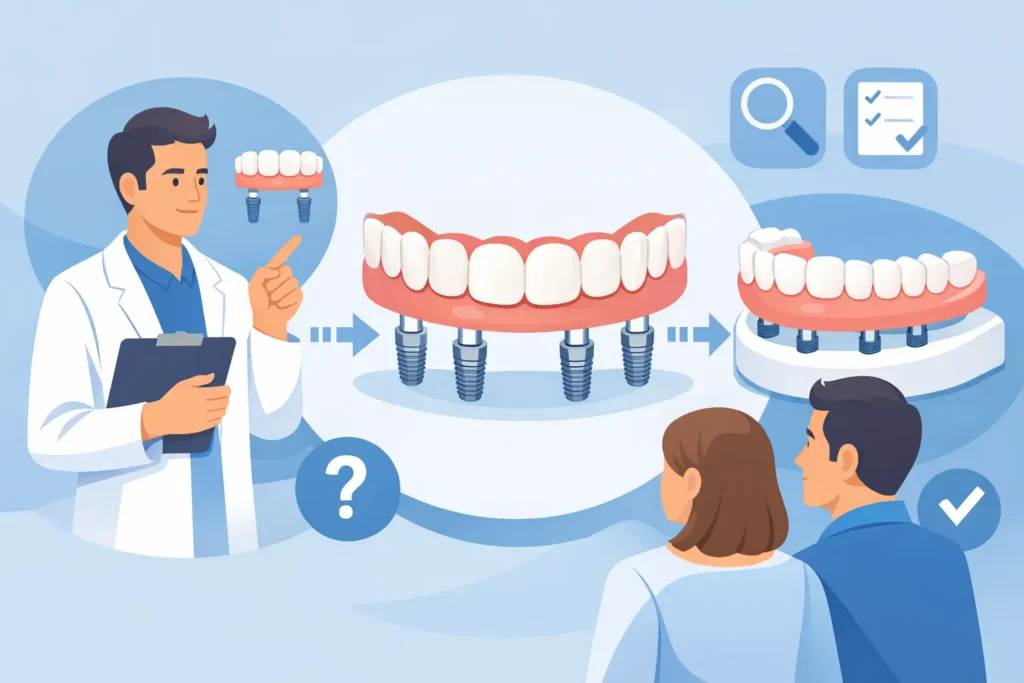
Losing most or all of your teeth changes more than your smile. It changes how you eat, speak, travel, and even how willing you are to be in photos. If you are researching how to choose full arch implants, the real question is not just which implant brand or technique sounds best. It is which treatment plan gives you fixed teeth, predictable healing, strong long-term function, and a team you can trust from the first scan to the final prosthetic.
That decision matters because full-arch treatment is not a small dental purchase. It is a major reconstruction of your bite, bone support, facial structure, and daily comfort. The right clinic will make the process clear. The wrong one will sell you on price alone and leave out the details that affect whether your new teeth actually last.
How to choose full arch implants without guessing
Start with the diagnosis, not the marketing. Many patients compare All-on-4, All-on-6, and All-on-X as if they are products on a shelf. They are not. These are treatment concepts built around your anatomy, bone volume, bite force, medical history, and esthetic goals.
A real evaluation should include a CT scan, photos, a review of your existing teeth or dentures, and a discussion of whether extractions, bone reduction, gum design, and bite correction are needed. If a provider tells you exactly what you need before reviewing a 3D scan, that is a red flag. Full-arch implant treatment should be planned from the bone up.
In many cases, fewer implants can work very well. In other cases, more implants create better support and a more stable distribution of force. The best plan is not the one with the biggest name. It is the one that matches your case.
The surgeon matters more than the slogan
Patients often focus on whether they want All-on-4 or All-on-6. A better question is who is placing the implants, how often they do full-arch cases, and whether they plan them digitally. The skill of the implant surgeon has a bigger impact on your outcome than the label attached to the case.
You want a provider who routinely handles complex extractions, immediate load cases, bone reduction when needed, and full-mouth rehabilitation. Ask whether your case is being led by an implant specialist, not passed between general providers with limited surgical experience. Guided surgery, digital planning, and intraoral scanning all help, but technology only works well in trained hands.
If the clinic can explain why implant positions are chosen, how the bite is designed, and what happens if bone quality is weaker than expected, that is a good sign. Clear answers usually reflect real experience.
Compare the prosthetic, not just the implants
When people ask how to choose full arch implants, they often mean the whole restoration. That includes the implants in the bone and the fixed teeth attached on top. The prosthetic is what you see, bite with, clean around, and live with every day.
This is where material choice matters. Many patients begin with a same-day temporary fixed bridge so they do not leave without teeth. That can be an excellent option, especially when the case is carefully planned and the bite is protected during healing. But your final prosthetic is the long-term investment.
Zirconia is popular for a reason. It is strong, highly esthetic, and well suited for full-arch restorations when designed correctly. Acrylic hybrids can lower upfront cost and still serve certain patients well, especially if budget is a deciding factor. The trade-off is that acrylic generally wears faster and may need more maintenance over time. A lower initial price can become more expensive if repairs and remakes add up.
Ask what temporary prosthetic is included, what final material is recommended for your case, and why. The right answer should connect material choice to bite force, esthetics, longevity, and maintenance, not just sales language.
Immediate teeth are valuable, but only when the case supports them
Same-day temporary fixed teeth are a major reason many patients travel for full-arch treatment. They offer confidence, function, and a faster return to normal life. But not every patient is an ideal candidate for immediate loading.
Primary implant stability, bone density, parafunctional habits like clenching, and overall health all affect whether immediate fixed teeth are predictable. A responsible clinic will tell you when same-day teeth make sense and when a modified plan is safer. Fast treatment is valuable, but stability comes first.
Cost matters, but cheap dentistry is not the goal
For many patients in the U.S. and Canada, cost is what starts the search. Full-arch implant treatment can be dramatically more affordable outside the American dental system, and that matters. Saving a substantial amount without sacrificing quality is smart. Choosing the lowest number on a quote without understanding what is included is risky.
Compare total treatment value. Does the quote include extractions, temporary fixed teeth, sedation, imaging, guided surgery, abutments, final prosthetic, follow-up visits, and possible revisions? Or are those separate charges waiting to appear later?
A clinic that delivers high value should be able to explain pricing in plain language. You should know what phase one includes, what happens before the final bridge, and what maintenance costs to expect. Save money, yes. But save it on geography and overhead, not on surgical standards, materials, or planning.
Travel patients need coordination, not confusion
If you are traveling for treatment, logistics become part of the clinical decision. The best implant center for a local patient is not always the best one for a travel patient. You need a team that can review your CT scan remotely, organize your treatment timeline efficiently, and tell you exactly how long you need to stay for each phase.
This is especially important with full-arch cases, because there is usually an initial surgical visit and a later restorative phase after healing. A clinic experienced with international and out-of-town patients should make this process feel organized, not vague. Recovery instructions, pain control, diet guidance, and check-in timing should all be explained before you book travel.
That is one reason many patients choose specialist-led centers such as Expertos Dentista E Implantes. The model works best when clinical planning and patient coordination are equally strong.
Ask about maintenance before you commit
Full-arch implants are fixed, but they are not maintenance-free. You still need professional checkups, home care instruction, and occasional replacement of small components depending on the design. This does not make implants a bad choice. It makes them a real medical treatment.
A trustworthy clinic will explain how to clean under the bridge, how often to return for maintenance, and what warning signs to watch for. If you have a history of gum disease, diabetes, smoking, or heavy grinding, those factors should be part of the conversation. They do not always rule out treatment, but they can affect healing and long-term success.
The more transparent the clinic is about maintenance, the more likely they are planning for your long-term result instead of just the sale.
What the best full-arch treatment plans have in common
The strongest treatment plans are usually not the flashiest. They are clear, customized, and backed by evidence from your scan and exam. They explain why a certain number of implants is recommended, whether bone reduction is needed, what type of temporary you will wear, and when your final prosthetic will be delivered.
They also leave room for clinical judgment. Sometimes the best plan changes after extractions or once bone quality is confirmed during surgery. That is normal. What matters is whether the team anticipated those possibilities and discussed them with you beforehand.
If you feel pressured to decide immediately, slow down. If you receive a detailed review of your scan, a realistic timeline, and a treatment plan that balances speed, esthetics, function, and value, you are probably looking in the right direction.
How to know you are ready to move forward
You are ready when you understand the diagnosis, trust the surgeon, know what your final teeth are made of, and have a realistic picture of healing, travel, and cost. You do not need to memorize every implant term. You do need enough clarity to know why this plan is being recommended for you.
The right full-arch implant treatment should feel like a smart decision, not a gamble. Fixed teeth can restore confidence fast, but the real win is choosing a team that builds the case carefully enough for that confidence to last.
If you are comparing options now, send your CT scan, ask direct questions, and pay close attention to who answers with specifics. The best provider will not just promise a new smile. They will show you exactly how they plan to build it.