
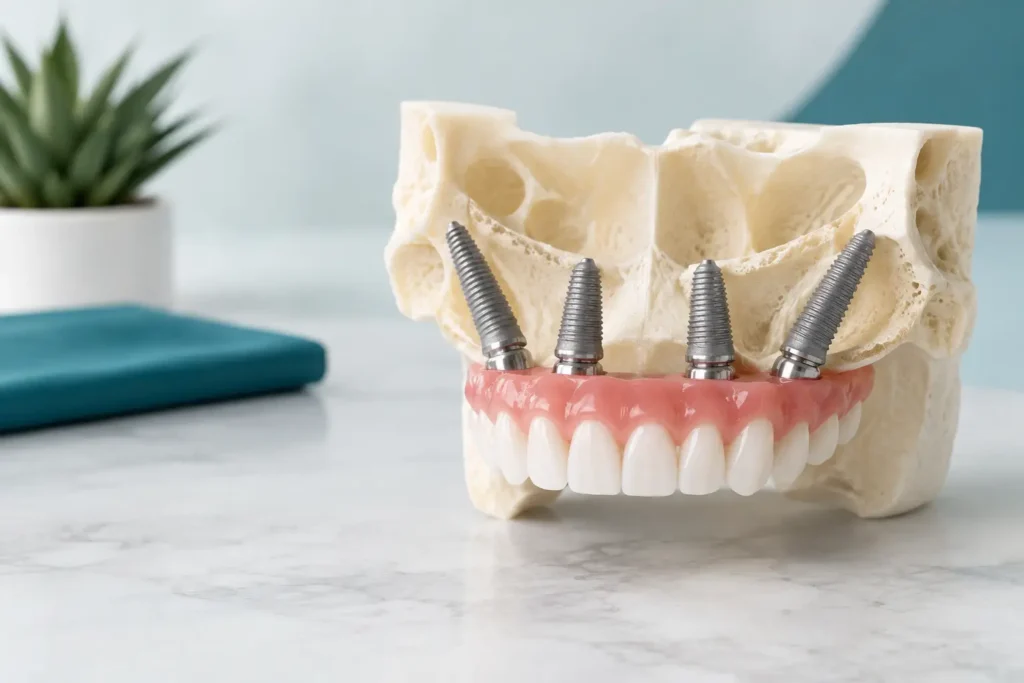
For people who have been told they do not have enough bone for conventional upper dental implants, zygomatic implants Cabo San Lucas may offer another path to fixed full-arch teeth. These are highly specialized implants used in selected cases of severe upper-jaw bone loss. They are not a routine substitute for standard implants, and suitability can only be determined through a clinical examination and CT scan review.
At Expertos Dentista e Implantes in Los Cabos, treatment planning begins with the question that matters most: what approach is appropriate for your anatomy, health history, current teeth, and goals? For some patients, conventional All-on-4 or All-on-6 treatment is suitable. For others, zygomatic, transnasal, or pterygoid implants may be considered as part of a personalized full-arch plan.
What are zygomatic implants?
Zygomatic implants are longer dental implants that anchor in the zygomatic bone, commonly called the cheekbone, rather than relying only on bone in the upper jaw. The cheekbone can provide stable anchorage when the back portion of the upper jaw has lost substantial volume.
This approach may help certain patients avoid or reduce the need for bone grafting before a full-arch restoration. That does not mean it is the right answer for every person with missing upper teeth or loose dentures. Zygomatic treatment is technically demanding and requires detailed three-dimensional planning because of the anatomy involved.
A zygomatic implant plan is generally considered for people with advanced bone loss in the upper jaw who want a fixed full-arch solution and may not be ideal candidates for conventional implant placement in that arch. Your CT scan, bite, gum condition, medical history, and remaining teeth all affect the recommendation.
When conventional implants may still be enough
Many people assume they need zygomatic implants after hearing they have bone loss. Sometimes they do not. All-on-4 uses strategically angled implants to support a full fixed arch, while All-on-6 uses six implants when anatomy and treatment goals support that approach. Both can be appropriate options for upper-jaw rehabilitation in the right case.
The decision is not simply about choosing the treatment with more implants or the most complex procedure. It is about choosing a design that has appropriate support, cleansability, restorative space, and a realistic long-term maintenance plan. A CT-based evaluation helps determine whether conventional implants can be placed predictably or whether alternative anchorage should be discussed.
For selected patients with extensive upper-jaw bone loss, transnasal or pterygoid implants may also be part of the conversation. These are specialized techniques, not automatic add-ons. A written plan should explain why a specific approach is recommended and what alternatives may be reasonable.
Zygomatic implants in Cabo San Lucas: planning comes first
A panoramic X-ray is useful, but it is not enough to plan a complex full-arch case by itself. A cone beam CT scan provides a three-dimensional view of bone volume, sinus areas, nasal anatomy, and other structures relevant to implant placement. Patients who already have a CT scan can ask the clinic how to share it securely for preliminary review.
The planning process may include digital implant positioning, guided-surgery planning where clinically appropriate, intraoral scanning, and photogrammetry. Photogrammetry is a digital method used to capture highly precise implant positions for the restorative phase. These tools support accuracy, but they do not replace clinical judgment or careful surgical execution.
A useful treatment plan should be clear about the proposed implant approach, whether extractions are needed, the type of provisional teeth that may be possible, the final restoration material, expected visits, fees, and follow-up needs. It should also identify what cannot be confirmed until an in-person examination or surgical assessment.
What treatment stages can look like
Full-arch care is a staged process, not a single product. If teeth need to be removed, the surgical plan may include extractions and implant placement during the same visit when conditions allow. Whether temporary fixed teeth can be provided depends on clinical factors such as implant stability, bite forces, bone quality, and the overall surgical plan.
When provided, temporary fixed teeth are provisional. They are designed to support function and appearance during healing, but they are not the final zirconia bridge. They may require dietary restrictions, adjustments, and careful hygiene while the implants integrate with the bone.
After healing and reassessment, the final prosthesis is planned. Expertos Dentista e Implantes provides zirconia full-arch restorations rather than acrylic or metal full-arch bridges. Zirconia can be an excellent material for many full-arch restorations because of its strength and appearance, but the design, bite, opposing teeth, and hygiene access still need individual consideration.
Full-arch treatment normally involves two trips. The timing between visits depends on the individual case and healing progress, so it should be confirmed in your written treatment plan rather than assumed from a general schedule.
Published pricing and what per-arch means
Cost is often a central reason patients from California, Washington, Metro Vancouver, and Calgary consider treatment in Los Cabos. Transparent pricing starts with understanding what is being quoted. A fee stated per arch applies to either the upper or lower jaw, not automatically to both jaws.
Published guide pricing for zirconia full-arch treatment is USD 13,000 to USD 14,000 per arch for All-on-4 and USD 14,000 to USD 15,000 per arch for All-on-6. Zygomatic implant treatment with an All-on-4 approach is published at USD 16,000 per arch. These figures are indicative and require an individual written quote.
A personalized quote should clarify the planned procedure, restoration material, number and type of implants, provisional phase if clinically appropriate, laboratory work, and planned visits. If you need both arches restored, ask for the total cost for upper and lower treatment rather than doubling a number without confirming the recommended approach for each jaw.
Complex cases can involve variables that are not visible in a brief online exchange. An accurate CT scan and clinical evaluation are the most responsible way to move from a general price guide to a treatment recommendation.
Preparing for travel to Los Cabos
For patients traveling from the United States or Canada, preparation can make the process more manageable. Before booking travel, request a written outline of the expected appointments and ask what records should be sent in advance. If you wear a removable denture, share that information along with recent X-rays, CT scans if available, medication lists, and relevant medical history.
Plan for flexibility. A treatment team may need to adjust an appointment sequence based on the in-person examination, surgical findings, or how the provisional restoration fits. It is also wise to arrange for a travel companion if your clinician recommends it, particularly for a more extensive surgical appointment.
Before leaving Cabo San Lucas, make sure you understand the home-care instructions, dietary guidance, medication directions, and the process for contacting the clinic with questions. Follow-up is part of full-arch care, not an afterthought. Your local dentist may also play a role in routine cleanings and general dental care, while the implant team guides you on the maintenance needs of your specific restoration.
Long-term care protects the investment
Fixed teeth still require daily care. Food debris and plaque can collect beneath a full-arch bridge, so patients need to learn the cleaning methods recommended for their restoration. This may include a water flosser, specialized flossing tools, or interdental brushes, depending on the bridge design and available space.
Regular professional maintenance is equally important. The team should evaluate the condition of the gums, implants, bridge, bite, and screws as appropriate. Grinding, changes in bite, tobacco use, and missed hygiene appointments can all affect maintenance needs. A nightguard may be recommended for some patients, but only after an individual assessment.
If you have been told that upper-jaw bone loss limits your options, start with information rather than assumptions. Send your CT scan securely, request a personalized written treatment plan, and ask whether conventional, zygomatic, transnasal, or pterygoid implant options should be considered for your case.