
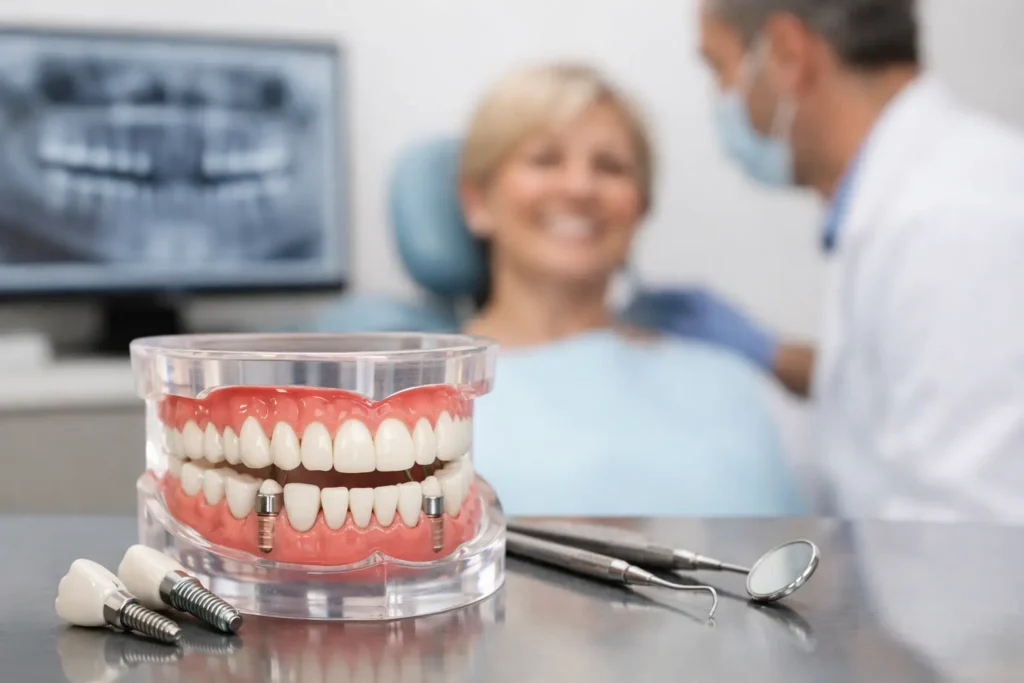
Losing most or all of your teeth changes more than your smile. It affects how you eat, how you speak, how confident you feel in public, and how much time and money you keep putting into temporary fixes. This full arch dental implant guide is for patients who are done patching things together and want a clear path to fixed teeth.
If you have failing teeth, advanced gum disease, broken dental work, or dentures you can no longer tolerate, full-arch implants may be the treatment that finally gives you stability. The key is understanding what the procedure actually involves, who qualifies, what it costs, and where shortcuts can create problems later.
What a full arch dental implant guide should explain first
A full-arch restoration replaces all teeth in the upper arch, lower arch, or both using a set number of implants that support a fixed bridge. Instead of replacing each tooth with a separate implant, the dentist places several implants in strategic positions, then attaches a full set of prosthetic teeth.
You may hear this described as All-on-4, All-on-6, or All-on-X. Those names refer to how many implants are used and how the case is designed. The right option depends on your bone volume, bite force, anatomy, medical history, and long-term goals. A patient with strong bone and lighter bite pressure may be a candidate for fewer implants. Someone with higher functional demands may benefit from additional support.
This is why serious treatment planning matters. Full-arch care is not a commodity. The best outcome comes from digital planning, accurate imaging, guided surgery when appropriate, and a prosthetic design that fits your face, bite, and function.
Who is a good candidate for full-arch implants?
Most candidates fall into one of a few groups. Some already wear removable dentures and want something fixed. Others still have natural teeth, but those teeth are failing from decay, fractures, infection, or periodontal disease. Another common group has spent years repairing one tooth after another and has reached the point where a full reset makes more sense than more crowns, root canals, and extractions.
Being a candidate does not mean your mouth has to be perfect. In fact, many full-arch patients come in with serious dental problems. What matters is whether the case can be treated safely and predictably. A CT scan is usually the starting point because it shows bone levels, sinus position, nerve pathways, and other details that regular X-rays can miss.
There are also situations where timing or technique needs to be adjusted. Smokers, patients with uncontrolled diabetes, heavy grinders, or people with significant bone loss can still qualify in many cases, but their treatment has to be planned carefully. Honest case selection protects you.
Full-arch treatment is not one-size-fits-all
A major mistake patients make is assuming all full-arch solutions are basically the same. They are not. The number of implants, implant brand, material of the final prosthesis, bite design, surgical protocol, and healing timeline all affect durability and comfort.
For example, a same-day temporary fixed bridge can be an excellent option for the right patient. It lets you leave surgery with teeth instead of wearing a removable denture during healing. That said, temporary does not mean final. The provisional bridge helps shape healing and lets your team test function and appearance before the definitive prosthesis is made.
The final bridge is often where quality differences become obvious. Many patients prefer zirconia because it is strong, highly esthetic, and suitable for long-term fixed full-arch restorations when designed correctly. But even a premium material can fail if the bite is poorly managed or the implants were not placed with precision.
What the process usually looks like
The first phase is evaluation. A clinic reviews your CT scan, photos, medical history, and current dental condition. This is where the team determines whether you need extractions, whether immediate loading is possible, and which arch or arches need treatment.
Next comes digital planning. This step matters because it connects surgery with the final prosthetic result. Implants should not just be placed where bone happens to be available. They need to be placed where they can support a stable, functional, attractive bridge.
The surgery itself often includes extractions, bone reduction when needed, implant placement, and delivery of a same-day temporary fixed prosthesis if the case allows. Some patients are surprised by how efficient this can be when the case is fully planned in advance.
Healing comes next. During this period, the implants integrate with the bone. You will usually follow a softer diet and return for progress checks. Once healing is complete and the implants are stable, the final bridge is fabricated and delivered.
For patients traveling from the U.S. or Canada, this structure is one reason full-arch treatment in a destination setting can work well. The process is coordinated in phases, which can reduce the endless back-and-forth many patients experience in traditional fragmented care.
Pain, recovery, and what most patients actually feel
Most patients expect the worst and are relieved to find recovery is manageable. Discomfort is normal after surgery, especially if extractions and bone reshaping are involved, but it is typically controlled with medication, swelling management, and a clear post-op plan.
The first few days are the most intense. Swelling, pressure, and fatigue are common. By the end of the first week, many patients feel significantly better. The bigger adjustment is often learning how to chew carefully during the healing phase and adapting to a fixed set of teeth after years of instability.
A good team prepares you for this. You should know what to eat, how to clean the prosthesis, what signs are normal, and when to report an issue. Strong support matters just as much as surgical skill.
Cost matters, but value matters more
For many patients, cost is the reason they begin researching treatment outside the U.S. Full-arch implants can be life-changing, but in many American practices the price is simply out of reach. That is why cross-border implant care has become a serious option for informed patients, not just bargain hunters.
The smarter question is not, Who is cheapest? It is, What exactly is included, who is planning the case, and what level of technology supports the work?
When comparing providers, ask whether the fee includes CT-based planning, extractions, temporary fixed teeth, final prosthesis, sedation options, follow-up visits, and prosthetic adjustments. Ask what material is used for the final bridge. Ask who performs the surgery and who designs the restorative phase. Low pricing can hide major omissions.
Patients looking at treatment in Mexico are often trying to save up to 70% versus U.S. pricing without lowering clinical standards. That can be realistic when the clinic is built around implant volume, digital workflow, and specialist-led treatment rather than general dentistry with occasional implant cases.
Why technology changes the full-arch experience
In a modern full arch dental implant guide, technology should not be presented as a gimmick. It should be explained as a tool that improves planning, precision, and predictability.
CBCT imaging gives the surgical team a 3D view of your anatomy. Intraoral scanning improves accuracy and patient comfort compared with older impression methods. Guided surgery can improve implant placement in the right case. Digital smile and bite planning helps align the temporary and final teeth with facial support, speech, and chewing function.
This matters because full-arch dentistry is both surgical and restorative. If either side is weak, the result suffers. The most predictable clinics integrate both from the beginning rather than treating surgery and prosthetics as separate jobs.
Questions patients should ask before saying yes
Before moving forward, ask direct questions and expect direct answers. Who is leading the case? How many full-arch cases does the team handle? Are same-day fixed teeth realistic for your anatomy? What happens if more implants or bone management are needed than expected? How many trips will be required? What maintenance will the prosthesis need?
You should also ask to see how the timeline works for out-of-town patients. Strong coordination is part of the treatment, not an extra. If a clinic offers remote case review, CT scan evaluation, and a clear sequence before you travel, that is a sign of a mature system.
At Expertos Dentista E Implantes, this planning-first model is central to how full-mouth cases are handled, especially for patients coming from the U.S. and Canada who want premium implant care without U.S.-level pricing.
The right decision is the one built on clarity
Full-arch implants are a major commitment, but for the right patient they can end years of instability, embarrassment, and repeated repair. The best results come when the diagnosis is honest, the planning is detailed, and the treatment is designed around long-term function instead of short-term sales pressure.
If you are comparing options now, do not wait until another tooth breaks or another denture adjustment fails. Send your CT scan today, ask for a specialist review, and get a real answer about whether fixed full-arch teeth are possible in your case. The turning point for most patients is not the surgery day. It is the day they stop guessing and get a clear plan.